

217
6.7 The Reaction Turbine
the inversing stator vane row and the second rotor blade row. Rotor work is about
4 times higher than with the Laval stage. The Curtis principle can be extended to 3
and more rotor blade rows. For a 1 = 90° and taking no losses into account, the following relations are optimal:
Laval: v u
u
1
2
/
,
= ψ = 2, l o = 1/2.
Curtis 2: v u
v u
v u
u
u
u
1
1
2
4
2
/
, /
/
,
=
′
= −
= ψ = 6 + 2 = 8, l o = 1/4.
Curtis 3: v
u
v
u
v
u
u
u
u
1
1
2
6
4
/
, ' /
/
,
=
=−
=
1u
2u
v" / u
v' / u 2,
= −
= y = 10 + 6 + 2 = 18, l o = 1/6.
Curtis stages with three rotor blade rows have never been used in practice, because the efficiency is even much lower than with two rotor blade rows. We will
discuss the application of a Curtis stage with two rotor blade rows in Sect. 6.8.2, but
Curtis stages are only very exceptionally applied in modern machines.
6.7 The Reaction Turbine
6.7.1 Degree of Reaction
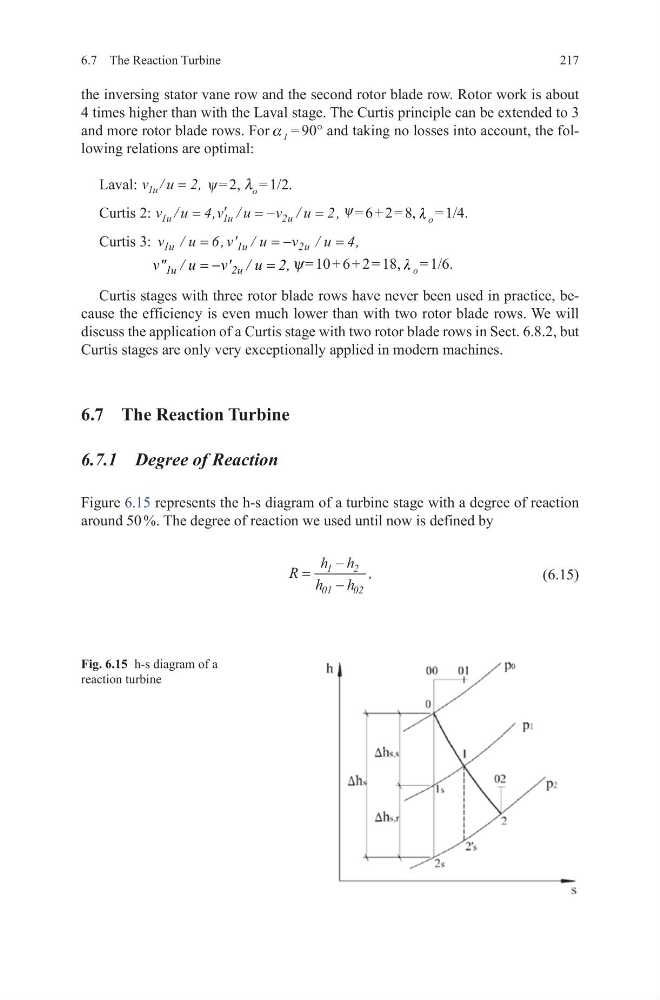
Figure 6.15 represents the h-s diagram of a turbine stage with a degree of reaction
around 50 %. The degree of reaction we used until now is defined by
(6.15)
R
h h
h
h
=
−
−
1
2
01
02
,
Fig. 6.15 h-s diagram of a
reaction turbine
6.7 The Reaction Turbine
the inversing stator vane row and the second rotor blade row. Rotor work is about
4 times higher than with the Laval stage. The Curtis principle can be extended to 3
and more rotor blade rows. For a 1 = 90° and taking no losses into account, the following relations are optimal:
Laval: v u
u
1
2
/
,
= ψ = 2, l o = 1/2.
Curtis 2: v u
v u
v u
u
u
u
1
1
2
4
2
/
, /
/
,
=
′
= −
= ψ = 6 + 2 = 8, l o = 1/4.
Curtis 3: v
u
v
u
v
u
u
u
u
1
1
2
6
4
/
, ' /
/
,
=
=−
=
1u
2u
v" / u
v' / u 2,
= −
= y = 10 + 6 + 2 = 18, l o = 1/6.
Curtis stages with three rotor blade rows have never been used in practice, because the efficiency is even much lower than with two rotor blade rows. We will
discuss the application of a Curtis stage with two rotor blade rows in Sect. 6.8.2, but
Curtis stages are only very exceptionally applied in modern machines.
6.7 The Reaction Turbine
6.7.1 Degree of Reaction
Figure 6.15 represents the h-s diagram of a turbine stage with a degree of reaction
around 50 %. The degree of reaction we used until now is defined by
(6.15)
R
h h
h
h
=
−
−
1
2
01
02
,
Fig. 6.15 h-s diagram of a
reaction turbine