

216
6 Steam Turbines
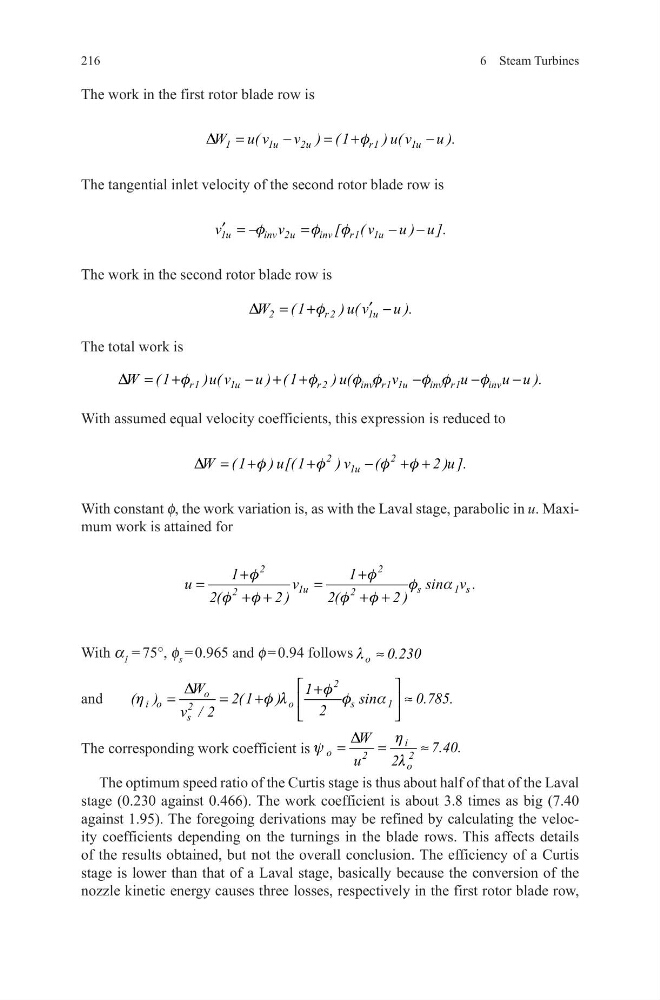
The work in the first rotor blade row is
The tangential inlet velocity of the second rotor blade row is
The work in the second rotor blade row is
The total work is
With assumed equal velocity coefficients, this expression is reduced to
With constant f, the work variation is, as with the Laval stage, parabolic in u. Maximum work is attained for
With a 1 = 75°, f s = 0.965 and f = 0.94 follows o 0.230
≈
l
and
2
o
i o
o
s
1
2
s
W
1
( )
2( 1
)
sin
0.785.
2
v / 2
+
=
=
+
≈
D
f
h
f l
f
a
The corresponding work coefficient is
i
o
2
2
o
W
7.40.
u
2
=
=
≈
h
D
y
l
The optimum speed ratio of the Curtis stage is thus about half of that of the Laval
stage (0.230 against 0.466). The work coefficient is about 3.8 times as big (7.40
against 1.95). The foregoing derivations may be refined by calculating the velocity coefficients depending on the turnings in the blade rows. This affects details
of the results obtained, but not the overall conclusion. The efficiency of a Curtis
stage is lower than that of a Laval stage, basically because the conversion of the
nozzle kinetic energy causes three losses, respectively in the first rotor blade row,
1
1u
2u
r1
1u
W u( v
v ) ( 1
) u( v
u ).
=
−
= +
−
D
f
1u
inv 2u
inv
r1 1u
v
v
[ ( v
u ) u ].
′ = −
=
− −
f
f f
2
r 2
1u
W ( 1
) u( v
u ).
′
= +
−
D
f
r1
1u
r 2
inv r1 1u
inv r1
inv
W ( 1
)u( v
u ) ( 1
) u(
v
u
u u ).
= +
− + +
−
−
−
D
f
f
f f
f f
f
2
2
1u
W ( 1
) u[( 1
) v
(
2 )u ].
= +
+
−
+ +
D
f
f
f f
2
2
1u
s
1 s
2
2
1
1
u
v
sin v .
2(
2 )
2(
2 )
+
+
=
=
+ +
+ +
f
f
f
a
f f
f f
6 Steam Turbines
The work in the first rotor blade row is
The tangential inlet velocity of the second rotor blade row is
The work in the second rotor blade row is
The total work is
With assumed equal velocity coefficients, this expression is reduced to
With constant f, the work variation is, as with the Laval stage, parabolic in u. Maximum work is attained for
With a 1 = 75°, f s = 0.965 and f = 0.94 follows o 0.230
≈
l
and
2
o
i o
o
s
1
2
s
W
1
( )
2( 1
)
sin
0.785.
2
v / 2
+
=
=
+
≈
D
f
h
f l
f
a
The corresponding work coefficient is
i
o
2
2
o
W
7.40.
u
2
=
=
≈
h
D
y
l
The optimum speed ratio of the Curtis stage is thus about half of that of the Laval
stage (0.230 against 0.466). The work coefficient is about 3.8 times as big (7.40
against 1.95). The foregoing derivations may be refined by calculating the velocity coefficients depending on the turnings in the blade rows. This affects details
of the results obtained, but not the overall conclusion. The efficiency of a Curtis
stage is lower than that of a Laval stage, basically because the conversion of the
nozzle kinetic energy causes three losses, respectively in the first rotor blade row,
1
1u
2u
r1
1u
W u( v
v ) ( 1
) u( v
u ).
=
−
= +
−
D
f
1u
inv 2u
inv
r1 1u
v
v
[ ( v
u ) u ].
′ = −
=
− −
f
f f
2
r 2
1u
W ( 1
) u( v
u ).
′
= +
−
D
f
r1
1u
r 2
inv r1 1u
inv r1
inv
W ( 1
)u( v
u ) ( 1
) u(
v
u
u u ).
= +
− + +
−
−
−
D
f
f
f f
f f
f
2
2
1u
W ( 1
) u[( 1
) v
(
2 )u ].
= +
+
−
+ +
D
f
f
f f
2
2
1u
s
1 s
2
2
1
1
u
v
sin v .
2(
2 )
2(
2 )
+
+
=
=
+ +
+ +
f
f
f
a
f f
f f