

212
6 Steam Turbines
6.5 The Pressure-Compounded Impulse Turbine
or Rateau Turbine
6.5.1 Principle
Pressure compounding is connecting stages in series with a pressure drop in each
of them. The objective is to distribute the enthalpy drop over a number of stages
so that the enthalpy drop per stage becomes tractable. In the previous section we
learned that the work coefficient of an impulse stage with loss of outlet kinetic energy amounts to about 1.95. The blade speed acceptable for a turbine depends on
steam temperature. At a temperature of the 500 °C order, it may amount to about
200 m/s. This rather low value comes from the use of relatively cheap steel materials. At the end of the expansion, near to the vacuum, steam temperature decreases
to about 50 °C and the blade speed at mean radius may increase to about 400 m/s.
For 200 m/s is ΔW ≈ 1.95 × (200)
2
J/kg ≈ 75 kJ/kg. For 400 m/s is ΔW ≈ 300 kJ/kg.
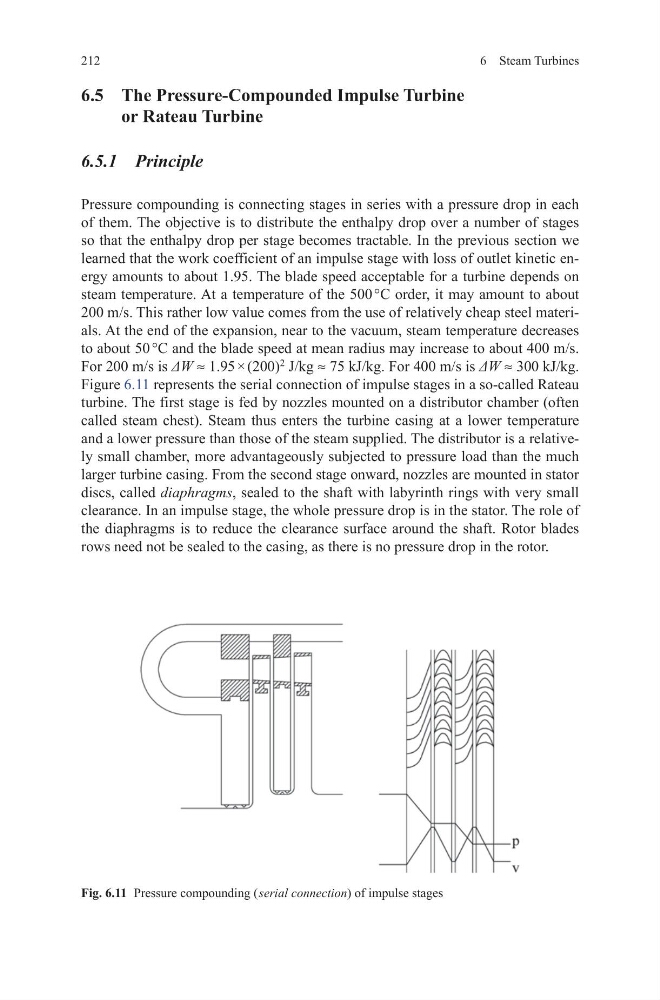
Figure 6.11 represents the serial connection of impulse stages in a so-called Rateau
turbine. The first stage is fed by nozzles mounted on a distributor chamber (often
called steam chest). Steam thus enters the turbine casing at a lower temperature
and a lower pressure than those of the steam supplied. The distributor is a relatively small chamber, more advantageously subjected to pressure load than the much
larger turbine casing. From the second stage onward, nozzles are mounted in stator
discs, called diaphragms, sealed to the shaft with labyrinth rings with very small
clearance. In an impulse stage, the whole pressure drop is in the stator. The role of
the diaphragms is to reduce the clearance surface around the shaft. Rotor blades
rows need not be sealed to the casing, as there is no pressure drop in the rotor.
Fig. 6.11 Pressure compounding ( serial connection) of impulse stages
6 Steam Turbines
6.5 The Pressure-Compounded Impulse Turbine
or Rateau Turbine
6.5.1 Principle
Pressure compounding is connecting stages in series with a pressure drop in each
of them. The objective is to distribute the enthalpy drop over a number of stages
so that the enthalpy drop per stage becomes tractable. In the previous section we
learned that the work coefficient of an impulse stage with loss of outlet kinetic energy amounts to about 1.95. The blade speed acceptable for a turbine depends on
steam temperature. At a temperature of the 500 °C order, it may amount to about
200 m/s. This rather low value comes from the use of relatively cheap steel materials. At the end of the expansion, near to the vacuum, steam temperature decreases
to about 50 °C and the blade speed at mean radius may increase to about 400 m/s.
For 200 m/s is ΔW ≈ 1.95 × (200)
2
J/kg ≈ 75 kJ/kg. For 400 m/s is ΔW ≈ 300 kJ/kg.
Figure 6.11 represents the serial connection of impulse stages in a so-called Rateau
turbine. The first stage is fed by nozzles mounted on a distributor chamber (often
called steam chest). Steam thus enters the turbine casing at a lower temperature
and a lower pressure than those of the steam supplied. The distributor is a relatively small chamber, more advantageously subjected to pressure load than the much
larger turbine casing. From the second stage onward, nozzles are mounted in stator
discs, called diaphragms, sealed to the shaft with labyrinth rings with very small
clearance. In an impulse stage, the whole pressure drop is in the stator. The role of
the diaphragms is to reduce the clearance surface around the shaft. Rotor blades
rows need not be sealed to the casing, as there is no pressure drop in the rotor.
Fig. 6.11 Pressure compounding ( serial connection) of impulse stages