

198
6 Steam Turbines
of reaction produce the largest work per stage. This was one of the reasons why
Laval opted for R = 0. The biggest possible enthalpy drop can then be handled in
one stage. Parsons’ machine has stator blades around the entire circumference. Laval’s machine has a stator consisting of one single nozzle, which does not cover
the entire circumference of the rotor. In other words, there is partial admission or,
more in general, partial flow. The rotor blades only produce work when passing
the nozzle. A partial admission machine can function adequately only with constant pressure in the rotor. With built-in pressure difference, the rotor blade channels not in front of the nozzle, would take flow from the nozzle. This flow cannot
enter the rotor at the appropriate angle. Furthermore, each nozzle flow deviation
causes angular deviations and consequently incidence losses at inlets of the rotor
blade channels in front of the nozzle. Partial flow thus necessitates, in principle,
constant pressure in the rotor. This was Laval’s second reason to opt for R = 0. A
partial-flow machine can be built for a fraction of the power it would supply with
full flow. Single-stage impulse turbines with partial admission are still built nowadays. They are mainly meant for mechanical drive. The degree of reaction is not
exactly zero, but typically around R = 0.10. This is intended to compensate rotor
losses. A partial admission impulse stage is also sometimes used as first stage in a
multistage machine (see Sect. 6.8.2).
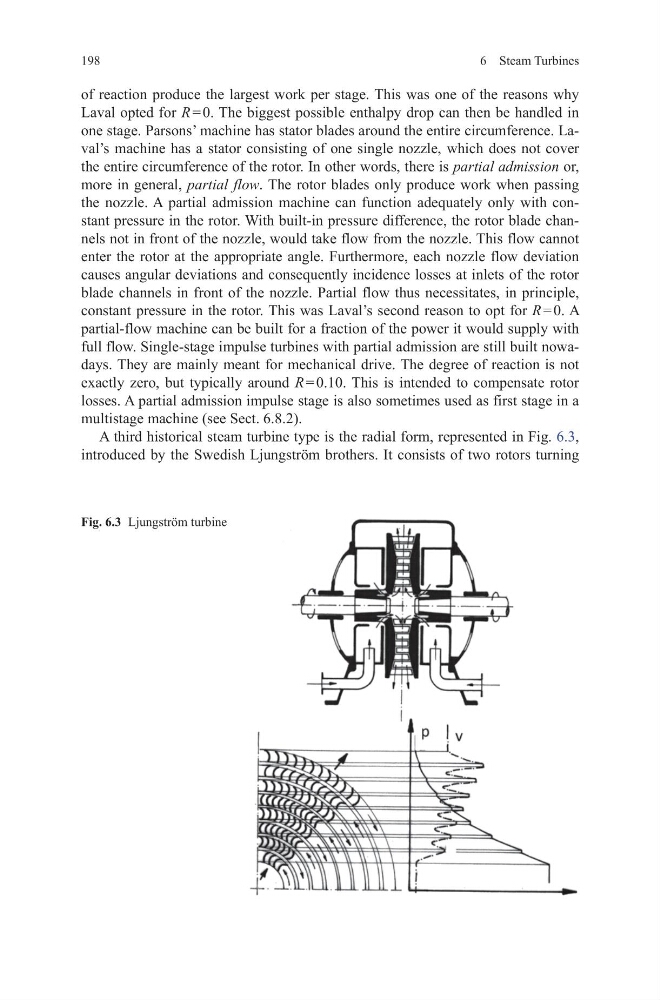
A third historical steam turbine type is the radial form, represented in Fig. 6.3,
introduced by the Swedish Ljungström brothers. It consists of two rotors turning
Fig. 6.3 Ljungström turbine
6 Steam Turbines
of reaction produce the largest work per stage. This was one of the reasons why
Laval opted for R = 0. The biggest possible enthalpy drop can then be handled in
one stage. Parsons’ machine has stator blades around the entire circumference. Laval’s machine has a stator consisting of one single nozzle, which does not cover
the entire circumference of the rotor. In other words, there is partial admission or,
more in general, partial flow. The rotor blades only produce work when passing
the nozzle. A partial admission machine can function adequately only with constant pressure in the rotor. With built-in pressure difference, the rotor blade channels not in front of the nozzle, would take flow from the nozzle. This flow cannot
enter the rotor at the appropriate angle. Furthermore, each nozzle flow deviation
causes angular deviations and consequently incidence losses at inlets of the rotor
blade channels in front of the nozzle. Partial flow thus necessitates, in principle,
constant pressure in the rotor. This was Laval’s second reason to opt for R = 0. A
partial-flow machine can be built for a fraction of the power it would supply with
full flow. Single-stage impulse turbines with partial admission are still built nowadays. They are mainly meant for mechanical drive. The degree of reaction is not
exactly zero, but typically around R = 0.10. This is intended to compensate rotor
losses. A partial admission impulse stage is also sometimes used as first stage in a
multistage machine (see Sect. 6.8.2).
A third historical steam turbine type is the radial form, represented in Fig. 6.3,
introduced by the Swedish Ljungström brothers. It consists of two rotors turning
Fig. 6.3 Ljungström turbine