

185
5.7 Laboratory Test of a Centrifugal Fan
characteristic is not measured at constant rotational speed. A prior mechanical measurement of the motor was done on a brake test rig. The torque and the rotational
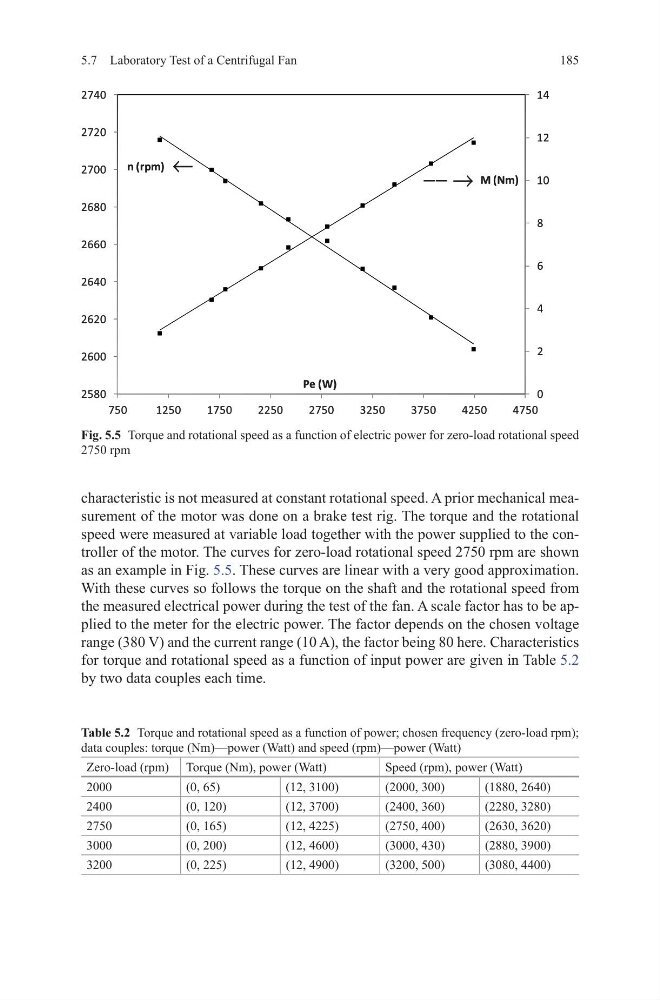
speed were measured at variable load together with the power supplied to the controller of the motor. The curves for zero-load rotational speed 2750 rpm are shown
as an example in Fig. 5.5. These curves are linear with a very good approximation.
With these curves so follows the torque on the shaft and the rotational speed from
the measured electrical power during the test of the fan. A scale factor has to be applied to the meter for the electric power. The factor depends on the chosen voltage
range (380 V) and the current range (10 A), the factor being 80 here. Characteristics
for torque and rotational speed as a function of input power are given in Table 5.2
by two data couples each time.
Table 5.2 Torque and rotational speed as a function of power; chosen frequency (zero-load rpm);
data couples: torque (Nm)—power (Watt) and speed (rpm)—power (Watt)
Zero-load (rpm) Torque (Nm), power (Watt)
Speed (rpm), power (Watt)
2000
(0, 65)
(12, 3100)
(2000, 300)
(1880, 2640)
2400
(0, 120)
(12, 3700)
(2400, 360)
(2280, 3280)
2750
(0, 165)
(12, 4225)
(2750, 400)
(2630, 3620)
3000
(0, 200)
(12, 4600)
(3000, 430)
(2880, 3900)
3200
(0, 225)
(12, 4900)
(3200, 500)
(3080, 4400)
0 0
2 2
4 4
6 6
8 8
10 10
12 12
14 14
2580 2580
2600 2600
2620 2620
2640 2640
2660 2660
2680 2680
2700 2700
2720 2720
2740 2740
75 750 0
125 1250 0
175 1750 0
225 2250 0
275 2750 0
325 3250 0
375 3750 0
425 4250 0
475 4750 0
M (Nm)
M (Nm)
n (rpm)
n (rpm)
Pe (W)
Pe (W)
−− →
−− →
← ←
Fig. 5.5 Torque and rotational speed as a function of electric power for zero-load rotational speed
2750 rpm
5.7 Laboratory Test of a Centrifugal Fan
characteristic is not measured at constant rotational speed. A prior mechanical measurement of the motor was done on a brake test rig. The torque and the rotational
speed were measured at variable load together with the power supplied to the controller of the motor. The curves for zero-load rotational speed 2750 rpm are shown
as an example in Fig. 5.5. These curves are linear with a very good approximation.
With these curves so follows the torque on the shaft and the rotational speed from
the measured electrical power during the test of the fan. A scale factor has to be applied to the meter for the electric power. The factor depends on the chosen voltage
range (380 V) and the current range (10 A), the factor being 80 here. Characteristics
for torque and rotational speed as a function of input power are given in Table 5.2
by two data couples each time.
Table 5.2 Torque and rotational speed as a function of power; chosen frequency (zero-load rpm);
data couples: torque (Nm)—power (Watt) and speed (rpm)—power (Watt)
Zero-load (rpm) Torque (Nm), power (Watt)
Speed (rpm), power (Watt)
2000
(0, 65)
(12, 3100)
(2000, 300)
(1880, 2640)
2400
(0, 120)
(12, 3700)
(2400, 360)
(2280, 3280)
2750
(0, 165)
(12, 4225)
(2750, 400)
(2630, 3620)
3000
(0, 200)
(12, 4600)
(3000, 430)
(2880, 3900)
3200
(0, 225)
(12, 4900)
(3200, 500)
(3080, 4400)
0 0
2 2
4 4
6 6
8 8
10 10
12 12
14 14
2580 2580
2600 2600
2620 2620
2640 2640
2660 2660
2680 2680
2700 2700
2720 2720
2740 2740
75 750 0
125 1250 0
175 1750 0
225 2250 0
275 2750 0
325 3250 0
375 3750 0
425 4250 0
475 4750 0
M (Nm)
M (Nm)
n (rpm)
n (rpm)
Pe (W)
Pe (W)
−− →
−− →
← ←
Fig. 5.5 Torque and rotational speed as a function of electric power for zero-load rotational speed
2750 rpm