

159
4.3 Compressibility Effect on the Velocity-Pressure Relation
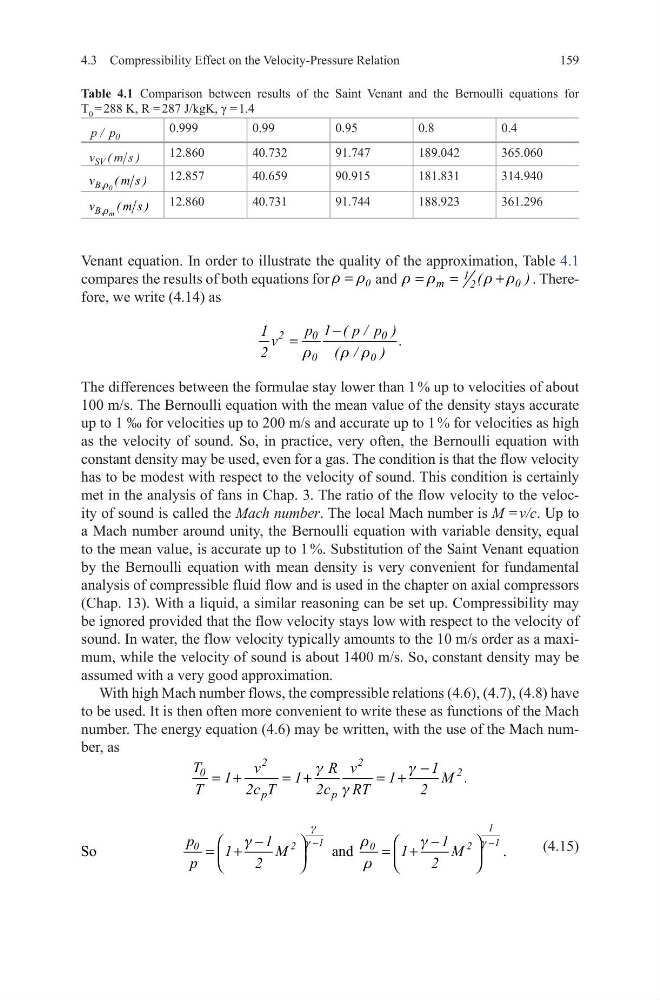
Venant equation. In order to illustrate the quality of the approximation, Table 4.1
compares the results of both equations for
0
r r
= and
1
m
0
2 (
)
r r
r r
=
=
+
. Therefore, we write (4.14) as
The differences between the formulae stay lower than 1 % up to velocities of about
100 m/s. The Bernoulli equation with the mean value of the density stays accurate
up to 1 ‰ for velocities up to 200 m/s and accurate up to 1 % for velocities as high
as the velocity of sound. So, in practice, very often, the Bernoulli equation with
constant density may be used, even for a gas. The condition is that the flow velocity
has to be modest with respect to the velocity of sound. This condition is certainly
met in the analysis of fans in Chap. 3. The ratio of the flow velocity to the velocity of sound is called the Mach number. The local Mach number is M = v/c. Up to
a Mach number around unity, the Bernoulli equation with variable density, equal
to the mean value, is accurate up to 1 %. Substitution of the Saint Venant equation
by the Bernoulli equation with mean density is very convenient for fundamental
analysis of compressible fluid flow and is used in the chapter on axial compressors
(Chap. 13). With a liquid, a similar reasoning can be set up. Compressibility may
be ignored provided that the flow velocity stays low with respect to the velocity of
sound. In water, the flow velocity typically amounts to the 10 m/s order as a maximum, while the velocity of sound is about 1400 m/s. So, constant density may be
assumed with a very good approximation.
With high Mach number flows, the compressible relations (4.6), (4.7), (4.8) have
to be used. It is then often more convenient to write these as functions of the Mach
number. The energy equation (4.6) may be written, with the use of the Mach number, as
(4.15)
2
0
0
0
0
p 1 ( p / p )
1 v
.
2
( /
)
r
r r
−
=
2
2
2
0
p
p
T
v
R v
1
1
1
1
M .
T
2c T
2c RT
2
g
g
g
−
= +
= +
= +
So
and
.
1
1
1
2
2
0
0
p
1
1
1
M
1
M
p
2
2
g
g
g
r
g
g
r
−
−
−
−
= +
= +
Table 4.1 Comparison between results of the Saint Venant and the Bernoulli equations for
T 0 = 288 K, R = 287 J/kgK, γ = 1.4
p p
/ 0
0.999
0.99
0.95
0.8
0.4
v m s
SV (
)
12.860
40.732
91.747
189.042
365.060
0
B,
v
( m s )
r
12.857
40.659
90.915
181.831
314.940
m
B,
v
( m s )
r
12.860
40.731
91.744
188.923
361.296
4.3 Compressibility Effect on the Velocity-Pressure Relation
Venant equation. In order to illustrate the quality of the approximation, Table 4.1
compares the results of both equations for
0
r r
= and
1
m
0
2 (
)
r r
r r
=
=
+
. Therefore, we write (4.14) as
The differences between the formulae stay lower than 1 % up to velocities of about
100 m/s. The Bernoulli equation with the mean value of the density stays accurate
up to 1 ‰ for velocities up to 200 m/s and accurate up to 1 % for velocities as high
as the velocity of sound. So, in practice, very often, the Bernoulli equation with
constant density may be used, even for a gas. The condition is that the flow velocity
has to be modest with respect to the velocity of sound. This condition is certainly
met in the analysis of fans in Chap. 3. The ratio of the flow velocity to the velocity of sound is called the Mach number. The local Mach number is M = v/c. Up to
a Mach number around unity, the Bernoulli equation with variable density, equal
to the mean value, is accurate up to 1 %. Substitution of the Saint Venant equation
by the Bernoulli equation with mean density is very convenient for fundamental
analysis of compressible fluid flow and is used in the chapter on axial compressors
(Chap. 13). With a liquid, a similar reasoning can be set up. Compressibility may
be ignored provided that the flow velocity stays low with respect to the velocity of
sound. In water, the flow velocity typically amounts to the 10 m/s order as a maximum, while the velocity of sound is about 1400 m/s. So, constant density may be
assumed with a very good approximation.
With high Mach number flows, the compressible relations (4.6), (4.7), (4.8) have
to be used. It is then often more convenient to write these as functions of the Mach
number. The energy equation (4.6) may be written, with the use of the Mach number, as
(4.15)
2
0
0
0
0
p 1 ( p / p )
1 v
.
2
( /
)
r
r r
−
=
2
2
2
0
p
p
T
v
R v
1
1
1
1
M .
T
2c T
2c RT
2
g
g
g
−
= +
= +
= +
So
and
.
1
1
1
2
2
0
0
p
1
1
1
M
1
M
p
2
2
g
g
g
r
g
g
r
−
−
−
−
= +
= +
Table 4.1 Comparison between results of the Saint Venant and the Bernoulli equations for
T 0 = 288 K, R = 287 J/kgK, γ = 1.4
p p
/ 0
0.999
0.99
0.95
0.8
0.4
v m s
SV (
)
12.860
40.732
91.747
189.042
365.060
0
B,
v
( m s )
r
12.857
40.659
90.915
181.831
314.940
m
B,
v
( m s )
r
12.860
40.731
91.744
188.923
361.296