

160
4 Compressible Fluids
4.4 Shape of a Nozzle
The cross-section area evolution follows from the mass equation (4.1):
The density change is linked to the pressure change by isentropy (for adiabatic
reversible flow):
The velocity change is linked to the pressure change by the work equation (4.2):
or
(4.16)
The section change is
(4.17)
Further:
and
(4.18)
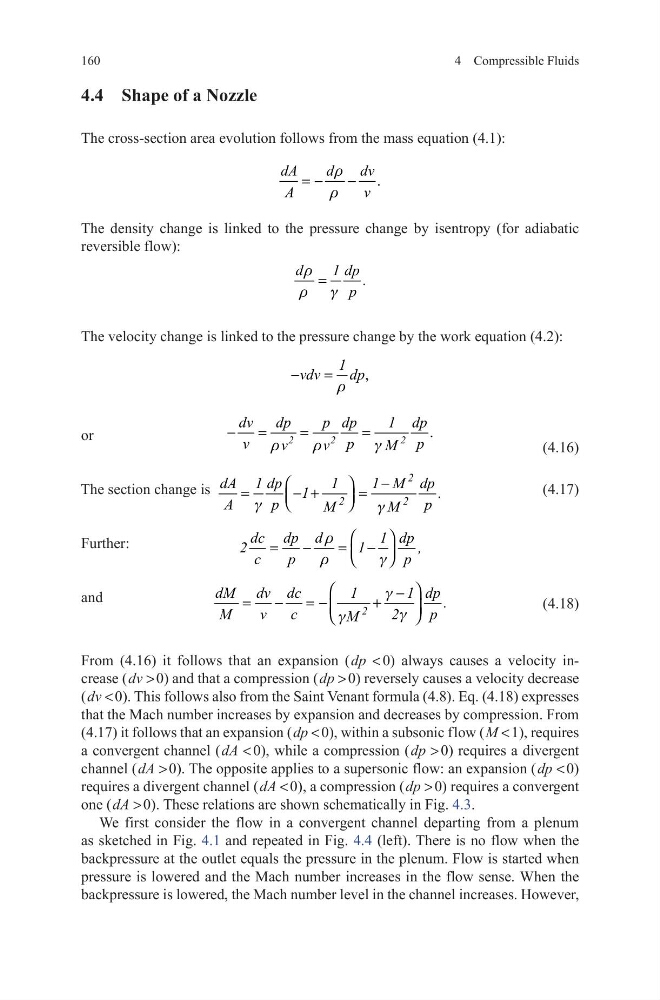
From (4.16) it follows that an expansion ( dp < 0) always causes a velocity increase ( dv > 0) and that a compression ( dp > 0) reversely causes a velocity decrease
( dv < 0). This follows also from the Saint Venant formula (4.8). Eq. (4.18) expresses
that the Mach number increases by expansion and decreases by compression. From
(4.17) it follows that an expansion ( dp < 0), within a subsonic f low ( M < 1), requires
a convergent channel ( dA < 0), while a compression ( dp > 0) requires a divergent
channel ( dA > 0). The opposite applies to a supersonic flow: an expansion ( dp < 0)
requires a divergent channel ( dA < 0), a compression ( dp > 0) requires a convergent
one ( dA > 0). These relations are shown schematically in Fig. 4.3.
We first consider the flow in a convergent channel departing from a plenum
as sketched in Fig. 4.1 and repeated in Fig. 4.4 (left). There is no flow when the
backpressure at the outlet equals the pressure in the plenum. Flow is started when
pressure is lowered and the Mach number increases in the flow sense. When the
backpressure is lowered, the Mach number level in the channel increases. However,
.
dA
d
dv
A
v
r
r
= −
−
d
1 dp .
p
r
r
g
=
,
1
vdv
dp
r
−
=
.
2
2
2
dv
dp
p dp
1 dp
v
p
p
v
v
M
r
r
g
−
=
=
=
2
2
2
dA 1 dp
1
1 M dp
1
.
A
p
p
M
M
g
g
−
=
− +
=
dc dp d
1 dp
2
1
,
c
p
p
r
r
g
=
−
= −
2
dM dv dc
1
1 dp .
M
v
c
2
p
M
g
g
g
−
=
−
= −
+
4 Compressible Fluids
4.4 Shape of a Nozzle
The cross-section area evolution follows from the mass equation (4.1):
The density change is linked to the pressure change by isentropy (for adiabatic
reversible flow):
The velocity change is linked to the pressure change by the work equation (4.2):
or
(4.16)
The section change is
(4.17)
Further:
and
(4.18)
From (4.16) it follows that an expansion ( dp < 0) always causes a velocity increase ( dv > 0) and that a compression ( dp > 0) reversely causes a velocity decrease
( dv < 0). This follows also from the Saint Venant formula (4.8). Eq. (4.18) expresses
that the Mach number increases by expansion and decreases by compression. From
(4.17) it follows that an expansion ( dp < 0), within a subsonic f low ( M < 1), requires
a convergent channel ( dA < 0), while a compression ( dp > 0) requires a divergent
channel ( dA > 0). The opposite applies to a supersonic flow: an expansion ( dp < 0)
requires a divergent channel ( dA < 0), a compression ( dp > 0) requires a convergent
one ( dA > 0). These relations are shown schematically in Fig. 4.3.
We first consider the flow in a convergent channel departing from a plenum
as sketched in Fig. 4.1 and repeated in Fig. 4.4 (left). There is no flow when the
backpressure at the outlet equals the pressure in the plenum. Flow is started when
pressure is lowered and the Mach number increases in the flow sense. When the
backpressure is lowered, the Mach number level in the channel increases. However,
.
dA
d
dv
A
v
r
r
= −
−
d
1 dp .
p
r
r
g
=
,
1
vdv
dp
r
−
=
.
2
2
2
dv
dp
p dp
1 dp
v
p
p
v
v
M
r
r
g
−
=
=
=
2
2
2
dA 1 dp
1
1 M dp
1
.
A
p
p
M
M
g
g
−
=
− +
=
dc dp d
1 dp
2
1
,
c
p
p
r
r
g
=
−
= −
2
dM dv dc
1
1 dp .
M
v
c
2
p
M
g
g
g
−
=
−
= −
+