

3.4 Internal Losses with Radial Fans
123
3.4.4 Rotor Friction Loss and Rotor Diffusion Loss
With a rotor that can be considered as composed of blade channels, this loss may
be estimated with formulae for ducts, applying an average hydraulic diameter. This
is mostly appropriate for pumps. For fans, it is more realistic to apply the formulae
for flow over plates with a calculation of the total friction surface. For a flow over
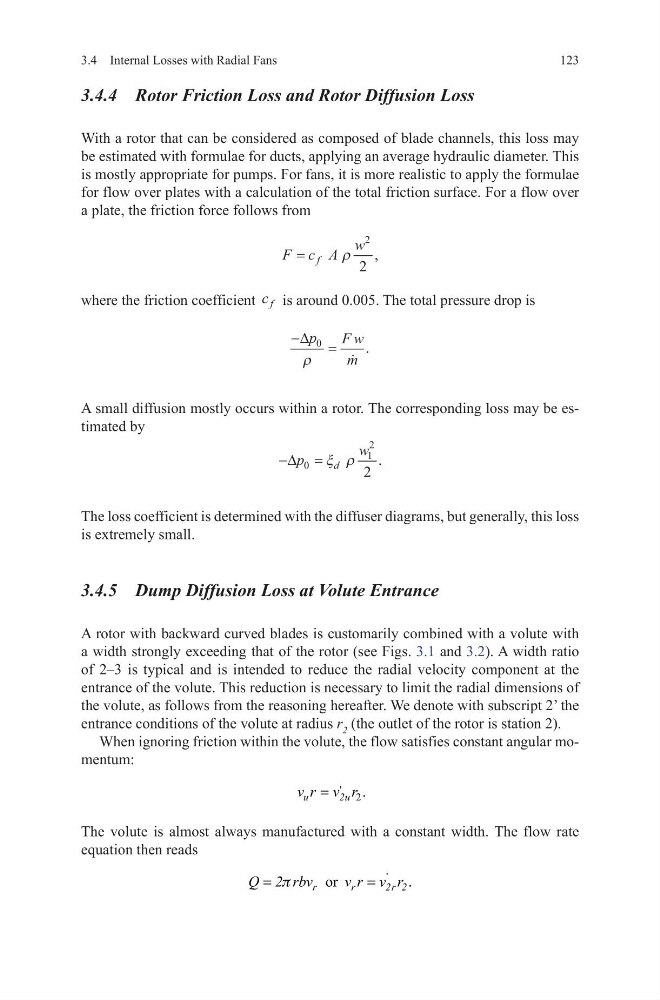
a plate, the friction force follows from
where the friction coefficient c f is around 0.005. The total pressure drop is
A small diffusion mostly occurs within a rotor. The corresponding loss may be estimated by
The loss coefficient is determined with the diffuser diagrams, but generally, this loss
is extremely small.
3.4.5 Dump Diffusion Loss at Volute Entrance
A rotor with backward curved blades is customarily combined with a volute with
a width strongly exceeding that of the rotor (see Figs. 3.1 and 3.2). A width ratio
of 2–3 is typical and is intended to reduce the radial velocity component at the
entrance of the volute. This reduction is necessary to limit the radial dimensions of
the volute, as follows from the reasoning hereafter. We denote with subscript 2’ the
entrance conditions of the volute at radius r 2 (the outlet of the rotor is station 2).
When ignoring friction within the volute, the flow satisfies constant angular momentum:
The volute is almost always manufactured with a constant width. The flow rate
equation then reads
F c A
w
f
=
ρ
2
2
,
−
=
∆p
F w
m
0
ρ
.
−
=
∆p
w
d
0
1
2
2
ξ ρ
.
' 2 .
u
2u
v r v r
=
'
or
.
r
r
2r 2
Q 2 rbv
v r v r
p
=
=
123
3.4.4 Rotor Friction Loss and Rotor Diffusion Loss
With a rotor that can be considered as composed of blade channels, this loss may
be estimated with formulae for ducts, applying an average hydraulic diameter. This
is mostly appropriate for pumps. For fans, it is more realistic to apply the formulae
for flow over plates with a calculation of the total friction surface. For a flow over
a plate, the friction force follows from
where the friction coefficient c f is around 0.005. The total pressure drop is
A small diffusion mostly occurs within a rotor. The corresponding loss may be estimated by
The loss coefficient is determined with the diffuser diagrams, but generally, this loss
is extremely small.
3.4.5 Dump Diffusion Loss at Volute Entrance
A rotor with backward curved blades is customarily combined with a volute with
a width strongly exceeding that of the rotor (see Figs. 3.1 and 3.2). A width ratio
of 2–3 is typical and is intended to reduce the radial velocity component at the
entrance of the volute. This reduction is necessary to limit the radial dimensions of
the volute, as follows from the reasoning hereafter. We denote with subscript 2’ the
entrance conditions of the volute at radius r 2 (the outlet of the rotor is station 2).
When ignoring friction within the volute, the flow satisfies constant angular momentum:
The volute is almost always manufactured with a constant width. The flow rate
equation then reads
F c A
w
f
=
ρ
2
2
,
−
=
∆p
F w
m
0
ρ
.
−
=
∆p
w
d
0
1
2
2
ξ ρ
.
' 2 .
u
2u
v r v r
=
'
or
.
r
r
2r 2
Q 2 rbv
v r v r
p
=
=