

122
3 Fans
with µ def being a coefficient of about 0.7–0.8.
3.4.3 Displacement by Blade Thickness
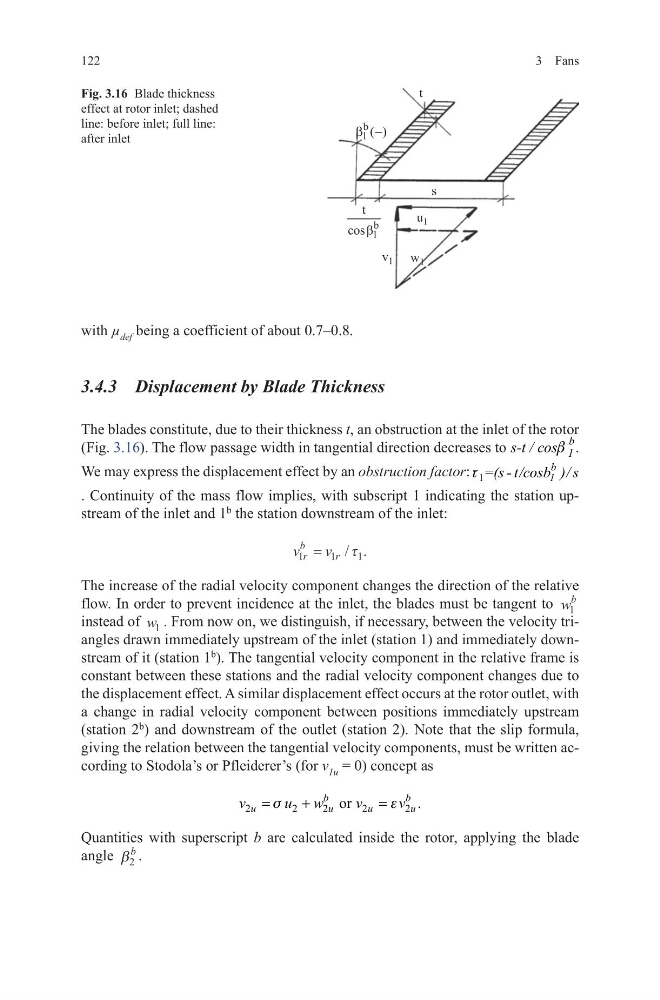
The blades constitute, due to their thickness t, an obstruction at the inlet of the rotor
(Fig. 3.16). The flow passage width in tangential direction decreases to
b
1
s-t / cosb .
We may express the displacement effect by an obstruction factor: 1 =
b
1
(s - t/cosb )/ s
t
. Continuity of the mass flow implies, with subscript 1 indicating the station upstream of the inlet and 1
b
the station downstream of the inlet:
The increase of the radial velocity component changes the direction of the relative
flow. In order to prevent incidence at the inlet, the blades must be tangent to w
b
1
instead of w 1 . From now on, we distinguish, if necessary, between the velocity triangles drawn immediately upstream of the inlet (station 1) and immediately downstream of it (station 1
b
). The tangential velocity component in the relative frame is
constant between these stations and the radial velocity component changes due to
the displacement effect. A similar displacement effect occurs at the rotor outlet, with
a change in radial velocity component between positions immediately upstream
(station 2
b
) and downstream of the outlet (station 2). Note that the slip formula,
giving the relation between the tangential velocity components, must be written according to Stodola’s or Pfleiderer’s (for v 1u = 0) concept as
Quantities with superscript b are calculated inside the rotor, applying the blade
angle β 2
b
.
v
v
r
b
r
1
1
1
=
/ .
τ
2
2
2
2
2
or
.
b
b
u
u
u
u
v
u w
v
v
s
e
=
+
=
Fig. 3.16 Blade thickness
effect at rotor inlet; dashed
line: before inlet; full line:
after inlet
3 Fans
with µ def being a coefficient of about 0.7–0.8.
3.4.3 Displacement by Blade Thickness
The blades constitute, due to their thickness t, an obstruction at the inlet of the rotor
(Fig. 3.16). The flow passage width in tangential direction decreases to
b
1
s-t / cosb .
We may express the displacement effect by an obstruction factor: 1 =
b
1
(s - t/cosb )/ s
t
. Continuity of the mass flow implies, with subscript 1 indicating the station upstream of the inlet and 1
b
the station downstream of the inlet:
The increase of the radial velocity component changes the direction of the relative
flow. In order to prevent incidence at the inlet, the blades must be tangent to w
b
1
instead of w 1 . From now on, we distinguish, if necessary, between the velocity triangles drawn immediately upstream of the inlet (station 1) and immediately downstream of it (station 1
b
). The tangential velocity component in the relative frame is
constant between these stations and the radial velocity component changes due to
the displacement effect. A similar displacement effect occurs at the rotor outlet, with
a change in radial velocity component between positions immediately upstream
(station 2
b
) and downstream of the outlet (station 2). Note that the slip formula,
giving the relation between the tangential velocity components, must be written according to Stodola’s or Pfleiderer’s (for v 1u = 0) concept as
Quantities with superscript b are calculated inside the rotor, applying the blade
angle β 2
b
.
v
v
r
b
r
1
1
1
=
/ .
τ
2
2
2
2
2
or
.
b
b
u
u
u
u
v
u w
v
v
s
e
=
+
=
Fig. 3.16 Blade thickness
effect at rotor inlet; dashed
line: before inlet; full line:
after inlet