

112
3 Fans
3.3.3 Slip: Reduction of Rotor Work
Due to the relative vortex motion (Fig. 3.9), the average outlet flow of a blade
channel deviates from the blade orientation into the sense opposite to the rotational
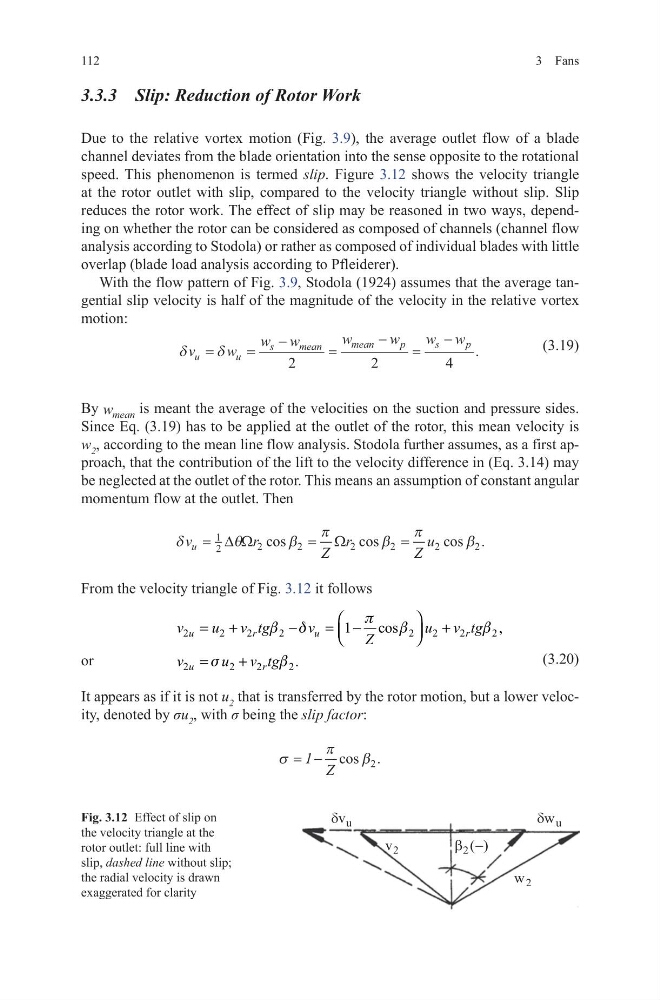
speed. This phenomenon is termed slip. Figure 3.12 shows the velocity triangle
at the rotor outlet with slip, compared to the velocity triangle without slip. Slip
reduces the rotor work. The effect of slip may be reasoned in two ways, depending on whether the rotor can be considered as composed of channels (channel flow
analysis according to Stodola) or rather as composed of individual blades with little
overlap (blade load analysis according to Pfleiderer).
With the flow pattern of Fig. 3.9, Stodola (1924) assumes that the average tangential slip velocity is half of the magnitude of the velocity in the relative vortex
motion:
(3.19)
By w mean is meant the average of the velocities on the suction and pressure sides.
Since Eq. (3.19) has to be applied at the outlet of the rotor, this mean velocity is
w 2 , according to the mean line flow analysis. Stodola further assumes, as a first approach, that the contribution of the lift to the velocity difference in (Eq. 3.14) may
be neglected at the outlet of the rotor. This means an assumption of constant angular
momentum flow at the outlet. Then
From the velocity triangle of Fig. 3.12 it follows
or
(3.20)
It appears as if it is not u 2 that is transferred by the rotor motion, but a lower velocity, denoted by σu 2 , with σ being the slip factor:
δ
δ
v
w
w w
w
w
w w
u
u
s
m ean
mean
p
s
p
=
=
−
=
−
=
−
2
2
4
.
δ
θ
β
π
β
π
β
v
r
Z
r
Z
u
u =
=
=
1
2
2
2
2
2
2
2
∆ Ω
Ω
cos
c os
cos .
2
2
2
2
2
2
2
2
2
2
2
2
1
cos
,
.
u
r
u
r
u
r
v
u v tg
v
u v tg
Z
v
u v tg
p
b d
b
b
s
b
= +
−
= −
+
=
+
σ
π
β
= −
1 Z
cos .
2
Fig. 3.12 Effect of slip on
the velocity triangle at the
rotor outlet: full line with
slip, dashed line without slip;
the radial velocity is drawn
exaggerated for clarity
3 Fans
3.3.3 Slip: Reduction of Rotor Work
Due to the relative vortex motion (Fig. 3.9), the average outlet flow of a blade
channel deviates from the blade orientation into the sense opposite to the rotational
speed. This phenomenon is termed slip. Figure 3.12 shows the velocity triangle
at the rotor outlet with slip, compared to the velocity triangle without slip. Slip
reduces the rotor work. The effect of slip may be reasoned in two ways, depending on whether the rotor can be considered as composed of channels (channel flow
analysis according to Stodola) or rather as composed of individual blades with little
overlap (blade load analysis according to Pfleiderer).
With the flow pattern of Fig. 3.9, Stodola (1924) assumes that the average tangential slip velocity is half of the magnitude of the velocity in the relative vortex
motion:
(3.19)
By w mean is meant the average of the velocities on the suction and pressure sides.
Since Eq. (3.19) has to be applied at the outlet of the rotor, this mean velocity is
w 2 , according to the mean line flow analysis. Stodola further assumes, as a first approach, that the contribution of the lift to the velocity difference in (Eq. 3.14) may
be neglected at the outlet of the rotor. This means an assumption of constant angular
momentum flow at the outlet. Then
From the velocity triangle of Fig. 3.12 it follows
or
(3.20)
It appears as if it is not u 2 that is transferred by the rotor motion, but a lower velocity, denoted by σu 2 , with σ being the slip factor:
δ
δ
v
w
w w
w
w
w w
u
u
s
m ean
mean
p
s
p
=
=
−
=
−
=
−
2
2
4
.
δ
θ
β
π
β
π
β
v
r
Z
r
Z
u
u =
=
=
1
2
2
2
2
2
2
2
∆ Ω
Ω
cos
c os
cos .
2
2
2
2
2
2
2
2
2
2
2
2
1
cos
,
.
u
r
u
r
u
r
v
u v tg
v
u v tg
Z
v
u v tg
p
b d
b
b
s
b
= +
−
= −
+
=
+
σ
π
β
= −
1 Z
cos .
2
Fig. 3.12 Effect of slip on
the velocity triangle at the
rotor outlet: full line with
slip, dashed line without slip;
the radial velocity is drawn
exaggerated for clarity