

113
This representation leads to a characteristic
0
1
p
r ∆
as a function of the flow rate,
parallel to the theoretical characteristic with an infinite number of blades, shifted
by (
)
1
2
2
−σ u . Stodola’s reasoning holds well when blade passages strongly form
channels. This always applies to pumps, but seldom to fans. A formula according
to Wiesner (1967) is mostly applied with pumps. Stodola’s formula has been corrected by Wiesner for curvature and friction effects with use of theoretical results by
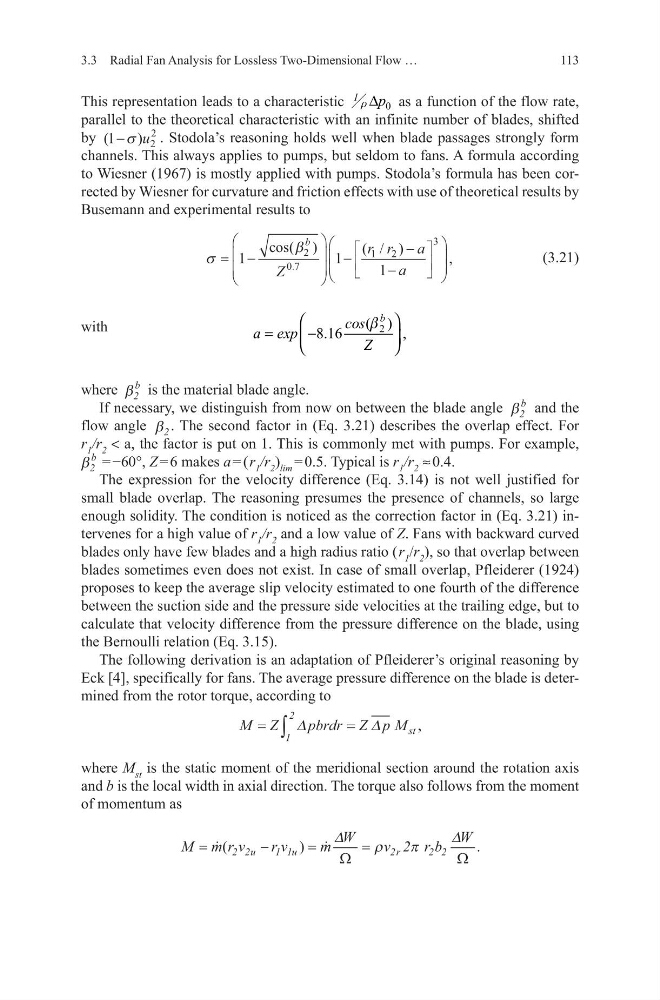
Busemann and experimental results to
(3.21)
with
where β 2
b
is the material blade angle.
If necessary, we distinguish from now on between the blade angle β 2
b
and the
flow angle β 2 . The second factor in (Eq. 3.21) describes the overlap effect. For
r 1 /r 2 < a, the factor is put on 1. This is commonly met with pumps. For example,
β 2
b
= −60°, Z = 6 makes a = ( r 1 /r 2 ) lim = 0.5. Typical is r 1 /r 2 ≈ 0.4.
The expression for the velocity difference (Eq. 3.14) is not well justified for
small blade overlap. The reasoning presumes the presence of channels, so large
enough solidity. The condition is noticed as the correction factor in (Eq. 3.21) intervenes for a high value of r 1 /r 2 and a low value of Z. Fans with backward curved
blades only have few blades and a high radius ratio ( r 1 /r 2 ), so that overlap between
blades sometimes even does not exist. In case of small overlap, Pfleiderer (1924)
proposes to keep the average slip velocity estimated to one fourth of the difference
between the suction side and the pressure side velocities at the trailing edge, but to
calculate that velocity difference from the pressure difference on the blade, using
the Bernoulli relation (Eq. 3.15).
The following derivation is an adaptation of Pfleiderer’s original reasoning by
Eck [4], specifically for fans. The average pressure difference on the blade is determined from the rotor torque, according to
where M st is the static moment of the meridional section around the rotation axis
and b is the local width in axial direction. The torque also follows from the moment
of momentum as
σ
β
= −
−
−
−
1
1
1
2
0 7
1 2
3
cos( )
( / )
,
.
b
Z
r r
a
a
2
( )
8.16
,
b
cos
a exp
Z
b
=
−
M Z
pbrdr Z p M st
=
=
∫ ∆
∆
1
2
,
M m r v
r v
m
W
v
rb
W
u
u
r
=
−
=
=
(
)
.
2 2
2
2 2
1 1
2
∆
∆
Ω
Ω
ρ
π
3.3 Radial Fan Analysis for Lossless Two-Dimensional Flow …
This representation leads to a characteristic
0
1
p
r ∆
as a function of the flow rate,
parallel to the theoretical characteristic with an infinite number of blades, shifted
by (
)
1
2
2
−σ u . Stodola’s reasoning holds well when blade passages strongly form
channels. This always applies to pumps, but seldom to fans. A formula according
to Wiesner (1967) is mostly applied with pumps. Stodola’s formula has been corrected by Wiesner for curvature and friction effects with use of theoretical results by
Busemann and experimental results to
(3.21)
with
where β 2
b
is the material blade angle.
If necessary, we distinguish from now on between the blade angle β 2
b
and the
flow angle β 2 . The second factor in (Eq. 3.21) describes the overlap effect. For
r 1 /r 2 < a, the factor is put on 1. This is commonly met with pumps. For example,
β 2
b
= −60°, Z = 6 makes a = ( r 1 /r 2 ) lim = 0.5. Typical is r 1 /r 2 ≈ 0.4.
The expression for the velocity difference (Eq. 3.14) is not well justified for
small blade overlap. The reasoning presumes the presence of channels, so large
enough solidity. The condition is noticed as the correction factor in (Eq. 3.21) intervenes for a high value of r 1 /r 2 and a low value of Z. Fans with backward curved
blades only have few blades and a high radius ratio ( r 1 /r 2 ), so that overlap between
blades sometimes even does not exist. In case of small overlap, Pfleiderer (1924)
proposes to keep the average slip velocity estimated to one fourth of the difference
between the suction side and the pressure side velocities at the trailing edge, but to
calculate that velocity difference from the pressure difference on the blade, using
the Bernoulli relation (Eq. 3.15).
The following derivation is an adaptation of Pfleiderer’s original reasoning by
Eck [4], specifically for fans. The average pressure difference on the blade is determined from the rotor torque, according to
where M st is the static moment of the meridional section around the rotation axis
and b is the local width in axial direction. The torque also follows from the moment
of momentum as
σ
β
= −
−
−
−
1
1
1
2
0 7
1 2
3
cos( )
( / )
,
.
b
Z
r r
a
a
2
( )
8.16
,
b
cos
a exp
Z
b
=
−
M Z
pbrdr Z p M st
=
=
∫ ∆
∆
1
2
,
M m r v
r v
m
W
v
rb
W
u
u
r
=
−
=
=
(
)
.
2 2
2
2 2
1 1
2
∆
∆
Ω
Ω
ρ
π
3.3 Radial Fan Analysis for Lossless Two-Dimensional Flow …