

111
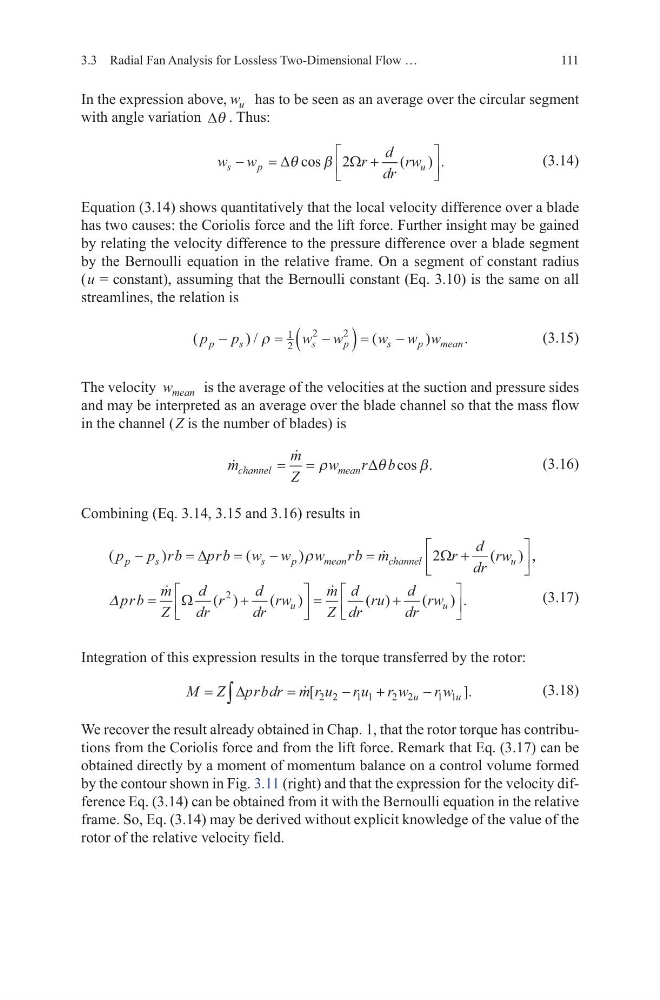
In the expression above, w u has to be seen as an average over the circular segment
with angle variation ∆θ . Thus:
(3.14)
Equation (3.14) shows quantitatively that the local velocity difference over a blade
has two causes: the Coriolis force and the lift force. Further insight may be gained
by relating the velocity difference to the pressure difference over a blade segment
by the Bernoulli equation in the relative frame. On a segment of constant radius
( u = constant), assuming that the Bernoulli constant (Eq. 3.10) is the same on all
streamlines, the relation is
(3.15)
The velocity w mean is the average of the velocities at the suction and pressure sides
and may be interpreted as an average over the blade channel so that the mass flow
in the channel ( Z is the number of blades) is
(3.16)
Combining (Eq. 3.14, 3.15 and 3.16) results in
(3.17)
Integration of this expression results in the torque transferred by the rotor:
(3.18)
We recover the result already obtained in Chap. 1, that the rotor torque has contributions from the Coriolis force and from the lift force. Remark that Eq. (3.17) can be
obtained directly by a moment of momentum balance on a control volume formed
by the contour shown in Fig. 3.11 (right) and that the expression for the velocity difference Eq. (3.14) can be obtained from it with the Bernoulli equation in the relative
frame. So, Eq. (3.14) may be derived without explicit knowledge of the value of the
rotor of the relative velocity field.
w w
r
d
dr
rw
s
p
u
−
=
+
∆
Ω
θ
β
cos
(
) .
2
(
)/
(
)
.
p
p
w w
w w w
p
s
s
p
s
p
mean
−
=
−
(
) = −
ρ
1
2
2
2
m
m
Z
w
r b
channel
m ean
= = ρ
θ
β
∆ cos .
(
)
(
)
(
)
p
p rb
prb w w
w
rb m
r
d
dr
rw
p
s
s
p
mean
channel
u
−
=
=
−
=
+
∆
Ω
ρ
2
, ,
( )
(
)
( )
(
)
∆ prb
m
Z
d
dr
r
d
dr
rw
m
Z
d
dr
ru
d
dr
rw
u
u
=
+
=
+
Ω
2
.
M Z prbdr m r u r u r w
r w
u
u
=
=
−
+
−
∫ ∆
[
] .
2 2
1 1
2 2
1 1
3.3 Radial Fan Analysis for Lossless Two-Dimensional Flow …
In the expression above, w u has to be seen as an average over the circular segment
with angle variation ∆θ . Thus:
(3.14)
Equation (3.14) shows quantitatively that the local velocity difference over a blade
has two causes: the Coriolis force and the lift force. Further insight may be gained
by relating the velocity difference to the pressure difference over a blade segment
by the Bernoulli equation in the relative frame. On a segment of constant radius
( u = constant), assuming that the Bernoulli constant (Eq. 3.10) is the same on all
streamlines, the relation is
(3.15)
The velocity w mean is the average of the velocities at the suction and pressure sides
and may be interpreted as an average over the blade channel so that the mass flow
in the channel ( Z is the number of blades) is
(3.16)
Combining (Eq. 3.14, 3.15 and 3.16) results in
(3.17)
Integration of this expression results in the torque transferred by the rotor:
(3.18)
We recover the result already obtained in Chap. 1, that the rotor torque has contributions from the Coriolis force and from the lift force. Remark that Eq. (3.17) can be
obtained directly by a moment of momentum balance on a control volume formed
by the contour shown in Fig. 3.11 (right) and that the expression for the velocity difference Eq. (3.14) can be obtained from it with the Bernoulli equation in the relative
frame. So, Eq. (3.14) may be derived without explicit knowledge of the value of the
rotor of the relative velocity field.
w w
r
d
dr
rw
s
p
u
−
=
+
∆
Ω
θ
β
cos
(
) .
2
(
)/
(
)
.
p
p
w w
w w w
p
s
s
p
s
p
mean
−
=
−
(
) = −
ρ
1
2
2
2
m
m
Z
w
r b
channel
m ean
= = ρ
θ
β
∆ cos .
(
)
(
)
(
)
p
p rb
prb w w
w
rb m
r
d
dr
rw
p
s
s
p
mean
channel
u
−
=
=
−
=
+
∆
Ω
ρ
2
, ,
( )
(
)
( )
(
)
∆ prb
m
Z
d
dr
r
d
dr
rw
m
Z
d
dr
ru
d
dr
rw
u
u
=
+
=
+
Ω
2
.
M Z prbdr m r u r u r w
r w
u
u
=
=
−
+
−
∫ ∆
[
] .
2 2
1 1
2 2
1 1
3.3 Radial Fan Analysis for Lossless Two-Dimensional Flow …