

110
3 Fans
Equation (3.12) demonstrates that the transversal velocity variation mainly originates from the Coriolis force, but that it decreases due to backward curving of the
streamlines ( R > 0). This result means, as found in Chap. 1, that rotor work decreases due to backward curving of the blades, causing negative work by the lift
associated to the streamline curvature.
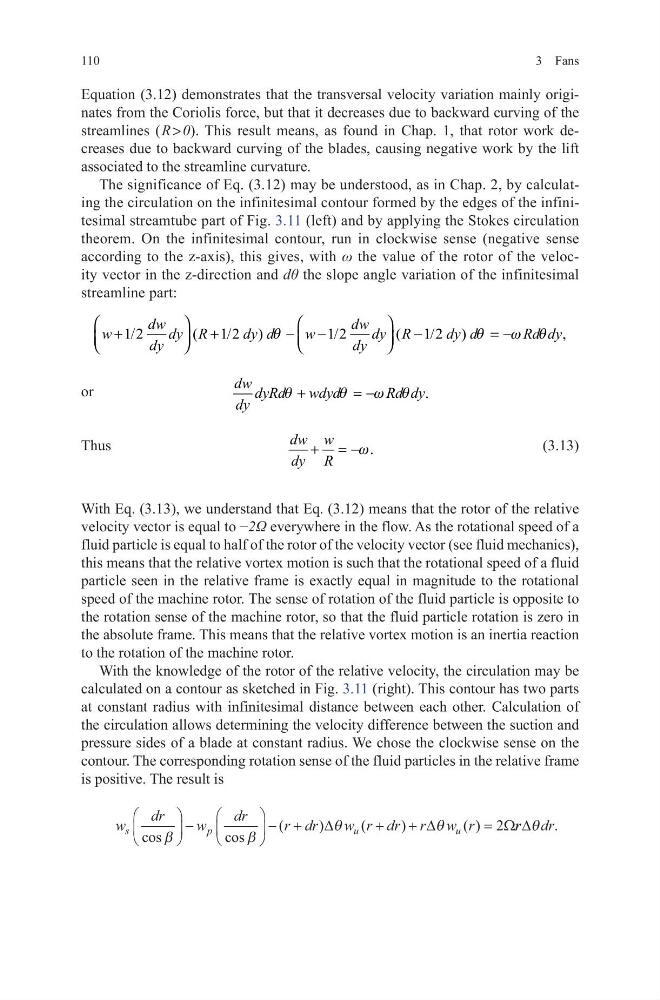
The significance of Eq. (3.12) may be understood, as in Chap. 2, by calculating the circulation on the infinitesimal contour formed by the edges of the infinitesimal streamtube part of Fig. 3.11 (left) and by applying the Stokes circulation
theorem. On the infinitesimal contour, run in clockwise sense (negative sense
according to the z-axis), this gives, with ω the value of the rotor of the velocity vector in the z-direction and dθ the slope angle variation of the infinitesimal
streamline part:
or
Thus
(3.13)
With Eq. (3.13), we understand that Eq. (3.12) means that the rotor of the relative
velocity vector is equal to −2Ω everywhere in the flow. As the rotational speed of a
fluid particle is equal to half of the rotor of the velocity vector (see fluid mechanics),
this means that the relative vortex motion is such that the rotational speed of a fluid
particle seen in the relative frame is exactly equal in magnitude to the rotational
speed of the machine rotor. The sense of rotation of the fluid particle is opposite to
the rotation sense of the machine rotor, so that the fluid particle rotation is zero in
the absolute frame. This means that the relative vortex motion is an inertia reaction
to the rotation of the machine rotor.
With the knowledge of the rotor of the relative velocity, the circulation may be
calculated on a contour as sketched in Fig. 3.11 (right). This contour has two parts
at constant radius with infinitesimal distance between each other. Calculation of
the circulation allows determining the velocity difference between the suction and
pressure sides of a blade at constant radius. We chose the clockwise sense on the
contour. The corresponding rotation sense of the fluid particles in the relative frame
is positive. The result is
1/2
(
1/2 )
1/2
(
1/2 )
,
dw
dw
w
dy R
dy d
w
dy R
dy d
Rd dy
dy
dy
q
q
w q
+
+
−
−
−
=−
.
dw dyRd
wdyd
Rd dy
dy
q
q
w q
+
= −
.
dw w
dy R
w
+ = −
w
dr
w
dr
r dr
w r dr r w r
s
p
u
u
cos
c os
(
)
(
)
( )
β
β
θ
θ
−
− +
+
+
=
∆
∆
Ω
2 r
r dr
∆θ .
3 Fans
Equation (3.12) demonstrates that the transversal velocity variation mainly originates from the Coriolis force, but that it decreases due to backward curving of the
streamlines ( R > 0). This result means, as found in Chap. 1, that rotor work decreases due to backward curving of the blades, causing negative work by the lift
associated to the streamline curvature.
The significance of Eq. (3.12) may be understood, as in Chap. 2, by calculating the circulation on the infinitesimal contour formed by the edges of the infinitesimal streamtube part of Fig. 3.11 (left) and by applying the Stokes circulation
theorem. On the infinitesimal contour, run in clockwise sense (negative sense
according to the z-axis), this gives, with ω the value of the rotor of the velocity vector in the z-direction and dθ the slope angle variation of the infinitesimal
streamline part:
or
Thus
(3.13)
With Eq. (3.13), we understand that Eq. (3.12) means that the rotor of the relative
velocity vector is equal to −2Ω everywhere in the flow. As the rotational speed of a
fluid particle is equal to half of the rotor of the velocity vector (see fluid mechanics),
this means that the relative vortex motion is such that the rotational speed of a fluid
particle seen in the relative frame is exactly equal in magnitude to the rotational
speed of the machine rotor. The sense of rotation of the fluid particle is opposite to
the rotation sense of the machine rotor, so that the fluid particle rotation is zero in
the absolute frame. This means that the relative vortex motion is an inertia reaction
to the rotation of the machine rotor.
With the knowledge of the rotor of the relative velocity, the circulation may be
calculated on a contour as sketched in Fig. 3.11 (right). This contour has two parts
at constant radius with infinitesimal distance between each other. Calculation of
the circulation allows determining the velocity difference between the suction and
pressure sides of a blade at constant radius. We chose the clockwise sense on the
contour. The corresponding rotation sense of the fluid particles in the relative frame
is positive. The result is
1/2
(
1/2 )
1/2
(
1/2 )
,
dw
dw
w
dy R
dy d
w
dy R
dy d
Rd dy
dy
dy
q
q
w q
+
+
−
−
−
=−
.
dw dyRd
wdyd
Rd dy
dy
q
q
w q
+
= −
.
dw w
dy R
w
+ = −
w
dr
w
dr
r dr
w r dr r w r
s
p
u
u
cos
c os
(
)
(
)
( )
β
β
θ
θ
−
− +
+
+
=
∆
∆
Ω
2 r
r dr
∆θ .