

and temperature. Common reducing agents such as iron sulfide (FeS) and pyrite
(FeS 2 ) have been used to precipitate Cr economically since both are naturally
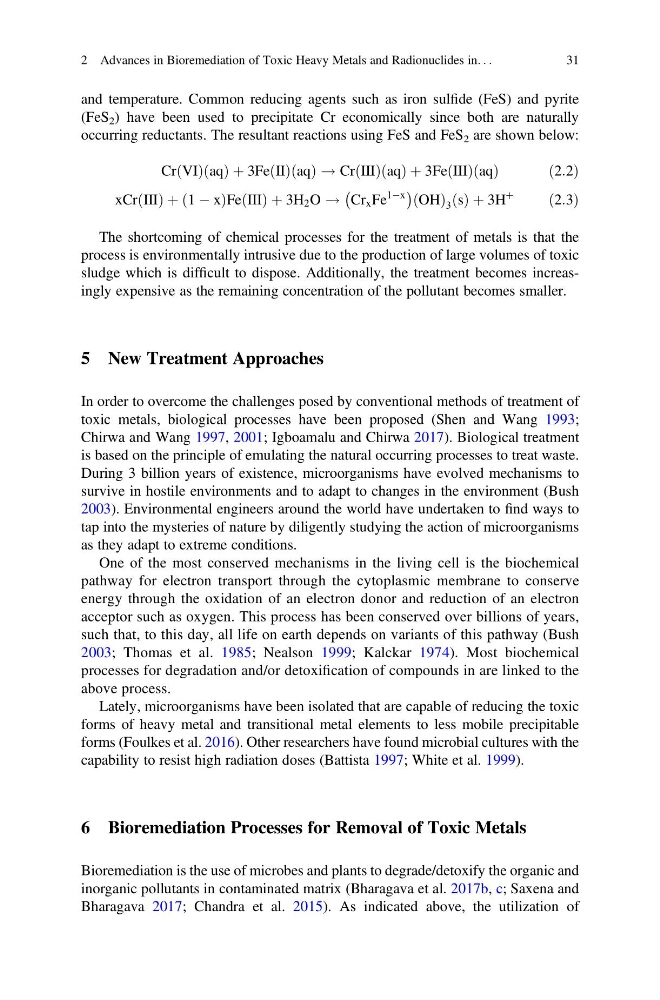
occurring reductants. The resultant reactions using FeS and FeS 2 are shown below:
Cr VI
ð Þ aq
ð Þ þ 3Fe II
ð Þ aq
ð Þ ! Cr III
ð Þ aq
ð Þ þ 3Fe III
ð Þ aq
ð Þ
ð2:2Þ
xCr III
ð Þ þ 1 À x
ð
ÞFe III
ð Þ þ 3H 2 O ! Cr x Fe
1Àx
À
Á
OH
ð Þ 3 s
ð Þ þ 3H
þ
ð2:3Þ
The shortcoming of chemical processes for the treatment of metals is that the
process is environmentally intrusive due to the production of large volumes of toxic
sludge which is difficult to dispose. Additionally, the treatment becomes increasingly expensive as the remaining concentration of the pollutant becomes smaller.
5 New Treatment Approaches
In order to overcome the challenges posed by conventional methods of treatment of
toxic metals, biological processes have been proposed (Shen and Wang 1993;
Chirwa and Wang 1997, 2001; Igboamalu and Chirwa 2017). Biological treatment
is based on the principle of emulating the natural occurring processes to treat waste.
During 3 billion years of existence, microorganisms have evolved mechanisms to
survive in hostile environments and to adapt to changes in the environment (Bush
2003). Environmental engineers around the world have undertaken to find ways to
tap into the mysteries of nature by diligently studying the action of microorganisms
as they adapt to extreme conditions.
One of the most conserved mechanisms in the living cell is the biochemical
pathway for electron transport through the cytoplasmic membrane to conserve
energy through the oxidation of an electron donor and reduction of an electron
acceptor such as oxygen. This process has been conserved over billions of years,
such that, to this day, all life on earth depends on variants of this pathway (Bush
2003; Thomas et al. 1985; Nealson 1999; Kalckar 1974). Most biochemical
processes for degradation and/or detoxification of compounds in are linked to the
above process.
Lately, microorganisms have been isolated that are capable of reducing the toxic
forms of heavy metal and transitional metal elements to less mobile precipitable
forms (Foulkes et al. 2016). Other researchers have found microbial cultures with the
capability to resist high radiation doses (Battista 1997; White et al. 1999).
6 Bioremediation Processes for Removal of Toxic Metals
Bioremediation is the use of microbes and plants to degrade/detoxify the organic and
inorganic pollutants in contaminated matrix (Bharagava et al. 2017b, c; Saxena and
Bharagava 2017; Chandra et al. 2015). As indicated above, the utilization of
2 Advances in Bioremediation of Toxic Heavy Metals and Radionuclides in. . .
31
(FeS 2 ) have been used to precipitate Cr economically since both are naturally
occurring reductants. The resultant reactions using FeS and FeS 2 are shown below:
Cr VI
ð Þ aq
ð Þ þ 3Fe II
ð Þ aq
ð Þ ! Cr III
ð Þ aq
ð Þ þ 3Fe III
ð Þ aq
ð Þ
ð2:2Þ
xCr III
ð Þ þ 1 À x
ð
ÞFe III
ð Þ þ 3H 2 O ! Cr x Fe
1Àx
À
Á
OH
ð Þ 3 s
ð Þ þ 3H
þ
ð2:3Þ
The shortcoming of chemical processes for the treatment of metals is that the
process is environmentally intrusive due to the production of large volumes of toxic
sludge which is difficult to dispose. Additionally, the treatment becomes increasingly expensive as the remaining concentration of the pollutant becomes smaller.
5 New Treatment Approaches
In order to overcome the challenges posed by conventional methods of treatment of
toxic metals, biological processes have been proposed (Shen and Wang 1993;
Chirwa and Wang 1997, 2001; Igboamalu and Chirwa 2017). Biological treatment
is based on the principle of emulating the natural occurring processes to treat waste.
During 3 billion years of existence, microorganisms have evolved mechanisms to
survive in hostile environments and to adapt to changes in the environment (Bush
2003). Environmental engineers around the world have undertaken to find ways to
tap into the mysteries of nature by diligently studying the action of microorganisms
as they adapt to extreme conditions.
One of the most conserved mechanisms in the living cell is the biochemical
pathway for electron transport through the cytoplasmic membrane to conserve
energy through the oxidation of an electron donor and reduction of an electron
acceptor such as oxygen. This process has been conserved over billions of years,
such that, to this day, all life on earth depends on variants of this pathway (Bush
2003; Thomas et al. 1985; Nealson 1999; Kalckar 1974). Most biochemical
processes for degradation and/or detoxification of compounds in are linked to the
above process.
Lately, microorganisms have been isolated that are capable of reducing the toxic
forms of heavy metal and transitional metal elements to less mobile precipitable
forms (Foulkes et al. 2016). Other researchers have found microbial cultures with the
capability to resist high radiation doses (Battista 1997; White et al. 1999).
6 Bioremediation Processes for Removal of Toxic Metals
Bioremediation is the use of microbes and plants to degrade/detoxify the organic and
inorganic pollutants in contaminated matrix (Bharagava et al. 2017b, c; Saxena and
Bharagava 2017; Chandra et al. 2015). As indicated above, the utilization of
2 Advances in Bioremediation of Toxic Heavy Metals and Radionuclides in. . .
31