

3.2.3 Radiocarbon-14 and Irradiated Organic Pollutants
In nuclear fuel processing, the problem is the generation of large volumes of the
partially water-soluble wastes that often contain toxic organic compounds. The use
of decontamination reagents such as carbon tetrachloride (CCl 4 ) together with
phenolic tar results in wastewater with high content of chlorophenols (Makgato
and Chirwa 2015). Chlorophenols are compounds of serious environmental concern
due to their toxic and carcinogenic impact on living organisms (Olaniran and
Igbinosa 2011). Operation of reactors at high neutron influx can result in the
transmutation of C-12 to C-14, a common problem in the graphite-moderated
generation-IV nuclear reactors. Additionally, upon exposure to high neutron flux,
most of the impregnated nonmetallic impurities are expected to transmute to unstable radioactive forms. For example, experimental exposure of graphite in nuclear
reactors has shown that the stable forms of oxygen, nitrogen, and C-12 are converted
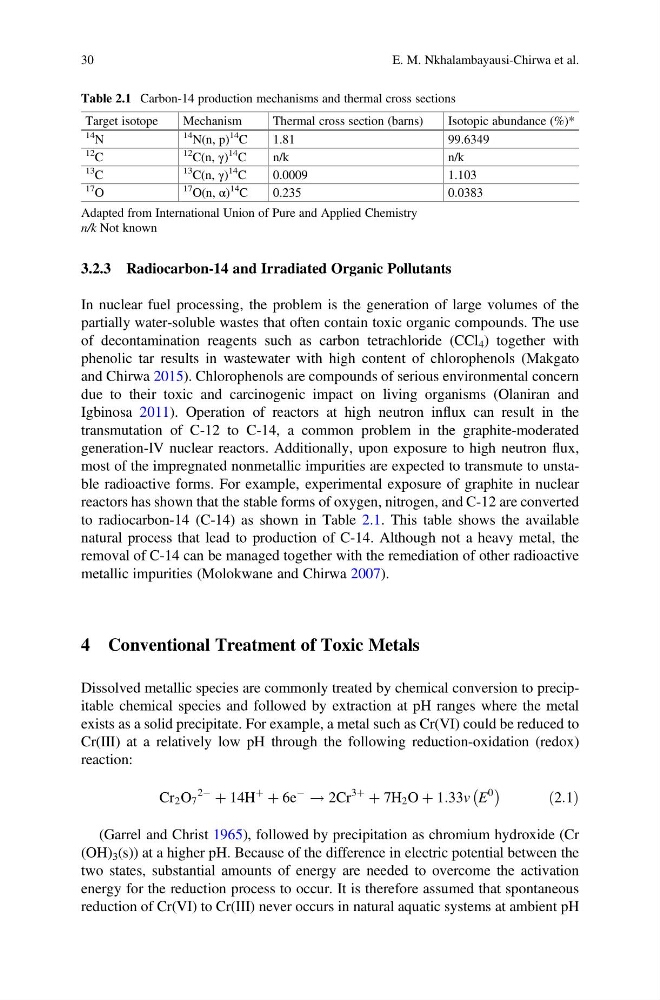
to radiocarbon-14 (C-14) as shown in Table 2.1. This table shows the available
natural process that lead to production of C-14. Although not a heavy metal, the
removal of C-14 can be managed together with the remediation of other radioactive
metallic impurities (Molokwane and Chirwa 2007).
4 Conventional Treatment of Toxic Metals
Dissolved metallic species are commonly treated by chemical conversion to precipitable chemical species and followed by extraction at pH ranges where the metal
exists as a solid precipitate. For example, a metal such as Cr(VI) could be reduced to
Cr(III) at a relatively low pH through the following reduction-oxidation (redox)
reaction:
Cr 2 O 7
2À
þ 14H
þ
þ 6e
À
! 2Cr
3þ
þ 7H 2 O þ 1:33v E
0
À Á
ð2:1Þ
(Garrel and Christ 1965), followed by precipitation as chromium hydroxide (Cr
(OH) 3 (s)) at a higher pH. Because of the difference in electric potential between the
two states, substantial amounts of energy are needed to overcome the activation
energy for the reduction process to occur. It is therefore assumed that spontaneous
reduction of Cr(VI) to Cr(III) never occurs in natural aquatic systems at ambient pH
Table 2.1 Carbon-14 production mechanisms and thermal cross sections
Target isotope
Mechanism
Thermal cross section (barns)
Isotopic abundance (%)*
14
N
14
N(n, p)
14
C
1.81
99.6349
12
C
12
C(n, γ)
14
C
n/k
n/k
13
C
13
C(n, γ)
14
C
0.0009
1.103
17
O
17
O(n, α)
14
C
0.235
0.0383
Adapted from International Union of Pure and Applied Chemistry
n/k Not known
30
E. M. Nkhalambayausi-Chirwa et al.
In nuclear fuel processing, the problem is the generation of large volumes of the
partially water-soluble wastes that often contain toxic organic compounds. The use
of decontamination reagents such as carbon tetrachloride (CCl 4 ) together with
phenolic tar results in wastewater with high content of chlorophenols (Makgato
and Chirwa 2015). Chlorophenols are compounds of serious environmental concern
due to their toxic and carcinogenic impact on living organisms (Olaniran and
Igbinosa 2011). Operation of reactors at high neutron influx can result in the
transmutation of C-12 to C-14, a common problem in the graphite-moderated
generation-IV nuclear reactors. Additionally, upon exposure to high neutron flux,
most of the impregnated nonmetallic impurities are expected to transmute to unstable radioactive forms. For example, experimental exposure of graphite in nuclear
reactors has shown that the stable forms of oxygen, nitrogen, and C-12 are converted
to radiocarbon-14 (C-14) as shown in Table 2.1. This table shows the available
natural process that lead to production of C-14. Although not a heavy metal, the
removal of C-14 can be managed together with the remediation of other radioactive
metallic impurities (Molokwane and Chirwa 2007).
4 Conventional Treatment of Toxic Metals
Dissolved metallic species are commonly treated by chemical conversion to precipitable chemical species and followed by extraction at pH ranges where the metal
exists as a solid precipitate. For example, a metal such as Cr(VI) could be reduced to
Cr(III) at a relatively low pH through the following reduction-oxidation (redox)
reaction:
Cr 2 O 7
2À
þ 14H
þ
þ 6e
À
! 2Cr
3þ
þ 7H 2 O þ 1:33v E
0
À Á
ð2:1Þ
(Garrel and Christ 1965), followed by precipitation as chromium hydroxide (Cr
(OH) 3 (s)) at a higher pH. Because of the difference in electric potential between the
two states, substantial amounts of energy are needed to overcome the activation
energy for the reduction process to occur. It is therefore assumed that spontaneous
reduction of Cr(VI) to Cr(III) never occurs in natural aquatic systems at ambient pH
Table 2.1 Carbon-14 production mechanisms and thermal cross sections
Target isotope
Mechanism
Thermal cross section (barns)
Isotopic abundance (%)*
14
N
14
N(n, p)
14
C
1.81
99.6349
12
C
12
C(n, γ)
14
C
n/k
n/k
13
C
13
C(n, γ)
14
C
0.0009
1.103
17
O
17
O(n, α)
14
C
0.235
0.0383
Adapted from International Union of Pure and Applied Chemistry
n/k Not known
30
E. M. Nkhalambayausi-Chirwa et al.