

3.2.2 Sr-90and Cs-120
The radioactive isotope of strontium (Sr-90) is of great concern, and its toxic effects
on human beings are well documented (Chen 1997; Kossman and Weiss 2000;
Noshchenko et al. 2001; Greve et al. 2007). Strontium can be highly mobile in both
soil and groundwater systems, and it has a half-life of 28 years. Due to its chemical
similarity with calcium, it is easily incorporated into bone material in mammals.
When incorporated in the organisms in this manner, it continues to irradiate localized
tissues with the eventual development of bone sarcoma and leukemia (Chen 1997).
The main disadvantages of using conventional adsorbents, such as zeolites and
synthetic organic ion exchangers, for strontium removal from radioactive waste is
their unsuitability at high pH, high sodium concentrations, and in irradiated environments (Chaalal and Islam 2001). However, the main disadvantages with the
above methods is their unsuitability at high pH, high sodium concentrations, and
in irradiated environments.
Open pit/ underground Mining
Uranium ore
Milling
Uranium Mill
Tailings
Uranium Ore Concentrate (U 3 O 8 )
Conversion to Uranium hexafluoride (UF 6 )
UF 6 Enrichment (eUF 6 )
Fuel fabrication
Interim
storage
Reprocessing
Disposal
Waste Rock
Reactor
Spent Fuel
Uranium
Plutonium
Enriched UO 2 , increase 0.7%U
235 to 3-5% U
235
MOX
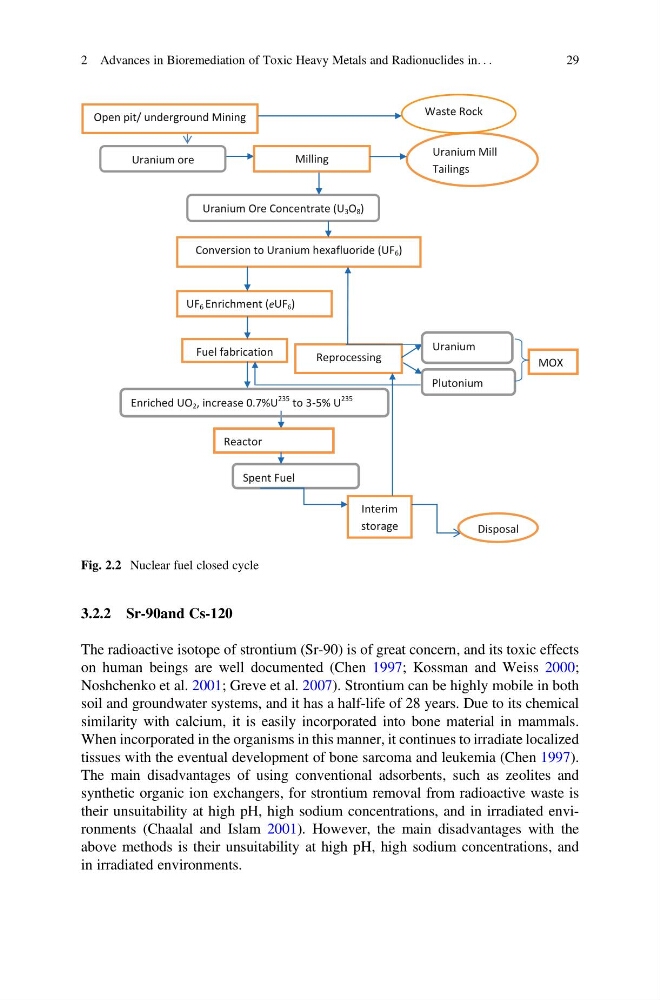
Fig. 2.2 Nuclear fuel closed cycle
2 Advances in Bioremediation of Toxic Heavy Metals and Radionuclides in. . .
29
The radioactive isotope of strontium (Sr-90) is of great concern, and its toxic effects
on human beings are well documented (Chen 1997; Kossman and Weiss 2000;
Noshchenko et al. 2001; Greve et al. 2007). Strontium can be highly mobile in both
soil and groundwater systems, and it has a half-life of 28 years. Due to its chemical
similarity with calcium, it is easily incorporated into bone material in mammals.
When incorporated in the organisms in this manner, it continues to irradiate localized
tissues with the eventual development of bone sarcoma and leukemia (Chen 1997).
The main disadvantages of using conventional adsorbents, such as zeolites and
synthetic organic ion exchangers, for strontium removal from radioactive waste is
their unsuitability at high pH, high sodium concentrations, and in irradiated environments (Chaalal and Islam 2001). However, the main disadvantages with the
above methods is their unsuitability at high pH, high sodium concentrations, and
in irradiated environments.
Open pit/ underground Mining
Uranium ore
Milling
Uranium Mill
Tailings
Uranium Ore Concentrate (U 3 O 8 )
Conversion to Uranium hexafluoride (UF 6 )
UF 6 Enrichment (eUF 6 )
Fuel fabrication
Interim
storage
Reprocessing
Disposal
Waste Rock
Reactor
Spent Fuel
Uranium
Plutonium
Enriched UO 2 , increase 0.7%U
235 to 3-5% U
235
MOX
Fig. 2.2 Nuclear fuel closed cycle
2 Advances in Bioremediation of Toxic Heavy Metals and Radionuclides in. . .
29