

biological systems to remove toxic metals from water, soil, and environmental
systems has been investigated extensively since the late 1980s. Metals can be
removed through reduction to precipitable species and oxidation to precipitable
species or by biosorption taking advantage of the ion-exchanging properties of cell
surfaces of bacteria, fungi, and/or algae. The following are examples of processes
that have been studied extensively by our research group at the University of Pretoria
and our collaborators overseas.
6.1 Biological Reduction, Separation, and Recovery
Any highly oxidized metallic element such as Cr(VI), U(VI), Tc(VII), and Se(VI) can
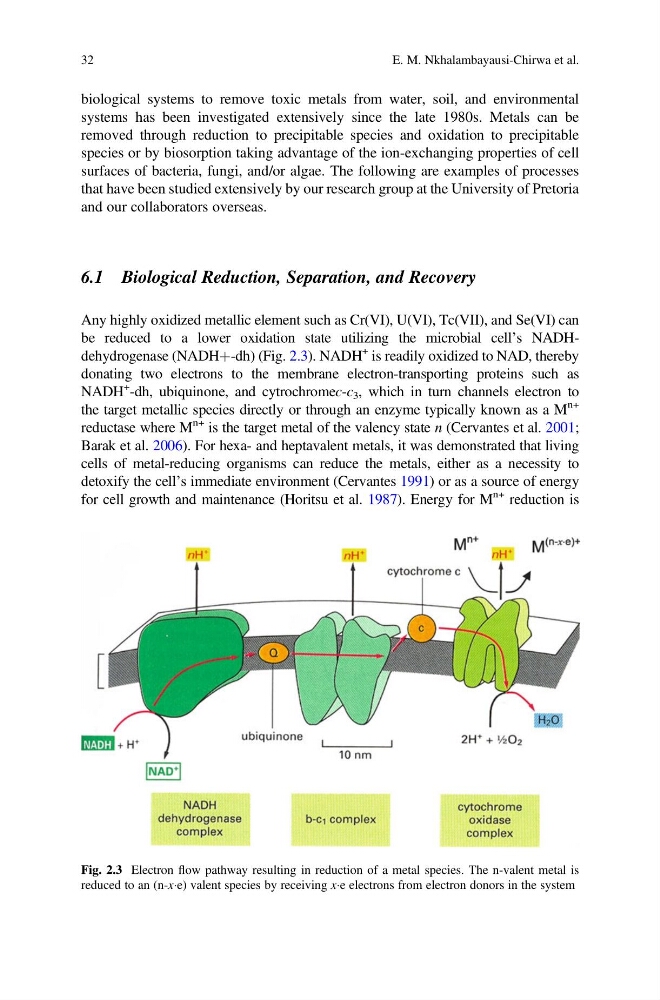
be reduced to a lower oxidation state utilizing the microbial cell’s NADHdehydrogenase (NADHþ-dh) (Fig. 2.3). NADH
+ is readily oxidized to NAD, thereby
donating two electrons to the membrane electron-transporting proteins such as
NADH
+
-dh, ubiquinone, and cytrochromec-c 3 , which in turn channels electron to
the target metallic species directly or through an enzyme typically known as a M
n+
reductase where M
n+ is the target metal of the valency state n (Cervantes et al. 2001;
Barak et al. 2006). For hexa- and heptavalent metals, it was demonstrated that living
cells of metal-reducing organisms can reduce the metals, either as a necessity to
detoxify the cell’s immediate environment (Cervantes 1991) or as a source of energy
for cell growth and maintenance (Horitsu et al. 1987). Energy for M
n+ reduction is
Fig. 2.3 Electron flow pathway resulting in reduction of a metal species. The n-valent metal is
reduced to an (n-xÁe) valent species by receiving xÁe electrons from electron donors in the system
32
E. M. Nkhalambayausi-Chirwa et al.
systems has been investigated extensively since the late 1980s. Metals can be
removed through reduction to precipitable species and oxidation to precipitable
species or by biosorption taking advantage of the ion-exchanging properties of cell
surfaces of bacteria, fungi, and/or algae. The following are examples of processes
that have been studied extensively by our research group at the University of Pretoria
and our collaborators overseas.
6.1 Biological Reduction, Separation, and Recovery
Any highly oxidized metallic element such as Cr(VI), U(VI), Tc(VII), and Se(VI) can
be reduced to a lower oxidation state utilizing the microbial cell’s NADHdehydrogenase (NADHþ-dh) (Fig. 2.3). NADH
+ is readily oxidized to NAD, thereby
donating two electrons to the membrane electron-transporting proteins such as
NADH
+
-dh, ubiquinone, and cytrochromec-c 3 , which in turn channels electron to
the target metallic species directly or through an enzyme typically known as a M
n+
reductase where M
n+ is the target metal of the valency state n (Cervantes et al. 2001;
Barak et al. 2006). For hexa- and heptavalent metals, it was demonstrated that living
cells of metal-reducing organisms can reduce the metals, either as a necessity to
detoxify the cell’s immediate environment (Cervantes 1991) or as a source of energy
for cell growth and maintenance (Horitsu et al. 1987). Energy for M
n+ reduction is
Fig. 2.3 Electron flow pathway resulting in reduction of a metal species. The n-valent metal is
reduced to an (n-xÁe) valent species by receiving xÁe electrons from electron donors in the system
32
E. M. Nkhalambayausi-Chirwa et al.