

with tap water for cyanobacterial growth. This scenario was ascribed mainly due to
its elevated levels of COD, high suspended solids, ammonia, and sulfate concentration, which appeared to be strongly inhibitory (chlorosis and photooxidative death of
the cyanobacterial cells) to the Spirulina growth.
The feasibility of physicochemically pre-treated tannery effluent to support the
growth of microalgae was investigated by Dunn (1997). What resulted here was the
recommendation that the available nutrient content was adequate for microalgae
growth, but the problem increased with higher ammonia concentration (measured as
7.3 times more than the 100 mg/L
À1 toxic level reported for Spirulina). The growth of
Spirulina sp. in pre-treated effluent was less at lower dilutions (5% and 10%), compared to control (defined medium), and higher dilutions (>20%). The photobioreactor
study of Spirulina on the removal of nutrients from tannery effluent, reported the
maximum COD of 91%, nitrates of 97%, and phosphates of 100% with 3% loading
rate. These outcomes are due to higher volumetric loading rates, where the microalgae
were exposed to higher ammonia levels and organic matter when compared to diluted
effluent (Abeliovich 1983). In order to function as a growth medium, the microalgae
growth required a reduction in organic and toxic load from tannery effluent through
aerobic or anaerobic treatment.
It was evident from the large-scale investigation on the high-rate algal pond
(HRAP) integrated with the anaerobic waste stabilization pond. The study unveiled
a maximum organic load (COD) reduction of about 84%, settleable solids of 99%,
and the removal of ammonia, phosphate, and sulfides of about 95%, 99%, and 99%,
62%
87%
73%
81%
36%
73%
0%
10%
20%
30%
40%
50%
60%
70%
80%
90%
100%
TN
TP
BOD
TN
TP
BOD
Chlorella pyrenoidosa in autoclaved textile wastewater (V.V.
Pathak et al. 2014)
Chlorella pyrenoidosa in unautoclaved textile
wastewater (V.V. Pathak et al. 2014)
Treatment efficiency
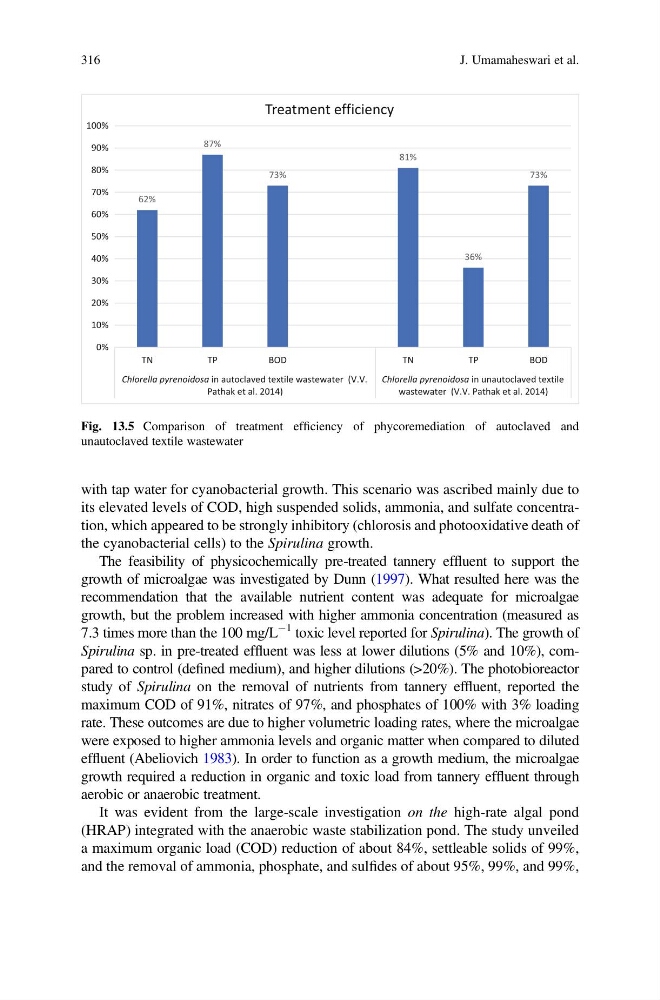
Fig. 13.5 Comparison of treatment efficiency of phycoremediation of autoclaved and
unautoclaved textile wastewater
316
J. Umamaheswari et al.
its elevated levels of COD, high suspended solids, ammonia, and sulfate concentration, which appeared to be strongly inhibitory (chlorosis and photooxidative death of
the cyanobacterial cells) to the Spirulina growth.
The feasibility of physicochemically pre-treated tannery effluent to support the
growth of microalgae was investigated by Dunn (1997). What resulted here was the
recommendation that the available nutrient content was adequate for microalgae
growth, but the problem increased with higher ammonia concentration (measured as
7.3 times more than the 100 mg/L
À1 toxic level reported for Spirulina). The growth of
Spirulina sp. in pre-treated effluent was less at lower dilutions (5% and 10%), compared to control (defined medium), and higher dilutions (>20%). The photobioreactor
study of Spirulina on the removal of nutrients from tannery effluent, reported the
maximum COD of 91%, nitrates of 97%, and phosphates of 100% with 3% loading
rate. These outcomes are due to higher volumetric loading rates, where the microalgae
were exposed to higher ammonia levels and organic matter when compared to diluted
effluent (Abeliovich 1983). In order to function as a growth medium, the microalgae
growth required a reduction in organic and toxic load from tannery effluent through
aerobic or anaerobic treatment.
It was evident from the large-scale investigation on the high-rate algal pond
(HRAP) integrated with the anaerobic waste stabilization pond. The study unveiled
a maximum organic load (COD) reduction of about 84%, settleable solids of 99%,
and the removal of ammonia, phosphate, and sulfides of about 95%, 99%, and 99%,
62%
87%
73%
81%
36%
73%
0%
10%
20%
30%
40%
50%
60%
70%
80%
90%
100%
TN
TP
BOD
TN
TP
BOD
Chlorella pyrenoidosa in autoclaved textile wastewater (V.V.
Pathak et al. 2014)
Chlorella pyrenoidosa in unautoclaved textile
wastewater (V.V. Pathak et al. 2014)
Treatment efficiency
Fig. 13.5 Comparison of treatment efficiency of phycoremediation of autoclaved and
unautoclaved textile wastewater
316
J. Umamaheswari et al.