

neurotoxin that affects the brain, liver, CNS, and kidneys and leads to developmental
disorders in children. Minamata disease, sometimes referred to as Chisso-Minamata
disease, is a neurological disorder caused by severe mercury poisoning, with symptoms including ataxia, hands and feet numbness, muscle weakness, and damage to
vision, hearing, and speech leading to paralysis, coma, and finally death.
3.4 Arsenic
Arsenic is naturally present in groundwater that has threatened its use as major
source of potable water (Bhutta et al. 2002; Harvey et al. 2002; Smedley and
Kinniburgh 2002; USEPA 2003; Mroczek 2005; Mohan et al. 2007). The major
sources are anthropogenic, biological, and geochemical reactions that mobilize
arsenic to groundwaters. Arsenic can exist in _3, 0, +3, and +5 oxidation states
(Smedley and Kinniburgh 2002). It is a hard acid and generally forms complex with
oxides and nitrogen, while the environmental forms comprise of arsenious acids,
arsenate, arsenic acids, etc. with major form as arsenite (AsO33_)/arsenic (III) and
arsenate (AsO43_)/arsenic (V) in water. It is highly toxic and is considered global
health problem as it affects millions of people. Arsenic contamination of groundwater and soil is a resultant of mining, milling, smelting of copper, lead ores, coal,
and pesticides (Adriano 2001; Ng et al. 2003). The only method to identify arsenic in
soils and other media in routine is its extraction by hot acid. Arsenic in water can
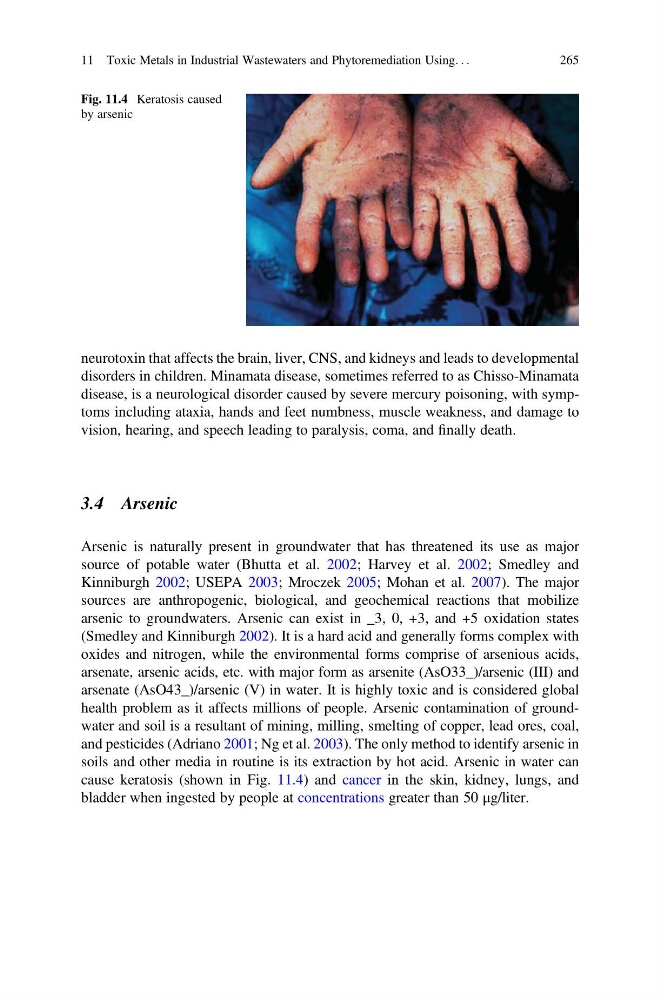
cause keratosis (shown in Fig. 11.4) and cancer in the skin, kidney, lungs, and
bladder when ingested by people at concentrations greater than 50 μg/liter.
Fig. 11.4 Keratosis caused
by arsenic
11 Toxic Metals in Industrial Wastewaters and Phytoremediation Using. . .
265
disorders in children. Minamata disease, sometimes referred to as Chisso-Minamata
disease, is a neurological disorder caused by severe mercury poisoning, with symptoms including ataxia, hands and feet numbness, muscle weakness, and damage to
vision, hearing, and speech leading to paralysis, coma, and finally death.
3.4 Arsenic
Arsenic is naturally present in groundwater that has threatened its use as major
source of potable water (Bhutta et al. 2002; Harvey et al. 2002; Smedley and
Kinniburgh 2002; USEPA 2003; Mroczek 2005; Mohan et al. 2007). The major
sources are anthropogenic, biological, and geochemical reactions that mobilize
arsenic to groundwaters. Arsenic can exist in _3, 0, +3, and +5 oxidation states
(Smedley and Kinniburgh 2002). It is a hard acid and generally forms complex with
oxides and nitrogen, while the environmental forms comprise of arsenious acids,
arsenate, arsenic acids, etc. with major form as arsenite (AsO33_)/arsenic (III) and
arsenate (AsO43_)/arsenic (V) in water. It is highly toxic and is considered global
health problem as it affects millions of people. Arsenic contamination of groundwater and soil is a resultant of mining, milling, smelting of copper, lead ores, coal,
and pesticides (Adriano 2001; Ng et al. 2003). The only method to identify arsenic in
soils and other media in routine is its extraction by hot acid. Arsenic in water can
cause keratosis (shown in Fig. 11.4) and cancer in the skin, kidney, lungs, and
bladder when ingested by people at concentrations greater than 50 μg/liter.
Fig. 11.4 Keratosis caused
by arsenic
11 Toxic Metals in Industrial Wastewaters and Phytoremediation Using. . .
265