

3.5 Chromium
Chromium (Cr) is a hard, steel gray-colored and bright transition metal. It derives its
name from Greek word “chroma” meaning color as its compounds exist in different
color. This metal is extracted as chromite ore from the mines. It exist in various
oxidative states like +1, +2, +3, +4, +5, +6, +2, +3, and +6 being most common. It is
majorly used in stainless steel alloys, chrome plating, and metal ceramics. The
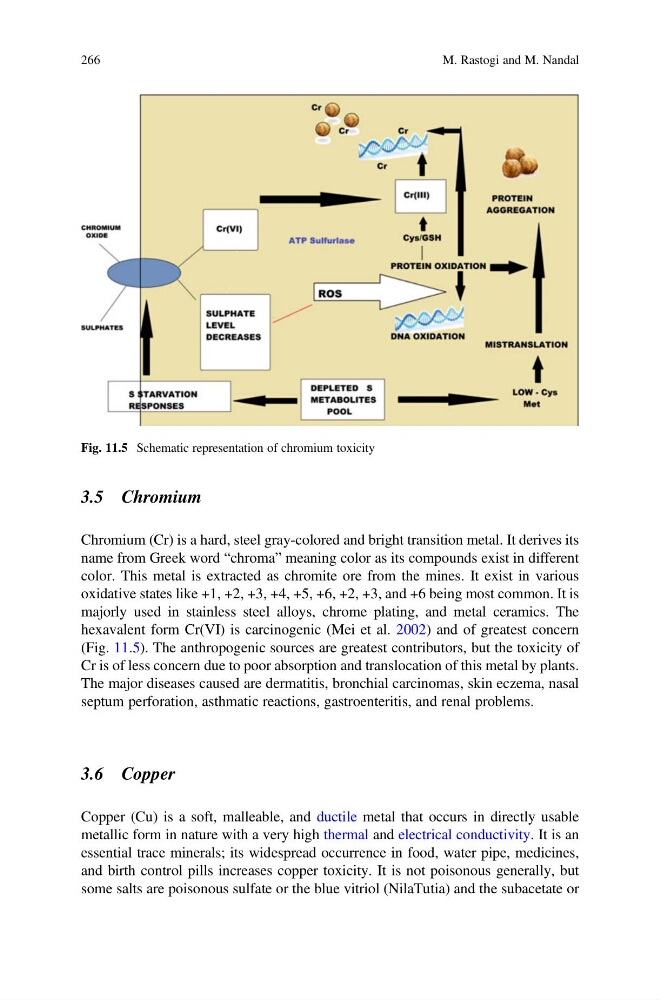
hexavalent form Cr(VI) is carcinogenic (Mei et al. 2002) and of greatest concern
(Fig. 11.5). The anthropogenic sources are greatest contributors, but the toxicity of
Cr is of less concern due to poor absorption and translocation of this metal by plants.
The major diseases caused are dermatitis, bronchial carcinomas, skin eczema, nasal
septum perforation, asthmatic reactions, gastroenteritis, and renal problems.
3.6 Copper
Copper (Cu) is a soft, malleable, and ductile metal that occurs in directly usable
metallic form in nature with a very high thermal and electrical conductivity. It is an
essential trace minerals; its widespread occurrence in food, water pipe, medicines,
and birth control pills increases copper toxicity. It is not poisonous generally, but
some salts are poisonous sulfate or the blue vitriol (NilaTutia) and the subacetate or
Fig. 11.5 Schematic representation of chromium toxicity
266
M. Rastogi and M. Nandal
Chromium (Cr) is a hard, steel gray-colored and bright transition metal. It derives its
name from Greek word “chroma” meaning color as its compounds exist in different
color. This metal is extracted as chromite ore from the mines. It exist in various
oxidative states like +1, +2, +3, +4, +5, +6, +2, +3, and +6 being most common. It is
majorly used in stainless steel alloys, chrome plating, and metal ceramics. The
hexavalent form Cr(VI) is carcinogenic (Mei et al. 2002) and of greatest concern
(Fig. 11.5). The anthropogenic sources are greatest contributors, but the toxicity of
Cr is of less concern due to poor absorption and translocation of this metal by plants.
The major diseases caused are dermatitis, bronchial carcinomas, skin eczema, nasal
septum perforation, asthmatic reactions, gastroenteritis, and renal problems.
3.6 Copper
Copper (Cu) is a soft, malleable, and ductile metal that occurs in directly usable
metallic form in nature with a very high thermal and electrical conductivity. It is an
essential trace minerals; its widespread occurrence in food, water pipe, medicines,
and birth control pills increases copper toxicity. It is not poisonous generally, but
some salts are poisonous sulfate or the blue vitriol (NilaTutia) and the subacetate or
Fig. 11.5 Schematic representation of chromium toxicity
266
M. Rastogi and M. Nandal