

3.2 Cadmium
Cadmium (Cd) is a silvery-white soft metal with high melting (320.9) and boiling
point (765 C), respectively. This heavy metal is rapidly oxidized to cadmium oxide,
and so is of great concern being highly toxic to animals and humans. Its natural
occurrence is in association with zinc, copper, or lead in sulfide form (Cameron
1992) and is found in argillaceous and shale deposits such as green rocks (CdS) or
otavite (CdCO3). The natural sources of Cadmium are volcanoes and anthropogenic
being industrial sector, steel plating, nickel-cadmium batteries (Fassett 1980) polyvinyl chloride plastic (PVC) manufacture, motor oils solders, textile manufacturing,
electroplating, fungicides, enamels, rubber, sewage, and phosphate fertilizers
(Bagshaw et al. 1986) causing severe environmental problems. It has carcinogenic,
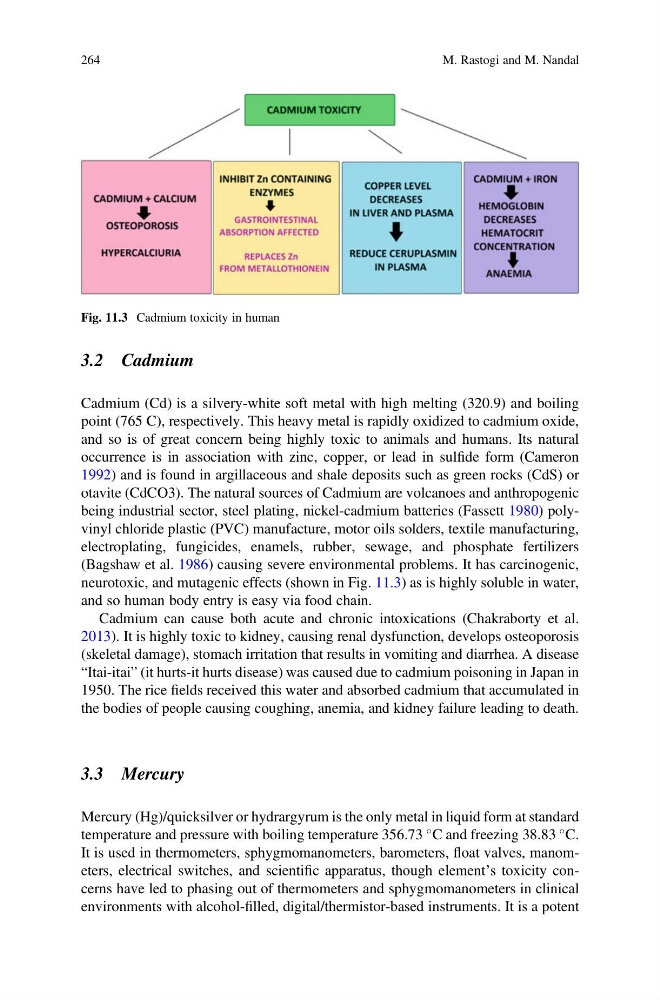
neurotoxic, and mutagenic effects (shown in Fig. 11.3) as is highly soluble in water,
and so human body entry is easy via food chain.
Cadmium can cause both acute and chronic intoxications (Chakraborty et al.
2013). It is highly toxic to kidney, causing renal dysfunction, develops osteoporosis
(skeletal damage), stomach irritation that results in vomiting and diarrhea. A disease
“Itai-itai” (it hurts-it hurts disease) was caused due to cadmium poisoning in Japan in
1950. The rice fields received this water and absorbed cadmium that accumulated in
the bodies of people causing coughing, anemia, and kidney failure leading to death.
3.3 Mercury
Mercury (Hg)/quicksilver or hydrargyrum is the only metal in liquid form at standard
temperature and pressure with boiling temperature 356.73
C and freezing 38.83
C.
It is used in thermometers, sphygmomanometers, barometers, float valves, manometers, electrical switches, and scientific apparatus, though element’s toxicity concerns have led to phasing out of thermometers and sphygmomanometers in clinical
environments with alcohol-filled, digital/thermistor-based instruments. It is a potent
Fig. 11.3 Cadmium toxicity in human
264
M. Rastogi and M. Nandal
Cadmium (Cd) is a silvery-white soft metal with high melting (320.9) and boiling
point (765 C), respectively. This heavy metal is rapidly oxidized to cadmium oxide,
and so is of great concern being highly toxic to animals and humans. Its natural
occurrence is in association with zinc, copper, or lead in sulfide form (Cameron
1992) and is found in argillaceous and shale deposits such as green rocks (CdS) or
otavite (CdCO3). The natural sources of Cadmium are volcanoes and anthropogenic
being industrial sector, steel plating, nickel-cadmium batteries (Fassett 1980) polyvinyl chloride plastic (PVC) manufacture, motor oils solders, textile manufacturing,
electroplating, fungicides, enamels, rubber, sewage, and phosphate fertilizers
(Bagshaw et al. 1986) causing severe environmental problems. It has carcinogenic,
neurotoxic, and mutagenic effects (shown in Fig. 11.3) as is highly soluble in water,
and so human body entry is easy via food chain.
Cadmium can cause both acute and chronic intoxications (Chakraborty et al.
2013). It is highly toxic to kidney, causing renal dysfunction, develops osteoporosis
(skeletal damage), stomach irritation that results in vomiting and diarrhea. A disease
“Itai-itai” (it hurts-it hurts disease) was caused due to cadmium poisoning in Japan in
1950. The rice fields received this water and absorbed cadmium that accumulated in
the bodies of people causing coughing, anemia, and kidney failure leading to death.
3.3 Mercury
Mercury (Hg)/quicksilver or hydrargyrum is the only metal in liquid form at standard
temperature and pressure with boiling temperature 356.73
C and freezing 38.83
C.
It is used in thermometers, sphygmomanometers, barometers, float valves, manometers, electrical switches, and scientific apparatus, though element’s toxicity concerns have led to phasing out of thermometers and sphygmomanometers in clinical
environments with alcohol-filled, digital/thermistor-based instruments. It is a potent
Fig. 11.3 Cadmium toxicity in human
264
M. Rastogi and M. Nandal