

3.1 Lead
Lead (Pb) is a soft, malleable, bluish-white metal tarnished to dull gray upon
exposure to air usually found in the +2 oxidation state. Lead is a toxic metal mainly
emitted from industrial sources, leaded aviation gasoline, and plumbing materials
causing health effects like behavioral problems, learning disabilities, seizures, and
death. Lead is widely used in the industries manufacturing batteries, metal products
(solder and pipes), ammunition, and X-ray shielding devices. The most common
source of lead exposure in humans is ingestion of food, drinking water, soil/dust, or
lead-based paint. It damages the nervous connections (especially in young children)
and can cause nephropathy and colic-like abdominal pains causing blood and brain
disorders in adults or children ultimately causing death, miscarriages in women, and
fertility reduction in males (Golub 2005). Chronic exposure to lead can result in
dyslexia, mental retardation, muscular weakness, birth defects, paralysis psychosis,
autism, allergies, weight loss, hyperactivity, brain damage, and kidney damage and
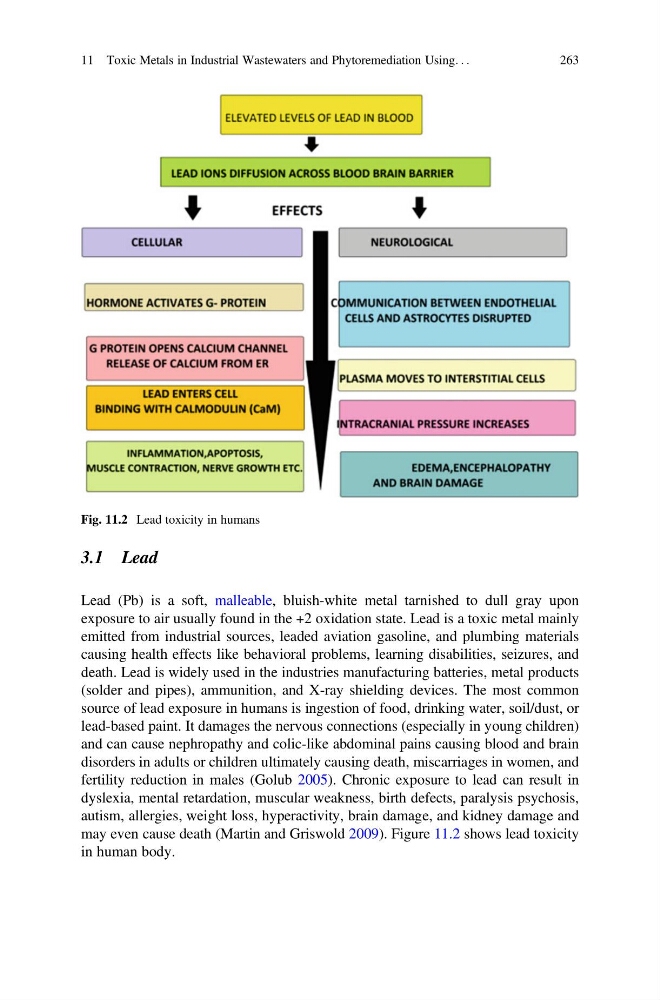
may even cause death (Martin and Griswold 2009). Figure 11.2 shows lead toxicity
in human body.
Fig. 11.2 Lead toxicity in humans
11 Toxic Metals in Industrial Wastewaters and Phytoremediation Using. . .
263
Lead (Pb) is a soft, malleable, bluish-white metal tarnished to dull gray upon
exposure to air usually found in the +2 oxidation state. Lead is a toxic metal mainly
emitted from industrial sources, leaded aviation gasoline, and plumbing materials
causing health effects like behavioral problems, learning disabilities, seizures, and
death. Lead is widely used in the industries manufacturing batteries, metal products
(solder and pipes), ammunition, and X-ray shielding devices. The most common
source of lead exposure in humans is ingestion of food, drinking water, soil/dust, or
lead-based paint. It damages the nervous connections (especially in young children)
and can cause nephropathy and colic-like abdominal pains causing blood and brain
disorders in adults or children ultimately causing death, miscarriages in women, and
fertility reduction in males (Golub 2005). Chronic exposure to lead can result in
dyslexia, mental retardation, muscular weakness, birth defects, paralysis psychosis,
autism, allergies, weight loss, hyperactivity, brain damage, and kidney damage and
may even cause death (Martin and Griswold 2009). Figure 11.2 shows lead toxicity
in human body.
Fig. 11.2 Lead toxicity in humans
11 Toxic Metals in Industrial Wastewaters and Phytoremediation Using. . .
263