

flow may be interrupted in long term experiments and the efficiency of removal may
be reduced. The selection of the microorganism is an important parameter because
the electro-bioremediation process is mainly associated with the bioavailability of
hydrophobic/hydrophilic contaminants or the lack of nutrients. The treatment of
high-saline soil contains chloride ions which are converted into chlorine gas and/or
hypochlorite in the bio-EK process. The formation of hypochlorite and chlorine gas
may affect bacterial mobility and sometimes inhibits bacterial growth. Hence,
anolyte selection should be done with low chloride. Based on the literature, more
data are available from bench-scale studies; few reports demonstrate the field setup
(Table 8.3).
6 Conclusions and Future Perspectives
Soil contamination is one of the most prominent fields in the treatment of polluted
lands, and EK is a unique technology which can operate in low-permeability soils.
EK is a promising technology for the in situ/ex situ treatment of inorganic and
organic dye pollutants in agricultural soil. South Korean researchers predominantly
use the EK process in the effective removal of salinity from agricultural soil.
Mass transfer by electromigration is vital in the removal of metal ions and salts
present in the contaminated soil where electro-osmosis is the main agent of removal
of these non-ionic pollutants. The EK process can effectively reduce the salinity and
conductivity of the soil, which correlates well with the agricultural norms. Hydrophobic/nonpolar organic compounds are difficult to remove by the EK process alone
because these are not ionized by electrolytes or the processing solution. Therefore,
two different biological and EK processes are tailored to accelerate the bioremediation process and the simultaneous removal/degradation of inorganic salts, metal
ions, and polar/nonpolar organics.
The integrated bio-EK process has been successful in laboratory-scale experiments whereas its field application is still in a developing stage. Thus, the bio-EK
process has some research gaps for future improvement, mainly field-scale implementation. The performance of bio-EK remediation may be improved by the evaluation of ecological parameters, viz., types of pollutants, pH, applied voltage
gradient, water content, selection of suitable electrodes, optimized cell design, and
electrode arrangement, which can be made eco-friendly and cost-effective.
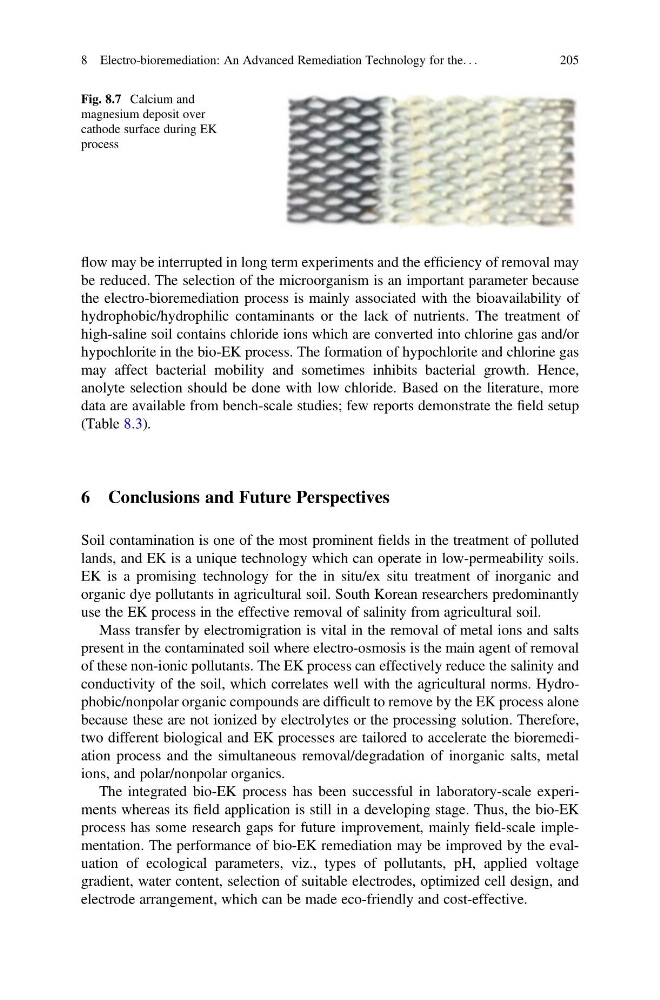
Fig. 8.7 Calcium and
magnesium deposit over
cathode surface during EK
process
8 Electro-bioremediation: An Advanced Remediation Technology for the. . .
205
be reduced. The selection of the microorganism is an important parameter because
the electro-bioremediation process is mainly associated with the bioavailability of
hydrophobic/hydrophilic contaminants or the lack of nutrients. The treatment of
high-saline soil contains chloride ions which are converted into chlorine gas and/or
hypochlorite in the bio-EK process. The formation of hypochlorite and chlorine gas
may affect bacterial mobility and sometimes inhibits bacterial growth. Hence,
anolyte selection should be done with low chloride. Based on the literature, more
data are available from bench-scale studies; few reports demonstrate the field setup
(Table 8.3).
6 Conclusions and Future Perspectives
Soil contamination is one of the most prominent fields in the treatment of polluted
lands, and EK is a unique technology which can operate in low-permeability soils.
EK is a promising technology for the in situ/ex situ treatment of inorganic and
organic dye pollutants in agricultural soil. South Korean researchers predominantly
use the EK process in the effective removal of salinity from agricultural soil.
Mass transfer by electromigration is vital in the removal of metal ions and salts
present in the contaminated soil where electro-osmosis is the main agent of removal
of these non-ionic pollutants. The EK process can effectively reduce the salinity and
conductivity of the soil, which correlates well with the agricultural norms. Hydrophobic/nonpolar organic compounds are difficult to remove by the EK process alone
because these are not ionized by electrolytes or the processing solution. Therefore,
two different biological and EK processes are tailored to accelerate the bioremediation process and the simultaneous removal/degradation of inorganic salts, metal
ions, and polar/nonpolar organics.
The integrated bio-EK process has been successful in laboratory-scale experiments whereas its field application is still in a developing stage. Thus, the bio-EK
process has some research gaps for future improvement, mainly field-scale implementation. The performance of bio-EK remediation may be improved by the evaluation of ecological parameters, viz., types of pollutants, pH, applied voltage
gradient, water content, selection of suitable electrodes, optimized cell design, and
electrode arrangement, which can be made eco-friendly and cost-effective.
Fig. 8.7 Calcium and
magnesium deposit over
cathode surface during EK
process
8 Electro-bioremediation: An Advanced Remediation Technology for the. . .
205