

phosphate-containing soil/water with such techniques as physical, chemical, and
biological methods, chemical methods are the most effective and best established
methods to date (Boisvert et al. 1997; Fytianos et al. 1998; Yeoman et al. 1988).
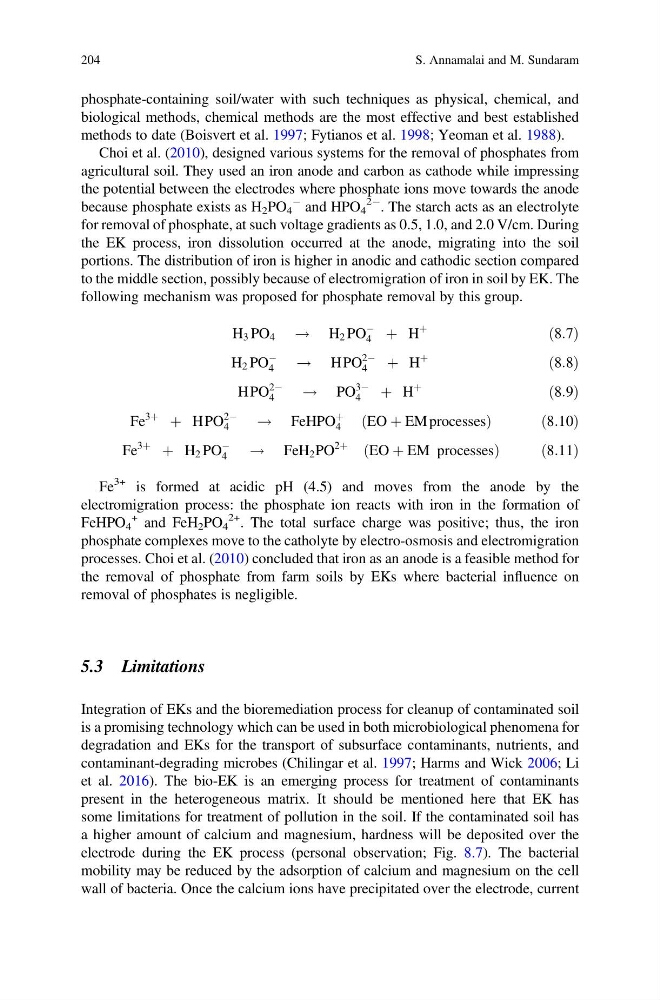
Choi et al. (2010), designed various systems for the removal of phosphates from
agricultural soil. They used an iron anode and carbon as cathode while impressing
the potential between the electrodes where phosphate ions move towards the anode
because phosphate exists as H 2 PO 4
À and HPO 4
2À
. The starch acts as an electrolyte
for removal of phosphate, at such voltage gradients as 0.5, 1.0, and 2.0 V/cm. During
the EK process, iron dissolution occurred at the anode, migrating into the soil
portions. The distribution of iron is higher in anodic and cathodic section compared
to the middle section, possibly because of electromigration of iron in soil by EK. The
following mechanism was proposed for phosphate removal by this group.
H 3 PO 4 ! H 2 PO
À
4 þ H
þ
ð8:7Þ
H 2 PO
À
4
! HPO
2À
4
þ H
þ
ð8:8Þ
HPO
2À
4
! PO
3À
4
þ H
þ
ð8:9Þ
Fe
3þ
þ HPO
2À
4
! FeHPO
þ
4
EO þ EM processes
ð
Þ
ð 8:10Þ
Fe
3þ
þ H 2 PO
À
4
! FeH 2 PO
2þ
EO þ EM processes
ð
Þ
ð 8:11Þ
Fe
3+ is formed at acidic pH (4.5) and moves from the anode by the
electromigration process: the phosphate ion reacts with iron in the formation of
FeHPO 4
+ and FeH 2 PO 4
2+ . The total surface charge was positive; thus, the iron
phosphate complexes move to the catholyte by electro-osmosis and electromigration
processes. Choi et al. (2010) concluded that iron as an anode is a feasible method for
the removal of phosphate from farm soils by EKs where bacterial influence on
removal of phosphates is negligible.
5.3 Limitations
Integration of EKs and the bioremediation process for cleanup of contaminated soil
is a promising technology which can be used in both microbiological phenomena for
degradation and EKs for the transport of subsurface contaminants, nutrients, and
contaminant-degrading microbes (Chilingar et al. 1997; Harms and Wick 2006; Li
et al. 2016). The bio-EK is an emerging process for treatment of contaminants
present in the heterogeneous matrix. It should be mentioned here that EK has
some limitations for treatment of pollution in the soil. If the contaminated soil has
a higher amount of calcium and magnesium, hardness will be deposited over the
electrode during the EK process (personal observation; Fig. 8.7). The bacterial
mobility may be reduced by the adsorption of calcium and magnesium on the cell
wall of bacteria. Once the calcium ions have precipitated over the electrode, current
204
S. Annamalai and M. Sundaram
biological methods, chemical methods are the most effective and best established
methods to date (Boisvert et al. 1997; Fytianos et al. 1998; Yeoman et al. 1988).
Choi et al. (2010), designed various systems for the removal of phosphates from
agricultural soil. They used an iron anode and carbon as cathode while impressing
the potential between the electrodes where phosphate ions move towards the anode
because phosphate exists as H 2 PO 4
À and HPO 4
2À
. The starch acts as an electrolyte
for removal of phosphate, at such voltage gradients as 0.5, 1.0, and 2.0 V/cm. During
the EK process, iron dissolution occurred at the anode, migrating into the soil
portions. The distribution of iron is higher in anodic and cathodic section compared
to the middle section, possibly because of electromigration of iron in soil by EK. The
following mechanism was proposed for phosphate removal by this group.
H 3 PO 4 ! H 2 PO
À
4 þ H
þ
ð8:7Þ
H 2 PO
À
4
! HPO
2À
4
þ H
þ
ð8:8Þ
HPO
2À
4
! PO
3À
4
þ H
þ
ð8:9Þ
Fe
3þ
þ HPO
2À
4
! FeHPO
þ
4
EO þ EM processes
ð
Þ
ð 8:10Þ
Fe
3þ
þ H 2 PO
À
4
! FeH 2 PO
2þ
EO þ EM processes
ð
Þ
ð 8:11Þ
Fe
3+ is formed at acidic pH (4.5) and moves from the anode by the
electromigration process: the phosphate ion reacts with iron in the formation of
FeHPO 4
+ and FeH 2 PO 4
2+ . The total surface charge was positive; thus, the iron
phosphate complexes move to the catholyte by electro-osmosis and electromigration
processes. Choi et al. (2010) concluded that iron as an anode is a feasible method for
the removal of phosphate from farm soils by EKs where bacterial influence on
removal of phosphates is negligible.
5.3 Limitations
Integration of EKs and the bioremediation process for cleanup of contaminated soil
is a promising technology which can be used in both microbiological phenomena for
degradation and EKs for the transport of subsurface contaminants, nutrients, and
contaminant-degrading microbes (Chilingar et al. 1997; Harms and Wick 2006; Li
et al. 2016). The bio-EK is an emerging process for treatment of contaminants
present in the heterogeneous matrix. It should be mentioned here that EK has
some limitations for treatment of pollution in the soil. If the contaminated soil has
a higher amount of calcium and magnesium, hardness will be deposited over the
electrode during the EK process (personal observation; Fig. 8.7). The bacterial
mobility may be reduced by the adsorption of calcium and magnesium on the cell
wall of bacteria. Once the calcium ions have precipitated over the electrode, current
204
S. Annamalai and M. Sundaram