

The excess nitrates are hazardous to human health (Choi et al. 2009). Many research
groups are concentrating on nitrate removal by such methods as biological techniques using denitrification and nitrification processes (Fierro et al. 2008; Okeke
et al. 2002; Rajakumar et al. 2008; Schipper and Vojvodić-Vuković 2001), hydraulic
gradients (Manokararajah and Ranjan 2005), chemical methods (Ahn et al. 2008; Su
and Puls 2004), EKs (Ottosen and Rörig-Dalgård 2007; Sahli et al. 2008; Yang et al.
2008), and biofilm reactors (Park et al. 2006). Nitrate is removed from the soil
mainly by EK processes: electromigration, electro-osmosis, and electrophoresis.
Cairo et al. (1996) demonstrated that the nitrate moves as much as 3 m in the soil
at different concentration. Kim et al. (2005) also observed dominant strains of
heterotrophic Bacillus in Korean soil, where this biological process can remove
nitrogen and phosphorus as well as organic matter efficiently (Choi et al. 2002). The
relationship between pH and the efficiency of nitrate reduction in the electrobioremediation systems with an iron electrode was evaluated by Choi and his
research group (Choi et al. 2009) in South Korean soil. They tested three types of
processes used to remove nitrates from contaminated soil: the EK process, the
bio-electrokinetic (bio-EK) process, and a biological process. Choi et al. (2009)
identified 21 strains (Bacillus spp.) from a Jinju-vinyl house used as nitrate reducers
in the EK process. Rajakumar et al. (2008) investigated various types of organic
sources, such as glucose, starch, cellulose, sucrose, and acetic acid, for removal of
nitrate by aerobic Pseudomonas sp. and Bacillus sp. in laboratory experiments, and
they suggested that starch was the best organic source in nitrate reduction. Choi et al.
(2009) postulated, however, that the supply of rich H
+ ion by electro-osmosis from
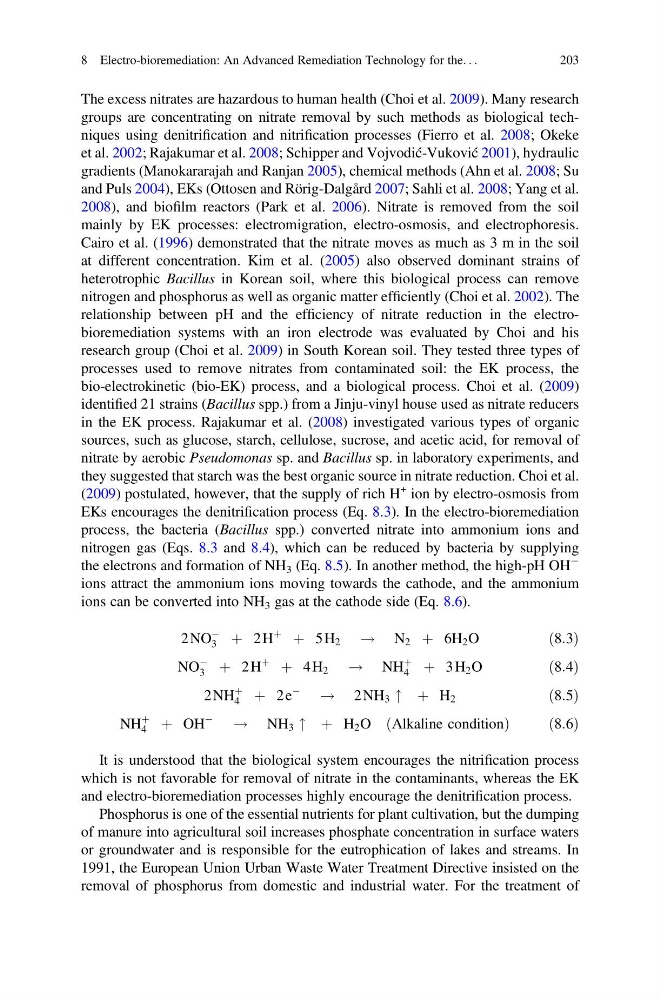
EKs encourages the denitrification process (Eq. 8.3). In the electro-bioremediation
process, the bacteria (Bacillus spp.) converted nitrate into ammonium ions and
nitrogen gas (Eqs. 8.3 and 8.4), which can be reduced by bacteria by supplying
the electrons and formation of NH 3 (Eq. 8.5). In another method, the high-pH OH
À
ions attract the ammonium ions moving towards the cathode, and the ammonium
ions can be converted into NH 3 gas at the cathode side (Eq. 8.6).
2NO
À
3 þ 2H
þ
þ 5H 2 ! N 2 þ 6H 2 O
ð8:3Þ
NO
À
3 þ 2H
þ
þ 4H 2 ! NH
þ
4 þ 3H 2 O
ð8:4Þ
2NH
þ
4 þ 2e
À
! 2NH 3 " þ H 2
ð8:5Þ
NH
þ
4 þ OH
À
! NH 3 " þ H 2 O Alkaline condition
ð
Þ
ð 8:6Þ
It is understood that the biological system encourages the nitrification process
which is not favorable for removal of nitrate in the contaminants, whereas the EK
and electro-bioremediation processes highly encourage the denitrification process.
Phosphorus is one of the essential nutrients for plant cultivation, but the dumping
of manure into agricultural soil increases phosphate concentration in surface waters
or groundwater and is responsible for the eutrophication of lakes and streams. In
1991, the European Union Urban Waste Water Treatment Directive insisted on the
removal of phosphorus from domestic and industrial water. For the treatment of
8 Electro-bioremediation: An Advanced Remediation Technology for the. . .
203
groups are concentrating on nitrate removal by such methods as biological techniques using denitrification and nitrification processes (Fierro et al. 2008; Okeke
et al. 2002; Rajakumar et al. 2008; Schipper and Vojvodić-Vuković 2001), hydraulic
gradients (Manokararajah and Ranjan 2005), chemical methods (Ahn et al. 2008; Su
and Puls 2004), EKs (Ottosen and Rörig-Dalgård 2007; Sahli et al. 2008; Yang et al.
2008), and biofilm reactors (Park et al. 2006). Nitrate is removed from the soil
mainly by EK processes: electromigration, electro-osmosis, and electrophoresis.
Cairo et al. (1996) demonstrated that the nitrate moves as much as 3 m in the soil
at different concentration. Kim et al. (2005) also observed dominant strains of
heterotrophic Bacillus in Korean soil, where this biological process can remove
nitrogen and phosphorus as well as organic matter efficiently (Choi et al. 2002). The
relationship between pH and the efficiency of nitrate reduction in the electrobioremediation systems with an iron electrode was evaluated by Choi and his
research group (Choi et al. 2009) in South Korean soil. They tested three types of
processes used to remove nitrates from contaminated soil: the EK process, the
bio-electrokinetic (bio-EK) process, and a biological process. Choi et al. (2009)
identified 21 strains (Bacillus spp.) from a Jinju-vinyl house used as nitrate reducers
in the EK process. Rajakumar et al. (2008) investigated various types of organic
sources, such as glucose, starch, cellulose, sucrose, and acetic acid, for removal of
nitrate by aerobic Pseudomonas sp. and Bacillus sp. in laboratory experiments, and
they suggested that starch was the best organic source in nitrate reduction. Choi et al.
(2009) postulated, however, that the supply of rich H
+ ion by electro-osmosis from
EKs encourages the denitrification process (Eq. 8.3). In the electro-bioremediation
process, the bacteria (Bacillus spp.) converted nitrate into ammonium ions and
nitrogen gas (Eqs. 8.3 and 8.4), which can be reduced by bacteria by supplying
the electrons and formation of NH 3 (Eq. 8.5). In another method, the high-pH OH
À
ions attract the ammonium ions moving towards the cathode, and the ammonium
ions can be converted into NH 3 gas at the cathode side (Eq. 8.6).
2NO
À
3 þ 2H
þ
þ 5H 2 ! N 2 þ 6H 2 O
ð8:3Þ
NO
À
3 þ 2H
þ
þ 4H 2 ! NH
þ
4 þ 3H 2 O
ð8:4Þ
2NH
þ
4 þ 2e
À
! 2NH 3 " þ H 2
ð8:5Þ
NH
þ
4 þ OH
À
! NH 3 " þ H 2 O Alkaline condition
ð
Þ
ð 8:6Þ
It is understood that the biological system encourages the nitrification process
which is not favorable for removal of nitrate in the contaminants, whereas the EK
and electro-bioremediation processes highly encourage the denitrification process.
Phosphorus is one of the essential nutrients for plant cultivation, but the dumping
of manure into agricultural soil increases phosphate concentration in surface waters
or groundwater and is responsible for the eutrophication of lakes and streams. In
1991, the European Union Urban Waste Water Treatment Directive insisted on the
removal of phosphorus from domestic and industrial water. For the treatment of
8 Electro-bioremediation: An Advanced Remediation Technology for the. . .
203