

transported in the opposite direction (Harms and Wick 2006). However, this transport mechanism is negligible in most soils (Harms and Wick 2006). Acar et al.
(1993) reported that electromigration velocity dominated over electro-osmosis
velocity in the heterogeneous matrix. Furthermore, they stated that the electroosmosis process affords an efficient removal of cationic contaminants as compared
to the anionic pollutants in the soil, whereas the electromigration process effectively
removesboth cationic and anionic pollutants from contaminated soil. Electroosmosis and electromigration are vital for removal of cationic contaminants in the
soil, and Acar et al. also claimed that the effect of the electromigration process may
be greater than that of the electro-osmosis process.
During these transport processes, many other side reactions may occur in a DC EK
that reduce the efficacy of the process, such as gaseous bubble generation at the anodic
(O 2 gas) and cathodic (H 2 gas) chamber, which covers the electrodes by electrolysis of
water (Virkutyte et al. 2002). These gas bubbles decreased conductivity and subsequently reduced the current. If a higher cell voltage is applied to the contaminated soil,
it will enhance evaporation from heat generation (Wick et al. 2007). Further, the metal
ions present in the soil can be deposited over the surface of the electrode.
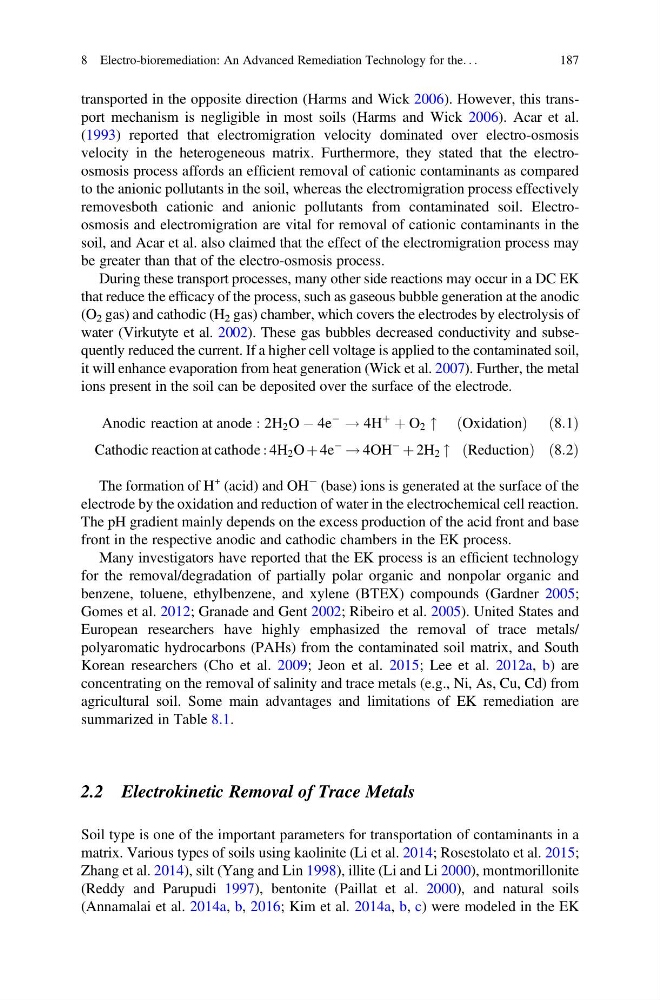
Anodic reaction at anode : 2H 2 O À 4e
À
! 4H
þ
þ O 2 "
Oxidation
ð
Þ ð 8:1Þ
Cathodic reaction at cathode : 4H 2 O þ 4e
À
! 4OH
À
þ 2H 2 " Reduction
ð
Þ ð 8:2Þ
The formation of H
+ (acid) and OH
À (base) ions is generated at the surface of the
electrode by the oxidation and reduction of water in the electrochemical cell reaction.
The pH gradient mainly depends on the excess production of the acid front and base
front in the respective anodic and cathodic chambers in the EK process.
Many investigators have reported that the EK process is an efficient technology
for the removal/degradation of partially polar organic and nonpolar organic and
benzene, toluene, ethylbenzene, and xylene (BTEX) compounds (Gardner 2005;
Gomes et al. 2012; Granade and Gent 2002; Ribeiro et al. 2005). United States and
European researchers have highly emphasized the removal of trace metals/
polyaromatic hydrocarbons (PAHs) from the contaminated soil matrix, and South
Korean researchers (Cho et al. 2009; Jeon et al. 2015; Lee et al. 2012a, b) are
concentrating on the removal of salinity and trace metals (e.g., Ni, As, Cu, Cd) from
agricultural soil. Some main advantages and limitations of EK remediation are
summarized in Table 8.1.
2.2 Electrokinetic Removal of Trace Metals
Soil type is one of the important parameters for transportation of contaminants in a
matrix. Various types of soils using kaolinite (Li et al. 2014; Rosestolato et al. 2015;
Zhang et al. 2014), silt (Yang and Lin 1998), illite (Li and Li 2000), montmorillonite
(Reddy and Parupudi 1997), bentonite (Paillat et al. 2000), and natural soils
(Annamalai et al. 2014a, b, 2016; Kim et al. 2014a, b, c) were modeled in the EK
8 Electro-bioremediation: An Advanced Remediation Technology for the. . .
187
(1993) reported that electromigration velocity dominated over electro-osmosis
velocity in the heterogeneous matrix. Furthermore, they stated that the electroosmosis process affords an efficient removal of cationic contaminants as compared
to the anionic pollutants in the soil, whereas the electromigration process effectively
removesboth cationic and anionic pollutants from contaminated soil. Electroosmosis and electromigration are vital for removal of cationic contaminants in the
soil, and Acar et al. also claimed that the effect of the electromigration process may
be greater than that of the electro-osmosis process.
During these transport processes, many other side reactions may occur in a DC EK
that reduce the efficacy of the process, such as gaseous bubble generation at the anodic
(O 2 gas) and cathodic (H 2 gas) chamber, which covers the electrodes by electrolysis of
water (Virkutyte et al. 2002). These gas bubbles decreased conductivity and subsequently reduced the current. If a higher cell voltage is applied to the contaminated soil,
it will enhance evaporation from heat generation (Wick et al. 2007). Further, the metal
ions present in the soil can be deposited over the surface of the electrode.
Anodic reaction at anode : 2H 2 O À 4e
À
! 4H
þ
þ O 2 "
Oxidation
ð
Þ ð 8:1Þ
Cathodic reaction at cathode : 4H 2 O þ 4e
À
! 4OH
À
þ 2H 2 " Reduction
ð
Þ ð 8:2Þ
The formation of H
+ (acid) and OH
À (base) ions is generated at the surface of the
electrode by the oxidation and reduction of water in the electrochemical cell reaction.
The pH gradient mainly depends on the excess production of the acid front and base
front in the respective anodic and cathodic chambers in the EK process.
Many investigators have reported that the EK process is an efficient technology
for the removal/degradation of partially polar organic and nonpolar organic and
benzene, toluene, ethylbenzene, and xylene (BTEX) compounds (Gardner 2005;
Gomes et al. 2012; Granade and Gent 2002; Ribeiro et al. 2005). United States and
European researchers have highly emphasized the removal of trace metals/
polyaromatic hydrocarbons (PAHs) from the contaminated soil matrix, and South
Korean researchers (Cho et al. 2009; Jeon et al. 2015; Lee et al. 2012a, b) are
concentrating on the removal of salinity and trace metals (e.g., Ni, As, Cu, Cd) from
agricultural soil. Some main advantages and limitations of EK remediation are
summarized in Table 8.1.
2.2 Electrokinetic Removal of Trace Metals
Soil type is one of the important parameters for transportation of contaminants in a
matrix. Various types of soils using kaolinite (Li et al. 2014; Rosestolato et al. 2015;
Zhang et al. 2014), silt (Yang and Lin 1998), illite (Li and Li 2000), montmorillonite
(Reddy and Parupudi 1997), bentonite (Paillat et al. 2000), and natural soils
(Annamalai et al. 2014a, b, 2016; Kim et al. 2014a, b, c) were modeled in the EK
8 Electro-bioremediation: An Advanced Remediation Technology for the. . .
187