

textile dye/organic and inorganic compounds, and to establish a combined approach
for the treatment process.
2 Electrokinetics
2.1 Principles of Electrokinetics
Electrokinetics is defined as the transportation of particles, charged ions, and fluids
in porous media produced as a response to an applied electric field (Acar et al.1995;
Acar and Alshawabkeh 1993). The electrokinetic process can be applicable for in
situ and ex situ treatment processes at low-intensity direct current for the remediation
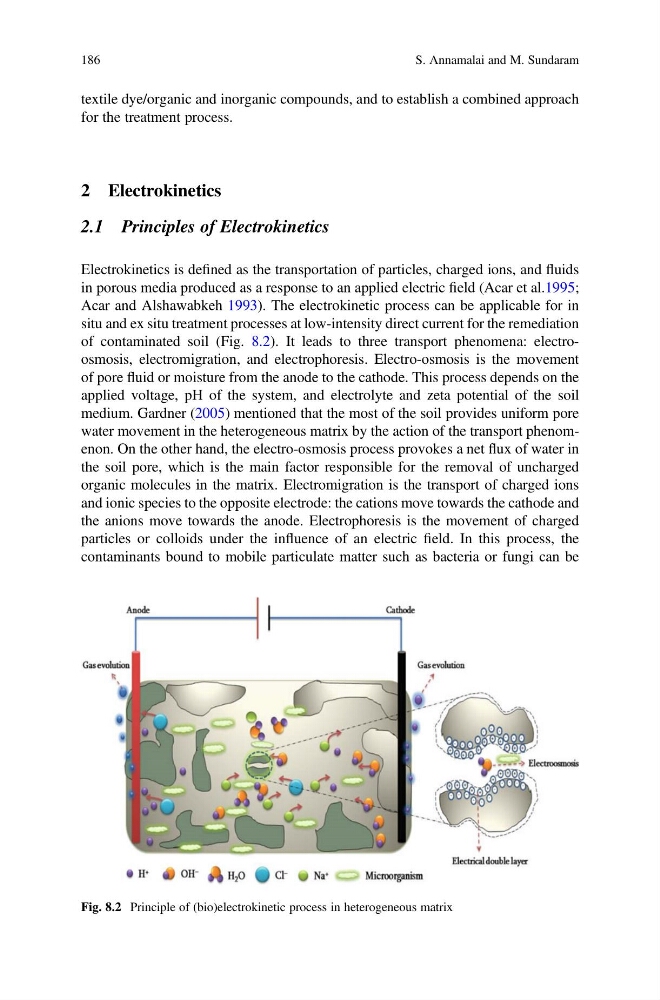
of contaminated soil (Fig. 8.2). It leads to three transport phenomena: electroosmosis, electromigration, and electrophoresis. Electro-osmosis is the movement
of pore fluid or moisture from the anode to the cathode. This process depends on the
applied voltage, pH of the system, and electrolyte and zeta potential of the soil
medium. Gardner (2005) mentioned that the most of the soil provides uniform pore
water movement in the heterogeneous matrix by the action of the transport phenomenon. On the other hand, the electro-osmosis process provokes a net flux of water in
the soil pore, which is the main factor responsible for the removal of uncharged
organic molecules in the matrix. Electromigration is the transport of charged ions
and ionic species to the opposite electrode: the cations move towards the cathode and
the anions move towards the anode. Electrophoresis is the movement of charged
particles or colloids under the influence of an electric field. In this process, the
contaminants bound to mobile particulate matter such as bacteria or fungi can be
Fig. 8.2 Principle of (bio)electrokinetic process in heterogeneous matrix
186
S. Annamalai and M. Sundaram
for the treatment process.
2 Electrokinetics
2.1 Principles of Electrokinetics
Electrokinetics is defined as the transportation of particles, charged ions, and fluids
in porous media produced as a response to an applied electric field (Acar et al.1995;
Acar and Alshawabkeh 1993). The electrokinetic process can be applicable for in
situ and ex situ treatment processes at low-intensity direct current for the remediation
of contaminated soil (Fig. 8.2). It leads to three transport phenomena: electroosmosis, electromigration, and electrophoresis. Electro-osmosis is the movement
of pore fluid or moisture from the anode to the cathode. This process depends on the
applied voltage, pH of the system, and electrolyte and zeta potential of the soil
medium. Gardner (2005) mentioned that the most of the soil provides uniform pore
water movement in the heterogeneous matrix by the action of the transport phenomenon. On the other hand, the electro-osmosis process provokes a net flux of water in
the soil pore, which is the main factor responsible for the removal of uncharged
organic molecules in the matrix. Electromigration is the transport of charged ions
and ionic species to the opposite electrode: the cations move towards the cathode and
the anions move towards the anode. Electrophoresis is the movement of charged
particles or colloids under the influence of an electric field. In this process, the
contaminants bound to mobile particulate matter such as bacteria or fungi can be
Fig. 8.2 Principle of (bio)electrokinetic process in heterogeneous matrix
186
S. Annamalai and M. Sundaram