

persistent organic compounds that exist for a prolonged time without proper handling or treatment methods. Hao et al. (2000) explained that the RB 19 half-life is
about 46 years at pH 7 (25
C). In addition, during the dye fixation process about
80 g sodium chloride or sodium sulfate is used per liter of dye bath solution. The
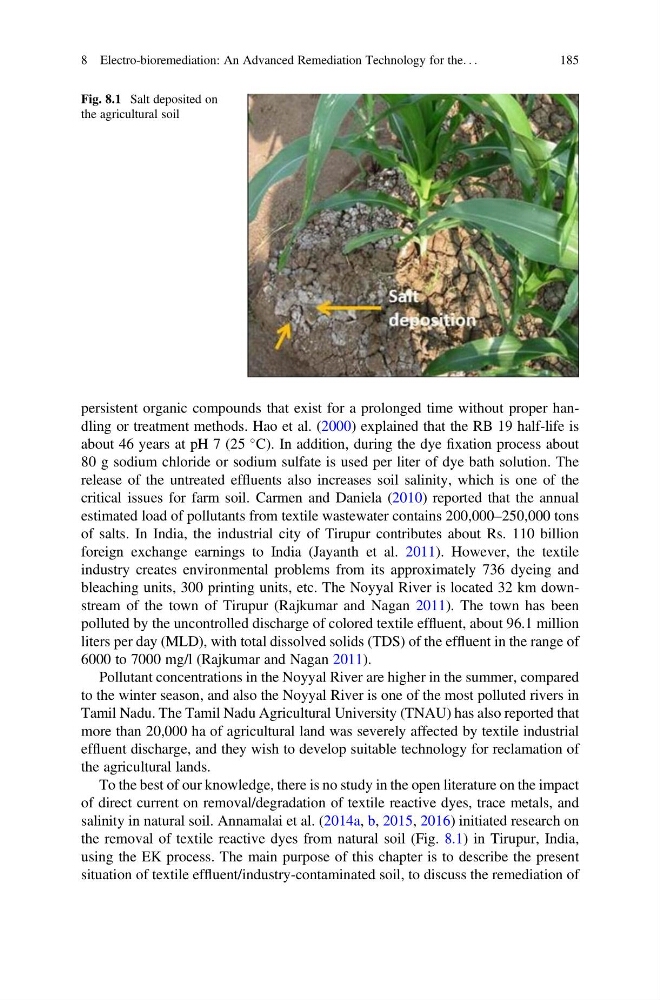
release of the untreated effluents also increases soil salinity, which is one of the
critical issues for farm soil. Carmen and Daniela (2010) reported that the annual
estimated load of pollutants from textile wastewater contains 200,000–250,000 tons
of salts. In India, the industrial city of Tirupur contributes about Rs. 110 billion
foreign exchange earnings to India (Jayanth et al. 2011). However, the textile
industry creates environmental problems from its approximately 736 dyeing and
bleaching units, 300 printing units, etc. The Noyyal River is located 32 km downstream of the town of Tirupur (Rajkumar and Nagan 2011). The town has been
polluted by the uncontrolled discharge of colored textile effluent, about 96.1 million
liters per day (MLD), with total dissolved solids (TDS) of the effluent in the range of
6000 to 7000 mg/l (Rajkumar and Nagan 2011).
Pollutant concentrations in the Noyyal River are higher in the summer, compared
to the winter season, and also the Noyyal River is one of the most polluted rivers in
Tamil Nadu. The Tamil Nadu Agricultural University (TNAU) has also reported that
more than 20,000 ha of agricultural land was severely affected by textile industrial
effluent discharge, and they wish to develop suitable technology for reclamation of
the agricultural lands.
To the best of our knowledge, there is no study in the open literature on the impact
of direct current on removal/degradation of textile reactive dyes, trace metals, and
salinity in natural soil. Annamalai et al. (2014a, b, 2015, 2016) initiated research on
the removal of textile reactive dyes from natural soil (Fig. 8.1) in Tirupur, India,
using the EK process. The main purpose of this chapter is to describe the present
situation of textile effluent/industry-contaminated soil, to discuss the remediation of
Fig. 8.1 Salt deposited on
the agricultural soil
8 Electro-bioremediation: An Advanced Remediation Technology for the. . .
185
about 46 years at pH 7 (25
C). In addition, during the dye fixation process about
80 g sodium chloride or sodium sulfate is used per liter of dye bath solution. The
release of the untreated effluents also increases soil salinity, which is one of the
critical issues for farm soil. Carmen and Daniela (2010) reported that the annual
estimated load of pollutants from textile wastewater contains 200,000–250,000 tons
of salts. In India, the industrial city of Tirupur contributes about Rs. 110 billion
foreign exchange earnings to India (Jayanth et al. 2011). However, the textile
industry creates environmental problems from its approximately 736 dyeing and
bleaching units, 300 printing units, etc. The Noyyal River is located 32 km downstream of the town of Tirupur (Rajkumar and Nagan 2011). The town has been
polluted by the uncontrolled discharge of colored textile effluent, about 96.1 million
liters per day (MLD), with total dissolved solids (TDS) of the effluent in the range of
6000 to 7000 mg/l (Rajkumar and Nagan 2011).
Pollutant concentrations in the Noyyal River are higher in the summer, compared
to the winter season, and also the Noyyal River is one of the most polluted rivers in
Tamil Nadu. The Tamil Nadu Agricultural University (TNAU) has also reported that
more than 20,000 ha of agricultural land was severely affected by textile industrial
effluent discharge, and they wish to develop suitable technology for reclamation of
the agricultural lands.
To the best of our knowledge, there is no study in the open literature on the impact
of direct current on removal/degradation of textile reactive dyes, trace metals, and
salinity in natural soil. Annamalai et al. (2014a, b, 2015, 2016) initiated research on
the removal of textile reactive dyes from natural soil (Fig. 8.1) in Tirupur, India,
using the EK process. The main purpose of this chapter is to describe the present
situation of textile effluent/industry-contaminated soil, to discuss the remediation of
Fig. 8.1 Salt deposited on
the agricultural soil
8 Electro-bioremediation: An Advanced Remediation Technology for the. . .
185