

Antibiotic is one of the major contributors involving in contamination of natural
environment (Khetan and Collins 2007). Occurrence of antibiotics in the environment has been reported worldwide, such as in rivers of Europe, Asia, and Africa.
These pharmaceuticals are excreted with urine and feces into the environment and
ultimately have negative effects on the biota. The major pathway of pharmaceutical compounds is municipal wastewater that enters into fresh or aquatic environments; there may be some other direct paths comprising the wastewater of
household from small populations, the animal feedlots effluents, and the wastewater of rural areas (Li et al. 2014). The presence of antibiotics and other pharmaceutical compounds in the soil and water is continuously reported in different
research studies (Camacho-Munoz et al. 2012), although research has yet to
establish a solid relationship between the antibiotics and health risks. Removal
of pharmaceuticals in wastewater can be difficult and depends on the properties of
the individual pollutants and environmental condition. The potential ecotoxicological effect of pharmaceutical metabolites is not known; thus, further study is
needed on the fate of pharmaceutical metabolites in various wastewater treatment
processes (Kotyza et al. 2010). Primary treatment and UV light disinfection
showed limited ability to degrade most contaminants of pharmaceuticals in different environments. A proper extent of the wastewater from hospitals or pharmaceutical manufacturers also contributes to the total loads of pharmaceuticals in
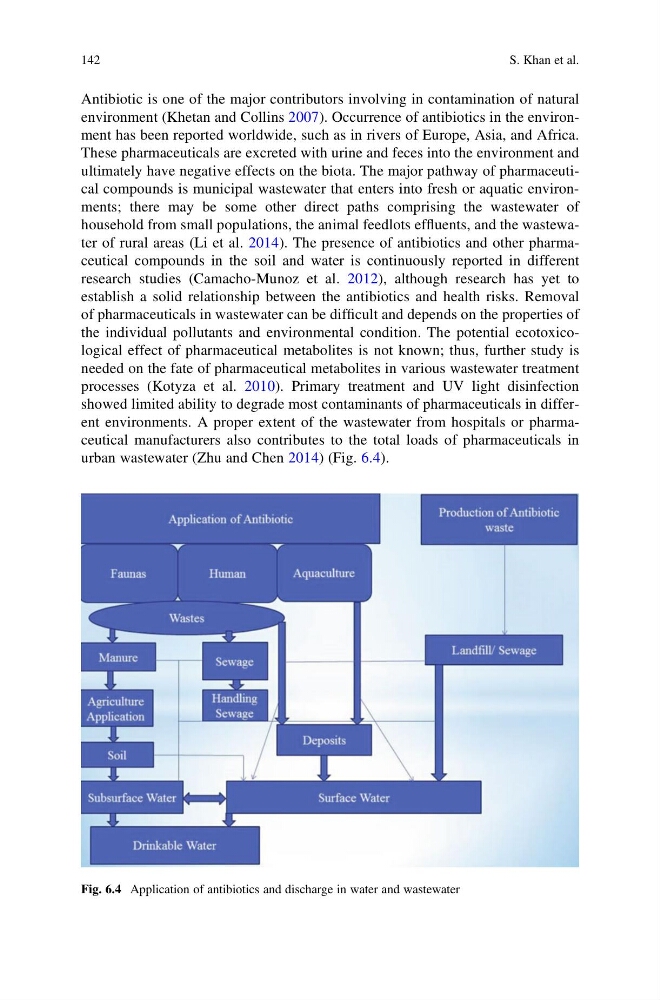
urban wastewater (Zhu and Chen 2014) (Fig. 6.4).
Fig. 6.4 Application of antibiotics and discharge in water and wastewater
142
S. Khan et al.
environment (Khetan and Collins 2007). Occurrence of antibiotics in the environment has been reported worldwide, such as in rivers of Europe, Asia, and Africa.
These pharmaceuticals are excreted with urine and feces into the environment and
ultimately have negative effects on the biota. The major pathway of pharmaceutical compounds is municipal wastewater that enters into fresh or aquatic environments; there may be some other direct paths comprising the wastewater of
household from small populations, the animal feedlots effluents, and the wastewater of rural areas (Li et al. 2014). The presence of antibiotics and other pharmaceutical compounds in the soil and water is continuously reported in different
research studies (Camacho-Munoz et al. 2012), although research has yet to
establish a solid relationship between the antibiotics and health risks. Removal
of pharmaceuticals in wastewater can be difficult and depends on the properties of
the individual pollutants and environmental condition. The potential ecotoxicological effect of pharmaceutical metabolites is not known; thus, further study is
needed on the fate of pharmaceutical metabolites in various wastewater treatment
processes (Kotyza et al. 2010). Primary treatment and UV light disinfection
showed limited ability to degrade most contaminants of pharmaceuticals in different environments. A proper extent of the wastewater from hospitals or pharmaceutical manufacturers also contributes to the total loads of pharmaceuticals in
urban wastewater (Zhu and Chen 2014) (Fig. 6.4).
Fig. 6.4 Application of antibiotics and discharge in water and wastewater
142
S. Khan et al.