

2.2.1 Surface Flow Constructed Wetland
Free surface flow wetlands are considered as artificial shallow ponds or shallow
marshy lands occupied by aquatic plants or hydrophytes (Wetlands International
2013). They are very shallow excavations or shallow earth-banked lagoons
enclosing an area of land demarcated for the purpose. The name of the free surface
wetland is related to the water layers which are thin free layers that are formed at the
surface in free surface wetland; for the marshy plants, the growing media are
provided by soil or some other media such as gravel. The surface should be virtually
flat to avoid short-circuiting with a very gentle slope toward the outlet end (Wetlands
International 2013). The wastewater is distributed over the inlet end of the wetland
through inlet zone, and the treated liquid is collected by a collection channel at the
outlet end. The wastewater in free surface wetland flows along the surface along with
settlement of solids and then come into contact with the population of bacteria on the
surface of the plant stem and media. These types of wetlands can be used as
substitute for the treatment systems for both smaller and larger communities. Furthermore, it can also be considered to treat point sources and nonpoint sources of
contamination and particularly well appropriate for surface-mined areas (UNEP
2004). Its additional ecological advantages are the amount of nutrients; water,
nitrogen, and saltwater filtering; support of threatened species; and production of
food that can possibly increase the cost-effective advantages in contrast to traditional
wastewater treatment plants (Ulsido 2014). In constructed wetlands,
phytoremediation technique is effective but mainly depends on hydrology, site
selected geology, air quality, characteristics of aquifers, conditions of soil, geochemistry, climatic conditions, distribution and types of microorganisms, and distribution
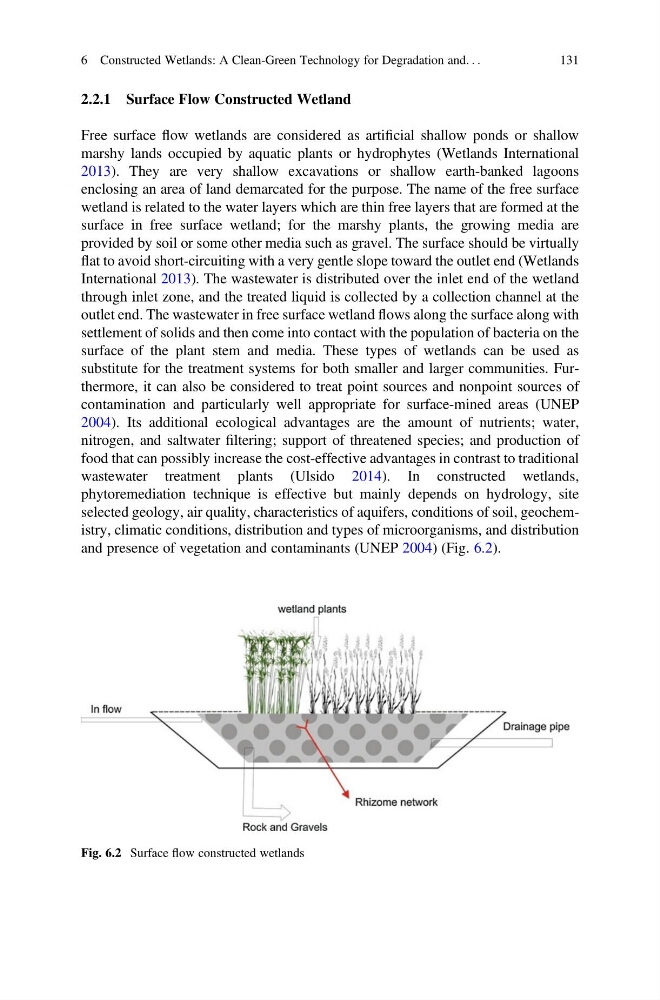
and presence of vegetation and contaminants (UNEP 2004) (Fig. 6.2).
Fig. 6.2 Surface flow constructed wetlands
6 Constructed Wetlands: A Clean-Green Technology for Degradation and. . .
131
Free surface flow wetlands are considered as artificial shallow ponds or shallow
marshy lands occupied by aquatic plants or hydrophytes (Wetlands International
2013). They are very shallow excavations or shallow earth-banked lagoons
enclosing an area of land demarcated for the purpose. The name of the free surface
wetland is related to the water layers which are thin free layers that are formed at the
surface in free surface wetland; for the marshy plants, the growing media are
provided by soil or some other media such as gravel. The surface should be virtually
flat to avoid short-circuiting with a very gentle slope toward the outlet end (Wetlands
International 2013). The wastewater is distributed over the inlet end of the wetland
through inlet zone, and the treated liquid is collected by a collection channel at the
outlet end. The wastewater in free surface wetland flows along the surface along with
settlement of solids and then come into contact with the population of bacteria on the
surface of the plant stem and media. These types of wetlands can be used as
substitute for the treatment systems for both smaller and larger communities. Furthermore, it can also be considered to treat point sources and nonpoint sources of
contamination and particularly well appropriate for surface-mined areas (UNEP
2004). Its additional ecological advantages are the amount of nutrients; water,
nitrogen, and saltwater filtering; support of threatened species; and production of
food that can possibly increase the cost-effective advantages in contrast to traditional
wastewater treatment plants (Ulsido 2014). In constructed wetlands,
phytoremediation technique is effective but mainly depends on hydrology, site
selected geology, air quality, characteristics of aquifers, conditions of soil, geochemistry, climatic conditions, distribution and types of microorganisms, and distribution
and presence of vegetation and contaminants (UNEP 2004) (Fig. 6.2).
Fig. 6.2 Surface flow constructed wetlands
6 Constructed Wetlands: A Clean-Green Technology for Degradation and. . .
131