

2.2.2 Subsurface Flow Constructed Wetlands
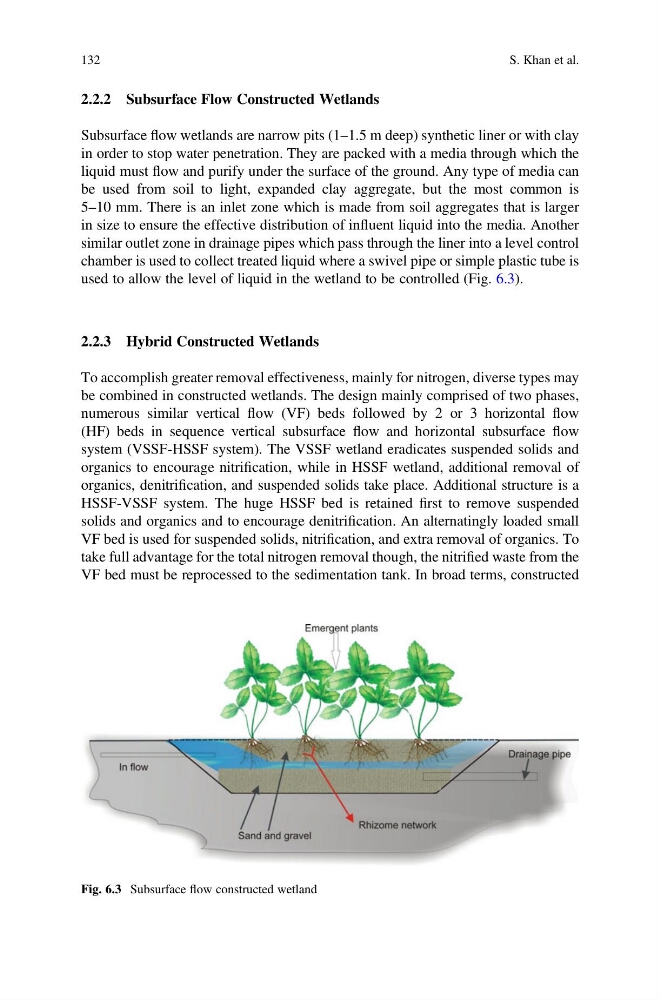
Subsurface flow wetlands are narrow pits (1–1.5 m deep) synthetic liner or with clay
in order to stop water penetration. They are packed with a media through which the
liquid must flow and purify under the surface of the ground. Any type of media can
be used from soil to light, expanded clay aggregate, but the most common is
5–10 mm. There is an inlet zone which is made from soil aggregates that is larger
in size to ensure the effective distribution of influent liquid into the media. Another
similar outlet zone in drainage pipes which pass through the liner into a level control
chamber is used to collect treated liquid where a swivel pipe or simple plastic tube is
used to allow the level of liquid in the wetland to be controlled (Fig. 6.3).
2.2.3 Hybrid Constructed Wetlands
To accomplish greater removal effectiveness, mainly for nitrogen, diverse types may
be combined in constructed wetlands. The design mainly comprised of two phases,
numerous similar vertical flow (VF) beds followed by 2 or 3 horizontal flow
(HF) beds in sequence vertical subsurface flow and horizontal subsurface flow
system (VSSF-HSSF system). The VSSF wetland eradicates suspended solids and
organics to encourage nitrification, while in HSSF wetland, additional removal of
organics, denitrification, and suspended solids take place. Additional structure is a
HSSF-VSSF system. The huge HSSF bed is retained first to remove suspended
solids and organics and to encourage denitrification. An alternatingly loaded small
VF bed is used for suspended solids, nitrification, and extra removal of organics. To
take full advantage for the total nitrogen removal though, the nitrified waste from the
VF bed must be reprocessed to the sedimentation tank. In broad terms, constructed
Fig. 6.3 Subsurface flow constructed wetland
132
S. Khan et al.
Subsurface flow wetlands are narrow pits (1–1.5 m deep) synthetic liner or with clay
in order to stop water penetration. They are packed with a media through which the
liquid must flow and purify under the surface of the ground. Any type of media can
be used from soil to light, expanded clay aggregate, but the most common is
5–10 mm. There is an inlet zone which is made from soil aggregates that is larger
in size to ensure the effective distribution of influent liquid into the media. Another
similar outlet zone in drainage pipes which pass through the liner into a level control
chamber is used to collect treated liquid where a swivel pipe or simple plastic tube is
used to allow the level of liquid in the wetland to be controlled (Fig. 6.3).
2.2.3 Hybrid Constructed Wetlands
To accomplish greater removal effectiveness, mainly for nitrogen, diverse types may
be combined in constructed wetlands. The design mainly comprised of two phases,
numerous similar vertical flow (VF) beds followed by 2 or 3 horizontal flow
(HF) beds in sequence vertical subsurface flow and horizontal subsurface flow
system (VSSF-HSSF system). The VSSF wetland eradicates suspended solids and
organics to encourage nitrification, while in HSSF wetland, additional removal of
organics, denitrification, and suspended solids take place. Additional structure is a
HSSF-VSSF system. The huge HSSF bed is retained first to remove suspended
solids and organics and to encourage denitrification. An alternatingly loaded small
VF bed is used for suspended solids, nitrification, and extra removal of organics. To
take full advantage for the total nitrogen removal though, the nitrified waste from the
VF bed must be reprocessed to the sedimentation tank. In broad terms, constructed
Fig. 6.3 Subsurface flow constructed wetland
132
S. Khan et al.