

originated from different sources for quality improvement. Various types of wastewater are treated by using CWs, i.e., agricultural wastewaters, landfill leachate,
urban stormwater, and industrial wastewater including paper and pulp, domestic
wastewater, acid mine drainage, food processing, petrochemical, chemical, textile,
and tannery. The mechanisms of wastewater treatment in wetlands are extremely
complicated, including a series of physical, chemical, and biochemical processes.
The wetland efficiency to remove the pollutants from the wastewater primarily
depends on the root zone relations between soil, pollutants, plant roots, and diversity
of microorganisms (Olejnik and Wojciechowski 2012) (Fig. 6.1).
The simple idea behind constructed wetlands is their ability to absorb, filter, and
metabolize dissolved and suspended matter. In order to mimic these natural structures, engineers and scientists are very interested to work for handling wastewaters
(UNEP 2004). This has encouraged the production of synthetic wetland’s construction and has prompted in order to handle with the diffuse contamination initiating
from septic tanks, agriculture, and other causes. The reason for the constructions of
artificial wetlands is its unique and cost-effective phyto-technology concept in order
to control various types of wastewater (UNEP 2004). Constructed wetlands are
commonly intended in such a way that water predominantly runs above the sediment
and through hydrophytes, or the design of stagnated waterlogged bed systems in
which water moves through plants for contact with plant roots or either planted or
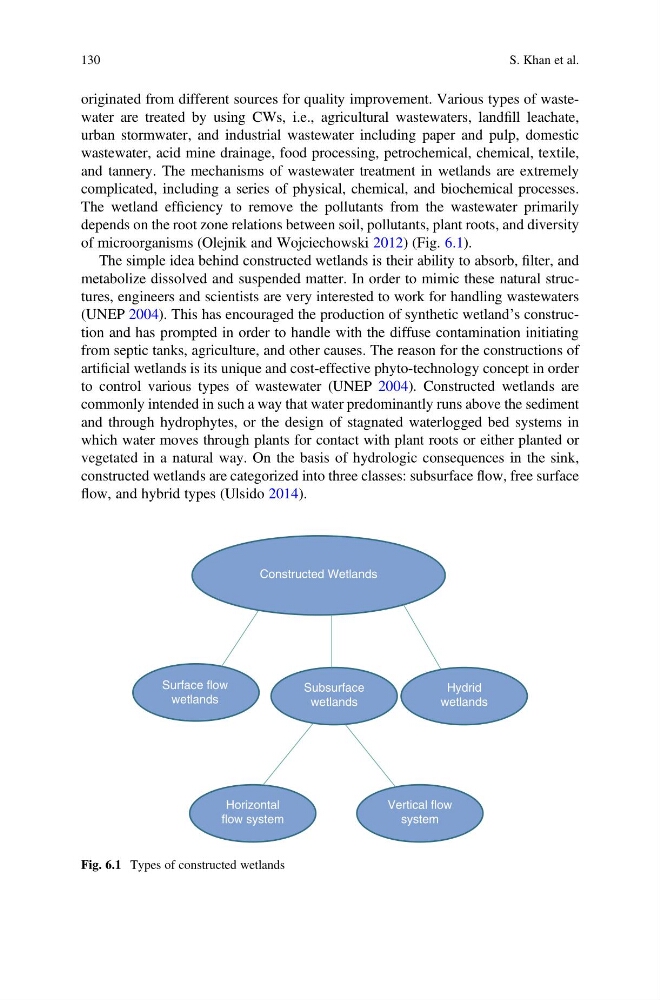
vegetated in a natural way. On the basis of hydrologic consequences in the sink,
constructed wetlands are categorized into three classes: subsurface flow, free surface
flow, and hybrid types (Ulsido 2014).
Constructed Wetlands
Surface flow
wetlands
Subsurface
wetlands
Hydrid
wetlands
Vertical flow
system
Horizontal
flow system
Fig. 6.1 Types of constructed wetlands
130
S. Khan et al.
urban stormwater, and industrial wastewater including paper and pulp, domestic
wastewater, acid mine drainage, food processing, petrochemical, chemical, textile,
and tannery. The mechanisms of wastewater treatment in wetlands are extremely
complicated, including a series of physical, chemical, and biochemical processes.
The wetland efficiency to remove the pollutants from the wastewater primarily
depends on the root zone relations between soil, pollutants, plant roots, and diversity
of microorganisms (Olejnik and Wojciechowski 2012) (Fig. 6.1).
The simple idea behind constructed wetlands is their ability to absorb, filter, and
metabolize dissolved and suspended matter. In order to mimic these natural structures, engineers and scientists are very interested to work for handling wastewaters
(UNEP 2004). This has encouraged the production of synthetic wetland’s construction and has prompted in order to handle with the diffuse contamination initiating
from septic tanks, agriculture, and other causes. The reason for the constructions of
artificial wetlands is its unique and cost-effective phyto-technology concept in order
to control various types of wastewater (UNEP 2004). Constructed wetlands are
commonly intended in such a way that water predominantly runs above the sediment
and through hydrophytes, or the design of stagnated waterlogged bed systems in
which water moves through plants for contact with plant roots or either planted or
vegetated in a natural way. On the basis of hydrologic consequences in the sink,
constructed wetlands are categorized into three classes: subsurface flow, free surface
flow, and hybrid types (Ulsido 2014).
Constructed Wetlands
Surface flow
wetlands
Subsurface
wetlands
Hydrid
wetlands
Vertical flow
system
Horizontal
flow system
Fig. 6.1 Types of constructed wetlands
130
S. Khan et al.