

Spatial Shift in Chickpeas in India
421
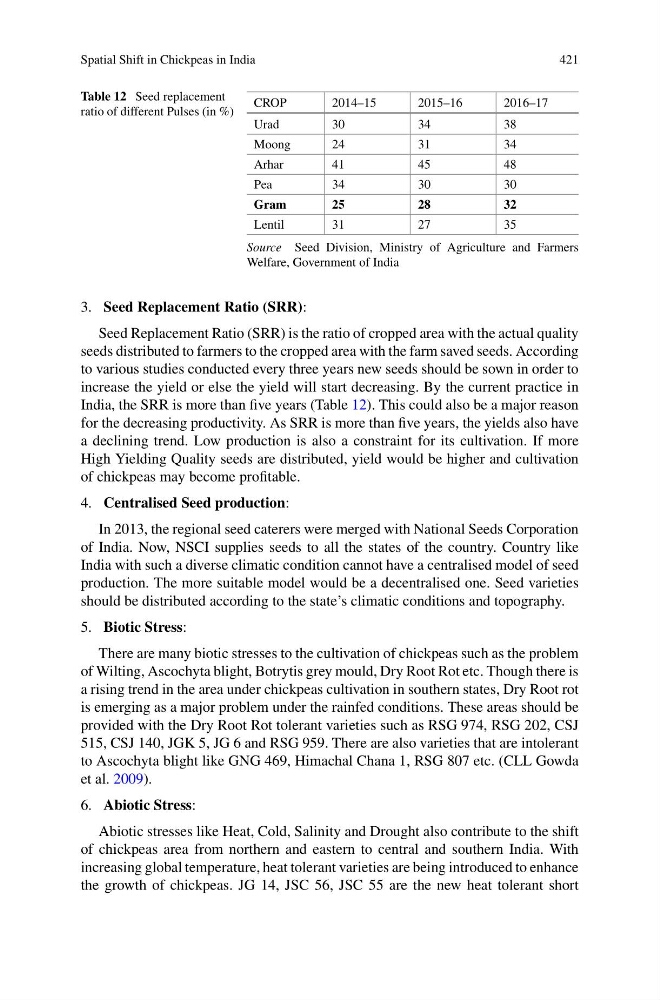
Table 12 Seed replacement
ratio of different Pulses (in %)
CROP
2014–15
2015–16
2016–17
Urad
30
34
38
Moong
24
31
34
Arhar
41
45
48
Pea
34
30
30
Gram
25
28
32
Lentil
31
27
35
Source Seed Division, Ministry of Agriculture and Farmers
Welfare, Government of India
3. Seed Replacement Ratio (SRR):
Seed Replacement Ratio (SRR) is the ratio of cropped area with the actual quality
seeds distributed to farmers to the cropped area with the farm saved seeds. According
to various studies conducted every three years new seeds should be sown in order to
increase the yield or else the yield will start decreasing. By the current practice in
India, the SRR is more than five years (Table 12). This could also be a major reason
for the decreasing productivity. As SRR is more than five years, the yields also have
a declining trend. Low production is also a constraint for its cultivation. If more
High Yielding Quality seeds are distributed, yield would be higher and cultivation
of chickpeas may become profitable.
4. Centralised Seed production:
In 2013, the regional seed caterers were merged with National Seeds Corporation
of India. Now, NSCI supplies seeds to all the states of the country. Country like
India with such a diverse climatic condition cannot have a centralised model of seed
production. The more suitable model would be a decentralised one. Seed varieties
should be distributed according to the state’s climatic conditions and topography.
5. Biotic Stress:
There are many biotic stresses to the cultivation of chickpeas such as the problem
of Wilting, Ascochyta blight, Botrytis grey mould, Dry Root Rot etc. Though there is
a rising trend in the area under chickpeas cultivation in southern states, Dry Root rot
is emerging as a major problem under the rainfed conditions. These areas should be
provided with the Dry Root Rot tolerant varieties such as RSG 974, RSG 202, CSJ
515, CSJ 140, JGK 5, JG 6 and RSG 959. There are also varieties that are intolerant
to Ascochyta blight like GNG 469, Himachal Chana 1, RSG 807 etc. (CLL Gowda
et al. 2009).
6. Abiotic Stress:
Abiotic stresses like Heat, Cold, Salinity and Drought also contribute to the shift
of chickpeas area from northern and eastern to central and southern India. With
increasing global temperature, heat tolerant varieties are being introduced to enhance
the growth of chickpeas. JG 14, JSC 56, JSC 55 are the new heat tolerant short
421
Table 12 Seed replacement
ratio of different Pulses (in %)
CROP
2014–15
2015–16
2016–17
Urad
30
34
38
Moong
24
31
34
Arhar
41
45
48
Pea
34
30
30
Gram
25
28
32
Lentil
31
27
35
Source Seed Division, Ministry of Agriculture and Farmers
Welfare, Government of India
3. Seed Replacement Ratio (SRR):
Seed Replacement Ratio (SRR) is the ratio of cropped area with the actual quality
seeds distributed to farmers to the cropped area with the farm saved seeds. According
to various studies conducted every three years new seeds should be sown in order to
increase the yield or else the yield will start decreasing. By the current practice in
India, the SRR is more than five years (Table 12). This could also be a major reason
for the decreasing productivity. As SRR is more than five years, the yields also have
a declining trend. Low production is also a constraint for its cultivation. If more
High Yielding Quality seeds are distributed, yield would be higher and cultivation
of chickpeas may become profitable.
4. Centralised Seed production:
In 2013, the regional seed caterers were merged with National Seeds Corporation
of India. Now, NSCI supplies seeds to all the states of the country. Country like
India with such a diverse climatic condition cannot have a centralised model of seed
production. The more suitable model would be a decentralised one. Seed varieties
should be distributed according to the state’s climatic conditions and topography.
5. Biotic Stress:
There are many biotic stresses to the cultivation of chickpeas such as the problem
of Wilting, Ascochyta blight, Botrytis grey mould, Dry Root Rot etc. Though there is
a rising trend in the area under chickpeas cultivation in southern states, Dry Root rot
is emerging as a major problem under the rainfed conditions. These areas should be
provided with the Dry Root Rot tolerant varieties such as RSG 974, RSG 202, CSJ
515, CSJ 140, JGK 5, JG 6 and RSG 959. There are also varieties that are intolerant
to Ascochyta blight like GNG 469, Himachal Chana 1, RSG 807 etc. (CLL Gowda
et al. 2009).
6. Abiotic Stress:
Abiotic stresses like Heat, Cold, Salinity and Drought also contribute to the shift
of chickpeas area from northern and eastern to central and southern India. With
increasing global temperature, heat tolerant varieties are being introduced to enhance
the growth of chickpeas. JG 14, JSC 56, JSC 55 are the new heat tolerant short