

420
B. Abirami and P. Kumar
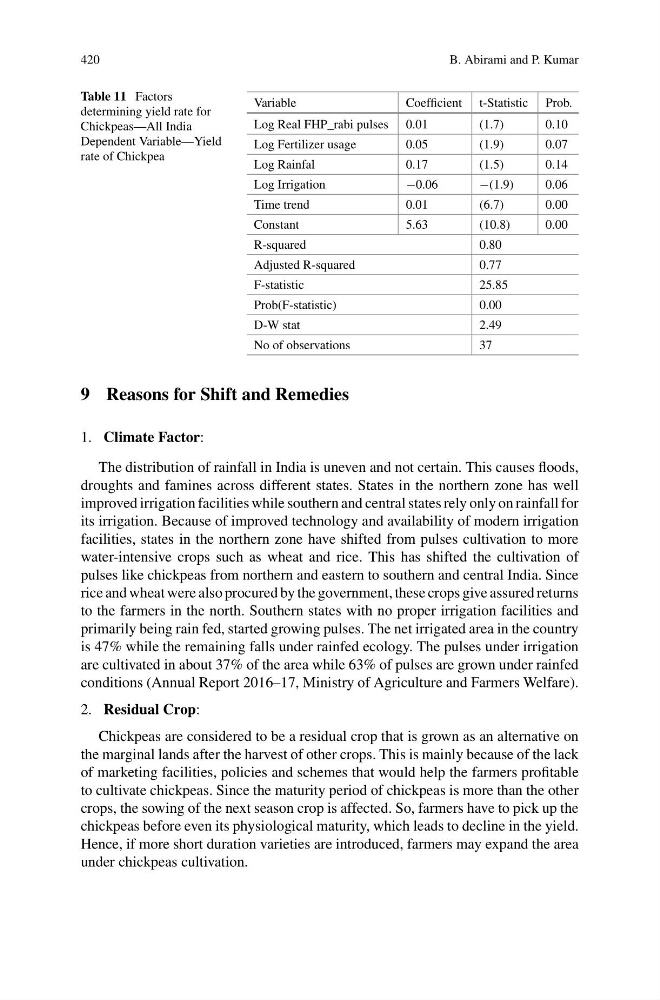
Table 11 Factors
determining yield rate for
Chickpeas—All India
Dependent Variable—Yield
rate of Chickpea
Variable
Coefficient t-Statistic Prob.
Log Real FHP_rabi pulses 0.01
(1.7)
0.10
Log Fertilizer usage
0.05
(1.9)
0.07
Log Rainfal
0.17
(1.5)
0.14
Log Irrigation
−0.06
−(1.9)
0.06
Time trend
0.01
(6.7)
0.00
Constant
5.63
(10.8)
0.00
R-squared
0.80
Adjusted R-squared
0.77
F-statistic
25.85
Prob(F-statistic)
0.00
D-W stat
2.49
No of observations
37
9 Reasons for Shift and Remedies
1. Climate Factor:
The distribution of rainfall in India is uneven and not certain. This causes floods,
droughts and famines across different states. States in the northern zone has well
improved irrigation facilities while southern and central states rely only on rainfall for
its irrigation. Because of improved technology and availability of modern irrigation
facilities, states in the northern zone have shifted from pulses cultivation to more
water-intensive crops such as wheat and rice. This has shifted the cultivation of
pulses like chickpeas from northern and eastern to southern and central India. Since
rice and wheat were also procured by the government, these crops give assured returns
to the farmers in the north. Southern states with no proper irrigation facilities and
primarily being rain fed, started growing pulses. The net irrigated area in the country
is 47% while the remaining falls under rainfed ecology. The pulses under irrigation
are cultivated in about 37% of the area while 63% of pulses are grown under rainfed
conditions (Annual Report 2016–17, Ministry of Agriculture and Farmers Welfare).
2. Residual Crop:
Chickpeas are considered to be a residual crop that is grown as an alternative on
the marginal lands after the harvest of other crops. This is mainly because of the lack
of marketing facilities, policies and schemes that would help the farmers profitable
to cultivate chickpeas. Since the maturity period of chickpeas is more than the other
crops, the sowing of the next season crop is affected. So, farmers have to pick up the
chickpeas before even its physiological maturity, which leads to decline in the yield.
Hence, if more short duration varieties are introduced, farmers may expand the area
under chickpeas cultivation.
B. Abirami and P. Kumar
Table 11 Factors
determining yield rate for
Chickpeas—All India
Dependent Variable—Yield
rate of Chickpea
Variable
Coefficient t-Statistic Prob.
Log Real FHP_rabi pulses 0.01
(1.7)
0.10
Log Fertilizer usage
0.05
(1.9)
0.07
Log Rainfal
0.17
(1.5)
0.14
Log Irrigation
−0.06
−(1.9)
0.06
Time trend
0.01
(6.7)
0.00
Constant
5.63
(10.8)
0.00
R-squared
0.80
Adjusted R-squared
0.77
F-statistic
25.85
Prob(F-statistic)
0.00
D-W stat
2.49
No of observations
37
9 Reasons for Shift and Remedies
1. Climate Factor:
The distribution of rainfall in India is uneven and not certain. This causes floods,
droughts and famines across different states. States in the northern zone has well
improved irrigation facilities while southern and central states rely only on rainfall for
its irrigation. Because of improved technology and availability of modern irrigation
facilities, states in the northern zone have shifted from pulses cultivation to more
water-intensive crops such as wheat and rice. This has shifted the cultivation of
pulses like chickpeas from northern and eastern to southern and central India. Since
rice and wheat were also procured by the government, these crops give assured returns
to the farmers in the north. Southern states with no proper irrigation facilities and
primarily being rain fed, started growing pulses. The net irrigated area in the country
is 47% while the remaining falls under rainfed ecology. The pulses under irrigation
are cultivated in about 37% of the area while 63% of pulses are grown under rainfed
conditions (Annual Report 2016–17, Ministry of Agriculture and Farmers Welfare).
2. Residual Crop:
Chickpeas are considered to be a residual crop that is grown as an alternative on
the marginal lands after the harvest of other crops. This is mainly because of the lack
of marketing facilities, policies and schemes that would help the farmers profitable
to cultivate chickpeas. Since the maturity period of chickpeas is more than the other
crops, the sowing of the next season crop is affected. So, farmers have to pick up the
chickpeas before even its physiological maturity, which leads to decline in the yield.
Hence, if more short duration varieties are introduced, farmers may expand the area
under chickpeas cultivation.