

53
the glacial moraines or debris are seen, also support this. This is further confirmed
by the radiocarbon dates of 10,200 years BP (Hiller et al. 1988) of the mumyo or the
biogenic material ascribed to the snow petrels (solidified stomach oil spit by
Pagodroma nivea), an age when the birds occupied the rocky areas for breeding.
Some of the surface till deposits in Schirmacher has been dated by Krause et al.
(1997) between 30 and 40,000 years B.P.
Priyadarshini Lake (L-49) which is deepest (5.5 m) at its eastern side with an
average depth of 2.5–3 m, has contributed maximum number of sediment cores. The
sediment cores show variations of sand, silt and clay in different proportions from
top to bottom with clayey proportions being more common at depths.
Six sediment core samples from this lake were analysed for the radiocarbon
dates by AMS technique from the NSF-Arizona AMS laboratory as the samples
showed very little Carbon content. The results are exhibited in Table 5. The top 2 cm
in the core are rich in organic content and show 526 ± 35 and 1630 ± 36
14
C age BP
respectively. The older ages given by the basal sections of the bulk sediment cores
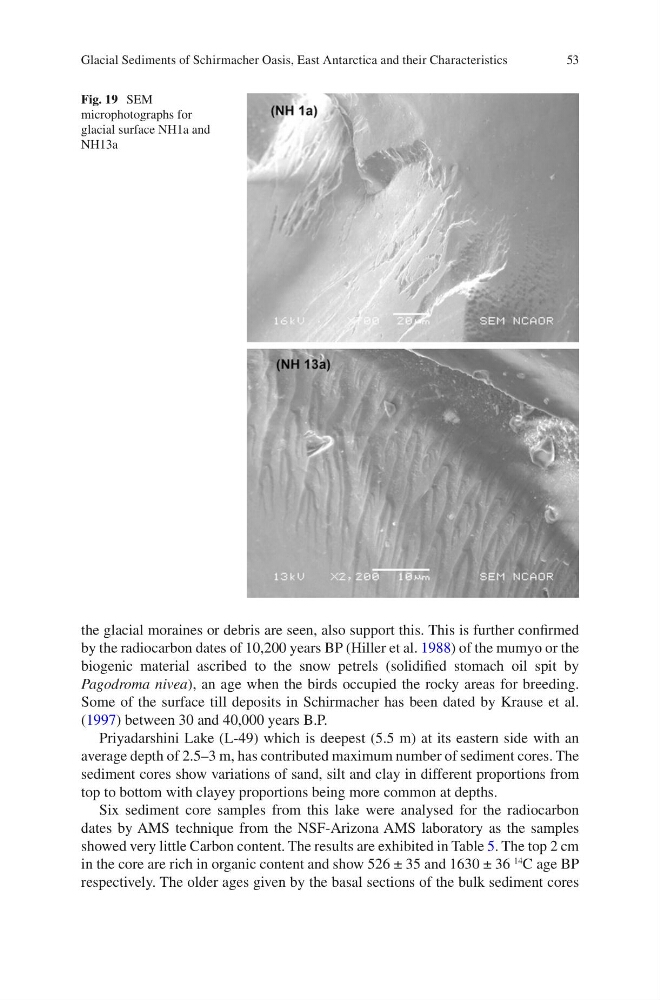
Fig. 19 SEM
microphotographs for
glacial surface NH1a and
NH13a
Glacial Sediments of Schirmacher Oasis, East Antarctica and their Characteristics
the glacial moraines or debris are seen, also support this. This is further confirmed
by the radiocarbon dates of 10,200 years BP (Hiller et al. 1988) of the mumyo or the
biogenic material ascribed to the snow petrels (solidified stomach oil spit by
Pagodroma nivea), an age when the birds occupied the rocky areas for breeding.
Some of the surface till deposits in Schirmacher has been dated by Krause et al.
(1997) between 30 and 40,000 years B.P.
Priyadarshini Lake (L-49) which is deepest (5.5 m) at its eastern side with an
average depth of 2.5–3 m, has contributed maximum number of sediment cores. The
sediment cores show variations of sand, silt and clay in different proportions from
top to bottom with clayey proportions being more common at depths.
Six sediment core samples from this lake were analysed for the radiocarbon
dates by AMS technique from the NSF-Arizona AMS laboratory as the samples
showed very little Carbon content. The results are exhibited in Table 5. The top 2 cm
in the core are rich in organic content and show 526 ± 35 and 1630 ± 36
14
C age BP
respectively. The older ages given by the basal sections of the bulk sediment cores
Fig. 19 SEM
microphotographs for
glacial surface NH1a and
NH13a
Glacial Sediments of Schirmacher Oasis, East Antarctica and their Characteristics