

40
relation marked by variation in cast size and break in slope. The upper till surfaces
designated as T 4 and T 5 are the younger ones and comprise of unconsolidated loose
boulders of huge sizes. The surfaces have noticeable gradient toward north, the
southern boundary being defined by the push moraines and the present position of
the glacier.
The samples T 4 and NH show similar composition of sand, silt and clay; likewise
samples T 2 and T 5 show analogous distribution. The high content of silt and clay of
T 4 and NH indicate that these samples have been transported and there might be a
sub-glacial component involved. On the other hand, the sand percentage in the samples T 2 and T 5 indicate that these particles are close to the depositional environment.
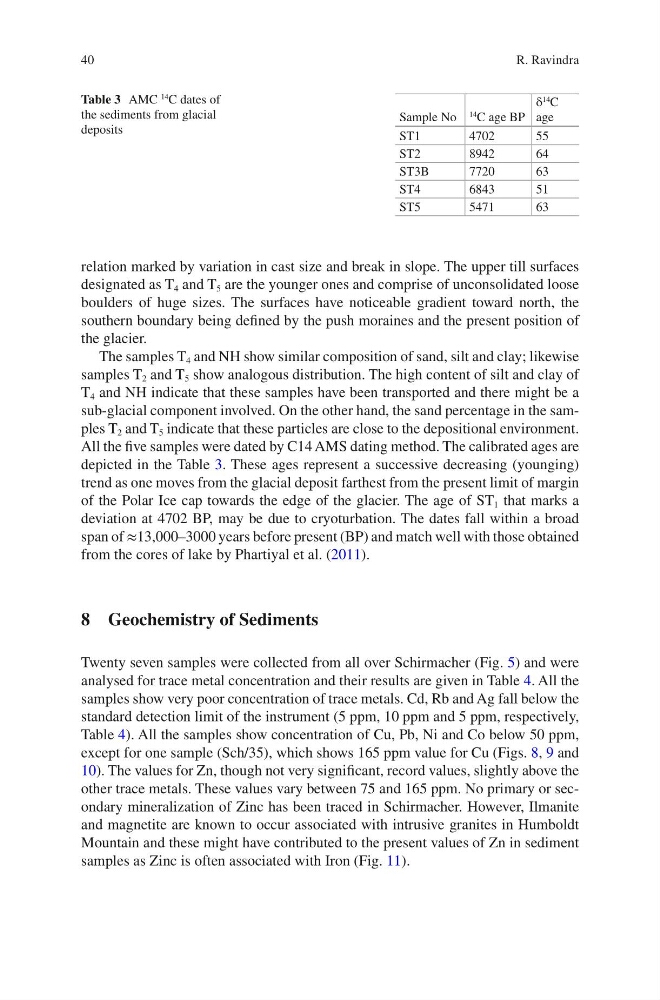
All the five samples were dated by C14 AMS dating method. The calibrated ages are
depicted in the Table 3. These ages represent a successive decreasing (younging)
trend as one moves from the glacial deposit farthest from the present limit of margin
of the Polar Ice cap towards the edge of the glacier. The age of ST 1 that marks a
deviation at 4702 BP, may be due to cryoturbation. The dates fall within a broad
span of ≈13,000–3000 years before present (BP) and match well with those obtained
from the cores of lake by Phartiyal et al. (2011).
8 Geochemistry of Sediments
Twenty seven samples were collected from all over Schirmacher (Fig. 5) and were
analysed for trace metal concentration and their results are given in Table 4. All the
samples show very poor concentration of trace metals. Cd, Rb and Ag fall below the
standard detection limit of the instrument (5 ppm, 10 ppm and 5 ppm, respectively,
Table 4). All the samples show concentration of Cu, Pb, Ni and Co below 50 ppm,
except for one sample (Sch/35), which shows 165 ppm value for Cu (Figs. 8, 9 and
10). The values for Zn, though not very significant, record values, slightly above the
other trace metals. These values vary between 75 and 165 ppm. No primary or secondary mineralization of Zinc has been traced in Schirmacher. However, Ilmanite
and magnetite are known to occur associated with intrusive granites in Humboldt
Mountain and these might have contributed to the present values of Zn in sediment
samples as Zinc is often associated with Iron (Fig. 11).
Table 3 AMC
14
C dates of
the sediments from glacial
deposits
Sample No
14 C age BP
δ
14 C
age
ST1
4702
55
ST2
8942
64
ST3B
7720
63
ST4
6843
51
ST5
5471
63
R. Ravindra
relation marked by variation in cast size and break in slope. The upper till surfaces
designated as T 4 and T 5 are the younger ones and comprise of unconsolidated loose
boulders of huge sizes. The surfaces have noticeable gradient toward north, the
southern boundary being defined by the push moraines and the present position of
the glacier.
The samples T 4 and NH show similar composition of sand, silt and clay; likewise
samples T 2 and T 5 show analogous distribution. The high content of silt and clay of
T 4 and NH indicate that these samples have been transported and there might be a
sub-glacial component involved. On the other hand, the sand percentage in the samples T 2 and T 5 indicate that these particles are close to the depositional environment.
All the five samples were dated by C14 AMS dating method. The calibrated ages are
depicted in the Table 3. These ages represent a successive decreasing (younging)
trend as one moves from the glacial deposit farthest from the present limit of margin
of the Polar Ice cap towards the edge of the glacier. The age of ST 1 that marks a
deviation at 4702 BP, may be due to cryoturbation. The dates fall within a broad
span of ≈13,000–3000 years before present (BP) and match well with those obtained
from the cores of lake by Phartiyal et al. (2011).
8 Geochemistry of Sediments
Twenty seven samples were collected from all over Schirmacher (Fig. 5) and were
analysed for trace metal concentration and their results are given in Table 4. All the
samples show very poor concentration of trace metals. Cd, Rb and Ag fall below the
standard detection limit of the instrument (5 ppm, 10 ppm and 5 ppm, respectively,
Table 4). All the samples show concentration of Cu, Pb, Ni and Co below 50 ppm,
except for one sample (Sch/35), which shows 165 ppm value for Cu (Figs. 8, 9 and
10). The values for Zn, though not very significant, record values, slightly above the
other trace metals. These values vary between 75 and 165 ppm. No primary or secondary mineralization of Zinc has been traced in Schirmacher. However, Ilmanite
and magnetite are known to occur associated with intrusive granites in Humboldt
Mountain and these might have contributed to the present values of Zn in sediment
samples as Zinc is often associated with Iron (Fig. 11).
Table 3 AMC
14
C dates of
the sediments from glacial
deposits
Sample No
14 C age BP
δ
14 C
age
ST1
4702
55
ST2
8942
64
ST3B
7720
63
ST4
6843
51
ST5
5471
63
R. Ravindra