

231
4.3 Climate Change Over NWH as Seen by Gridded Datasets
4.3.1 Long Term and Short Term Climatic Changes
Climate change is a reality today and assessment of its magnitude is of utmost
importance especially for areas like Himalayas. In climatology, minimum 30 years
of data is required to analyze the trends. Since all ground based observatories have
not been recording data since 30 years, study of long term trends is very much possible by use of gridded datasets. Also, the clustered distribution of observatories
may not always agree with trends of Himalayan zones overall. Hence present study
does not deliberate much on ground-based annual trends. It has been reported
worldwide that during 1998–2012, the observed rate of warming was comparatively slower than that recorded till year 1998 for which a popular term ‘Warming
Hiatus’ is used (Sillmann et al. 2014; England et al. (2014). It was also discussed
by Negi et al. (2017), that albedo showed an insignificant rising trend over GH and
KH after year 2001 and they attributed it to warming hiatus over the region after
year 2001. These findings further strengthen the need for analyzing trends before
and after year 2000. Thus we calculated annual trends for three durations, i.e.
1985–2015, 1985–2000 and 2001–2015. The magnitude of trend values is given in
Table 2.
Long term (1985–2015) temperature trends by ERA-I reveal warming over LH,
GH and KH as depicted by Fig. 8a. Similarly, CRU-TS depicts warming at all zones
during same period (Fig. 8d). Interestingly, both datasets captured higher rate of
warming before year 2000 than that after year 2000 for LH, GH and KH. However,
none of the datasets reported highest rate of warming on GH as reported by Negi
et al. (2018). In addition, ERA-I estimates a decreasing temperature trend over GH
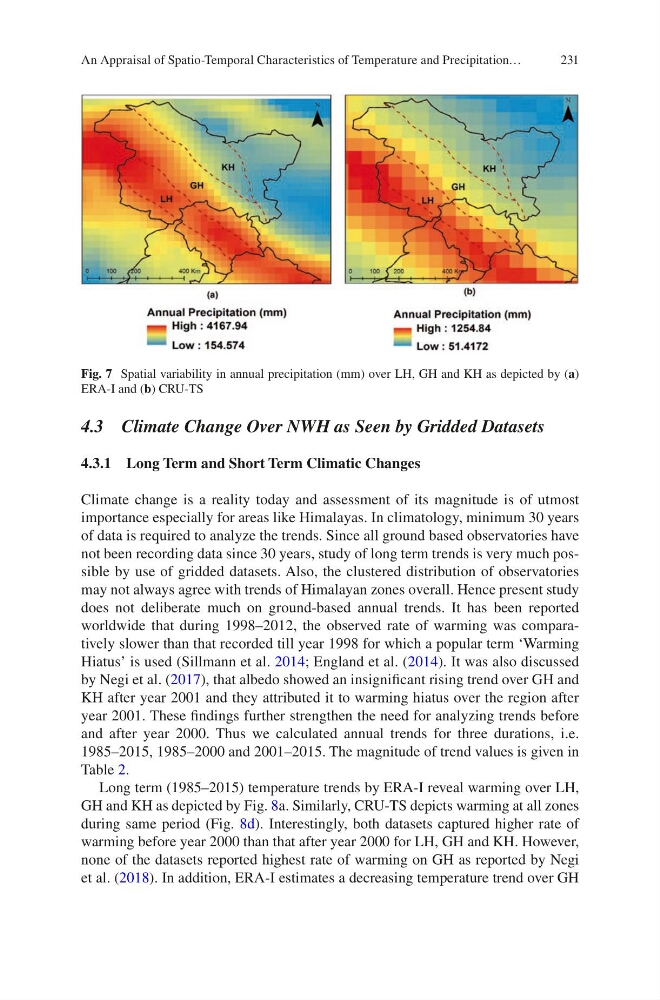
Fig. 7 Spatial variability in annual precipitation (mm) over LH, GH and KH as depicted by (a)
ERA-I and (b) CRU-TS
An Appraisal of Spatio-Temporal Characteristics of Temperature and Precipitation…
4.3 Climate Change Over NWH as Seen by Gridded Datasets
4.3.1 Long Term and Short Term Climatic Changes
Climate change is a reality today and assessment of its magnitude is of utmost
importance especially for areas like Himalayas. In climatology, minimum 30 years
of data is required to analyze the trends. Since all ground based observatories have
not been recording data since 30 years, study of long term trends is very much possible by use of gridded datasets. Also, the clustered distribution of observatories
may not always agree with trends of Himalayan zones overall. Hence present study
does not deliberate much on ground-based annual trends. It has been reported
worldwide that during 1998–2012, the observed rate of warming was comparatively slower than that recorded till year 1998 for which a popular term ‘Warming
Hiatus’ is used (Sillmann et al. 2014; England et al. (2014). It was also discussed
by Negi et al. (2017), that albedo showed an insignificant rising trend over GH and
KH after year 2001 and they attributed it to warming hiatus over the region after
year 2001. These findings further strengthen the need for analyzing trends before
and after year 2000. Thus we calculated annual trends for three durations, i.e.
1985–2015, 1985–2000 and 2001–2015. The magnitude of trend values is given in
Table 2.
Long term (1985–2015) temperature trends by ERA-I reveal warming over LH,
GH and KH as depicted by Fig. 8a. Similarly, CRU-TS depicts warming at all zones
during same period (Fig. 8d). Interestingly, both datasets captured higher rate of
warming before year 2000 than that after year 2000 for LH, GH and KH. However,
none of the datasets reported highest rate of warming on GH as reported by Negi
et al. (2018). In addition, ERA-I estimates a decreasing temperature trend over GH
Fig. 7 Spatial variability in annual precipitation (mm) over LH, GH and KH as depicted by (a)
ERA-I and (b) CRU-TS
An Appraisal of Spatio-Temporal Characteristics of Temperature and Precipitation…