

195
terrace and re-deposited sediment in the form of younger alluvial fans. In the narrow
valley segments, remnants of alluvial fans are dominant.
The sector-wise detailed account of valley morphology is discussed forward.
3.1.1 Sector-I
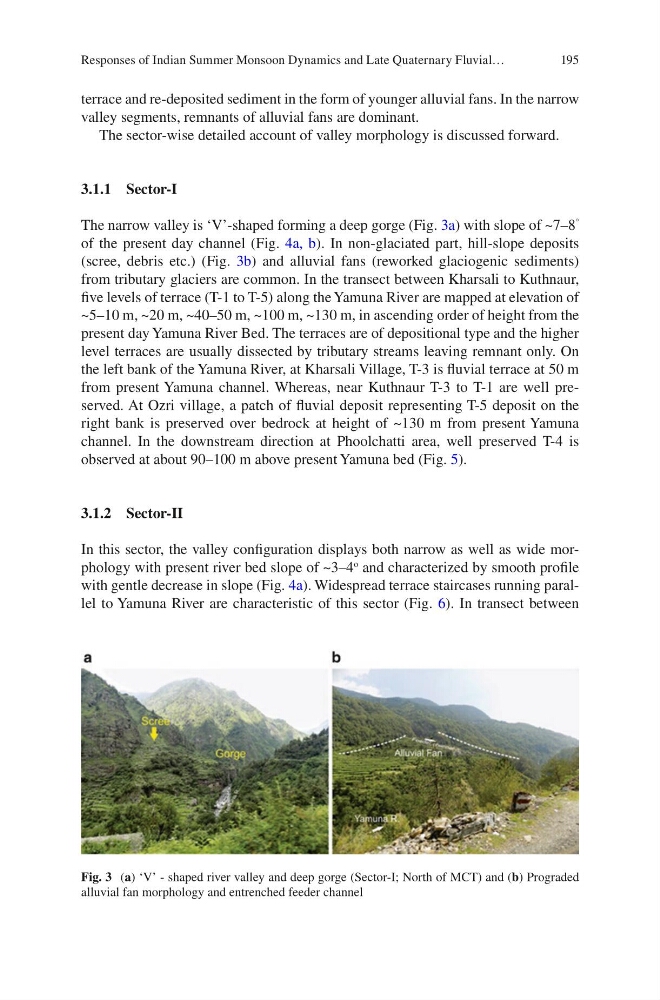
The narrow valley is ‘V’-shaped forming a deep gorge (Fig. 3a) with slope of ~7–8
°
of the present day channel (Fig. 4a, b). In non-glaciated part, hill-slope deposits
(scree, debris etc.) (Fig. 3b) and alluvial fans (reworked glaciogenic sediments)
from tributary glaciers are common. In the transect between Kharsali to Kuthnaur,
five levels of terrace (T-1 to T-5) along the Yamuna River are mapped at elevation of
~5–10 m, ~20 m, ~40–50 m, ~100 m, ~130 m, in ascending order of height from the
present day Yamuna River Bed. The terraces are of depositional type and the higher
level terraces are usually dissected by tributary streams leaving remnant only. On
the left bank of the Yamuna River, at Kharsali Village, T-3 is fluvial terrace at 50 m
from present Yamuna channel. Whereas, near Kuthnaur T-3 to T-1 are well preserved. At Ozri village, a patch of fluvial deposit representing T-5 deposit on the
right bank is preserved over bedrock at height of ~130 m from present Yamuna
channel. In the downstream direction at Phoolchatti area, well preserved T-4 is
observed at about 90–100 m above present Yamuna bed (Fig. 5).
3.1.2 Sector-II
In this sector, the valley configuration displays both narrow as well as wide morphology with present river bed slope of ~3–4
o
and characterized by smooth profile
with gentle decrease in slope (Fig. 4a). Widespread terrace staircases running parallel to Yamuna River are characteristic of this sector (Fig. 6). In transect between
Fig. 3 (a) ‘V’ - shaped river valley and deep gorge (Sector-I; North of MCT) and (b) Prograded
alluvial fan morphology and entrenched feeder channel
Responses of Indian Summer Monsoon Dynamics and Late Quaternary Fluvial…
terrace and re-deposited sediment in the form of younger alluvial fans. In the narrow
valley segments, remnants of alluvial fans are dominant.
The sector-wise detailed account of valley morphology is discussed forward.
3.1.1 Sector-I
The narrow valley is ‘V’-shaped forming a deep gorge (Fig. 3a) with slope of ~7–8
°
of the present day channel (Fig. 4a, b). In non-glaciated part, hill-slope deposits
(scree, debris etc.) (Fig. 3b) and alluvial fans (reworked glaciogenic sediments)
from tributary glaciers are common. In the transect between Kharsali to Kuthnaur,
five levels of terrace (T-1 to T-5) along the Yamuna River are mapped at elevation of
~5–10 m, ~20 m, ~40–50 m, ~100 m, ~130 m, in ascending order of height from the
present day Yamuna River Bed. The terraces are of depositional type and the higher
level terraces are usually dissected by tributary streams leaving remnant only. On
the left bank of the Yamuna River, at Kharsali Village, T-3 is fluvial terrace at 50 m
from present Yamuna channel. Whereas, near Kuthnaur T-3 to T-1 are well preserved. At Ozri village, a patch of fluvial deposit representing T-5 deposit on the
right bank is preserved over bedrock at height of ~130 m from present Yamuna
channel. In the downstream direction at Phoolchatti area, well preserved T-4 is
observed at about 90–100 m above present Yamuna bed (Fig. 5).
3.1.2 Sector-II
In this sector, the valley configuration displays both narrow as well as wide morphology with present river bed slope of ~3–4
o
and characterized by smooth profile
with gentle decrease in slope (Fig. 4a). Widespread terrace staircases running parallel to Yamuna River are characteristic of this sector (Fig. 6). In transect between
Fig. 3 (a) ‘V’ - shaped river valley and deep gorge (Sector-I; North of MCT) and (b) Prograded
alluvial fan morphology and entrenched feeder channel
Responses of Indian Summer Monsoon Dynamics and Late Quaternary Fluvial…