

194
broad as well as narrow ‘V’ -shaped valley morphology in Lesser Himalayan transect (MCT to MBT). From the mountainous catchment, the Trunk River is fed by
numerous glacial fed perennial as well as monsoon fed ephemeral tributaries that
descend to Trunk River showing variable slopes.
Along the Yamuna River Valley, Late Quaternary alluvial deposits are preserved
in the form of fluvial terraces (Yamuna River terrace; YRT) and local fan terraces
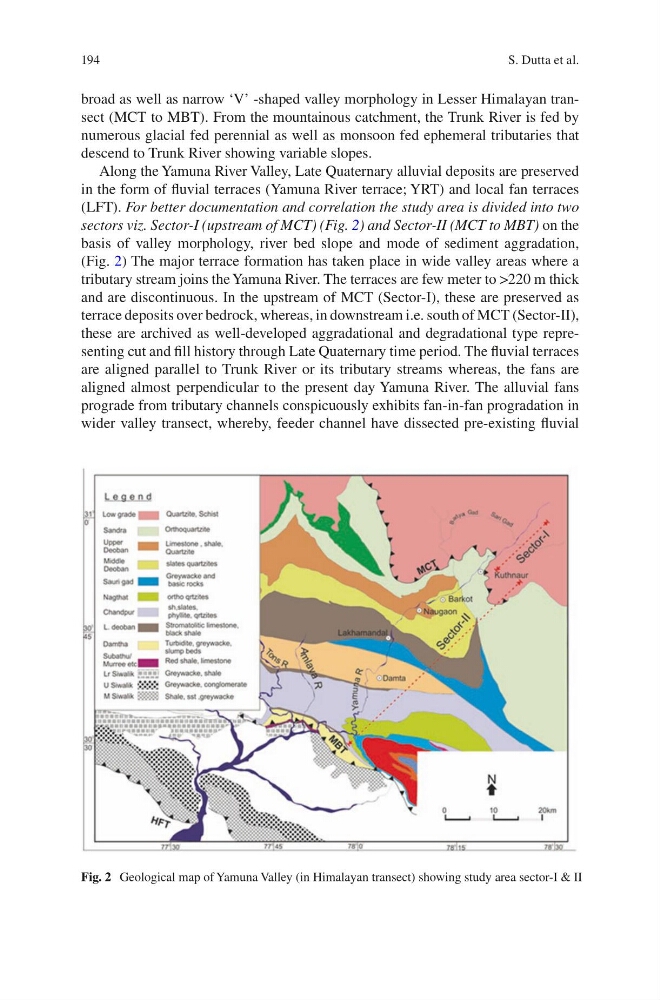
(LFT). For better documentation and correlation the study area is divided into two
sectors viz. Sector-I (upstream of MCT) (Fig. 2) and Sector-II (MCT to MBT) on the
basis of valley morphology, river bed slope and mode of sediment aggradation,
(Fig. 2) The major terrace formation has taken place in wide valley areas where a
tributary stream joins the Yamuna River. The terraces are few meter to >220 m thick
and are discontinuous. In the upstream of MCT (Sector-I), these are preserved as
terrace deposits over bedrock, whereas, in downstream i.e. south of MCT (Sector-II),
these are archived as well-developed aggradational and degradational type representing cut and fill history through Late Quaternary time period. The fluvial terraces
are aligned parallel to Trunk River or its tributary streams whereas, the fans are
aligned almost perpendicular to the present day Yamuna River. The alluvial fans
prograde from tributary channels conspicuously exhibits fan-in-fan progradation in
wider valley transect, whereby, feeder channel have dissected pre-existing fluvial
Fig. 2 Geological map of Yamuna Valley (in Himalayan transect) showing study area sector-I & II
S. Dutta et al.
broad as well as narrow ‘V’ -shaped valley morphology in Lesser Himalayan transect (MCT to MBT). From the mountainous catchment, the Trunk River is fed by
numerous glacial fed perennial as well as monsoon fed ephemeral tributaries that
descend to Trunk River showing variable slopes.
Along the Yamuna River Valley, Late Quaternary alluvial deposits are preserved
in the form of fluvial terraces (Yamuna River terrace; YRT) and local fan terraces
(LFT). For better documentation and correlation the study area is divided into two
sectors viz. Sector-I (upstream of MCT) (Fig. 2) and Sector-II (MCT to MBT) on the
basis of valley morphology, river bed slope and mode of sediment aggradation,
(Fig. 2) The major terrace formation has taken place in wide valley areas where a
tributary stream joins the Yamuna River. The terraces are few meter to >220 m thick
and are discontinuous. In the upstream of MCT (Sector-I), these are preserved as
terrace deposits over bedrock, whereas, in downstream i.e. south of MCT (Sector-II),
these are archived as well-developed aggradational and degradational type representing cut and fill history through Late Quaternary time period. The fluvial terraces
are aligned parallel to Trunk River or its tributary streams whereas, the fans are
aligned almost perpendicular to the present day Yamuna River. The alluvial fans
prograde from tributary channels conspicuously exhibits fan-in-fan progradation in
wider valley transect, whereby, feeder channel have dissected pre-existing fluvial
Fig. 2 Geological map of Yamuna Valley (in Himalayan transect) showing study area sector-I & II
S. Dutta et al.