

178
Besides, some of the ground water must be contributing to the glacier runoff below
the snout.
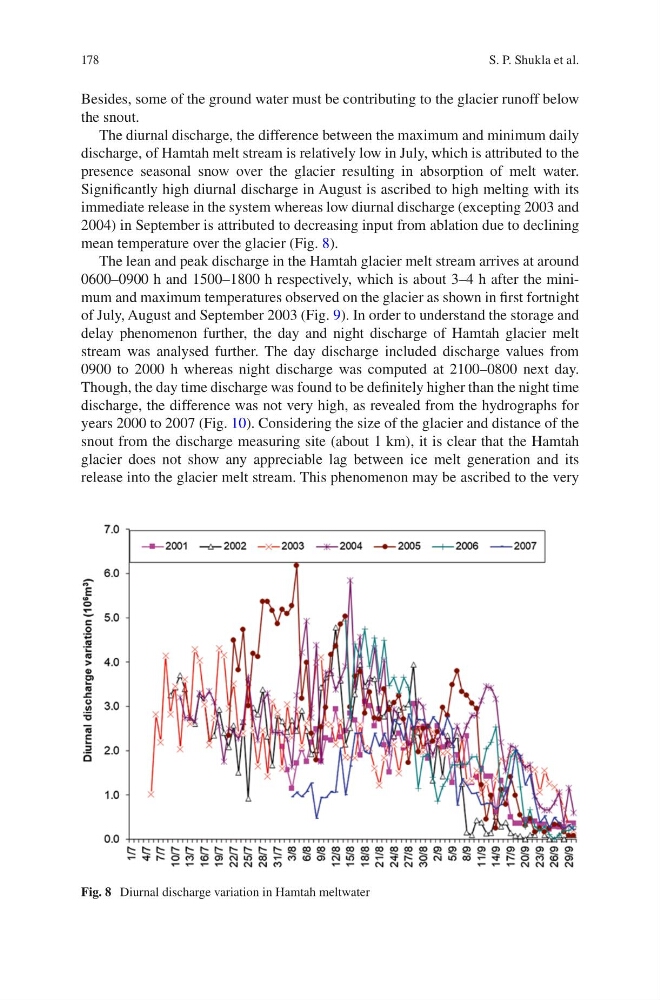
The diurnal discharge, the difference between the maximum and minimum daily
discharge, of Hamtah melt stream is relatively low in July, which is attributed to the
presence seasonal snow over the glacier resulting in absorption of melt water.
Significantly high diurnal discharge in August is ascribed to high melting with its
immediate release in the system whereas low diurnal discharge (excepting 2003 and
2004) in September is attributed to decreasing input from ablation due to declining
mean temperature over the glacier (Fig. 8).
The lean and peak discharge in the Hamtah glacier melt stream arrives at around
0600–0900 h and 1500–1800 h respectively, which is about 3–4 h after the minimum and maximum temperatures observed on the glacier as shown in first fortnight
of July, August and September 2003 (Fig. 9). In order to understand the storage and
delay phenomenon further, the day and night discharge of Hamtah glacier melt
stream was analysed further. The day discharge included discharge values from
0900 to 2000 h whereas night discharge was computed at 2100–0800 next day.
Though, the day time discharge was found to be definitely higher than the night time
discharge, the difference was not very high, as revealed from the hydrographs for
years 2000 to 2007 (Fig. 10). Considering the size of the glacier and distance of the
snout from the discharge measuring site (about 1 km), it is clear that the Hamtah
glacier does not show any appreciable lag between ice melt generation and its
release into the glacier melt stream. This phenomenon may be ascribed to the very
Fig. 8 Diurnal discharge variation in Hamtah meltwater
S. P. Shukla et al.
Besides, some of the ground water must be contributing to the glacier runoff below
the snout.
The diurnal discharge, the difference between the maximum and minimum daily
discharge, of Hamtah melt stream is relatively low in July, which is attributed to the
presence seasonal snow over the glacier resulting in absorption of melt water.
Significantly high diurnal discharge in August is ascribed to high melting with its
immediate release in the system whereas low diurnal discharge (excepting 2003 and
2004) in September is attributed to decreasing input from ablation due to declining
mean temperature over the glacier (Fig. 8).
The lean and peak discharge in the Hamtah glacier melt stream arrives at around
0600–0900 h and 1500–1800 h respectively, which is about 3–4 h after the minimum and maximum temperatures observed on the glacier as shown in first fortnight
of July, August and September 2003 (Fig. 9). In order to understand the storage and
delay phenomenon further, the day and night discharge of Hamtah glacier melt
stream was analysed further. The day discharge included discharge values from
0900 to 2000 h whereas night discharge was computed at 2100–0800 next day.
Though, the day time discharge was found to be definitely higher than the night time
discharge, the difference was not very high, as revealed from the hydrographs for
years 2000 to 2007 (Fig. 10). Considering the size of the glacier and distance of the
snout from the discharge measuring site (about 1 km), it is clear that the Hamtah
glacier does not show any appreciable lag between ice melt generation and its
release into the glacier melt stream. This phenomenon may be ascribed to the very
Fig. 8 Diurnal discharge variation in Hamtah meltwater
S. P. Shukla et al.