

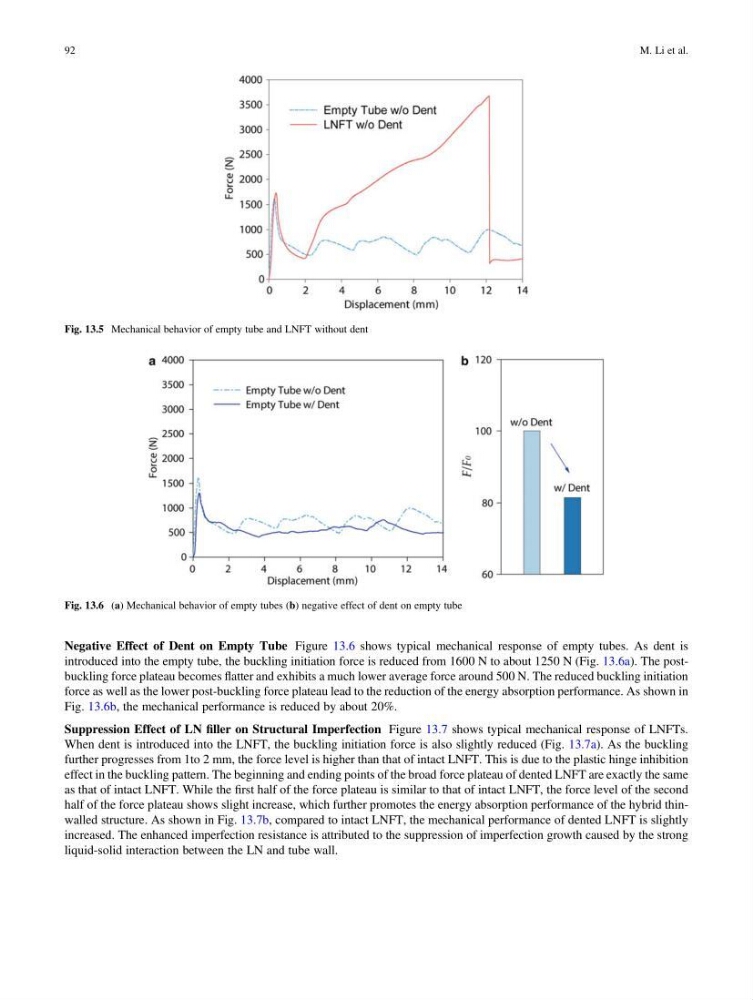
Negative Effect of Dent on Empty Tube Figure 13.6 shows typical mechanical response of empty tubes. As dent is
introduced into the empty tube, the buckling initiation force is reduced from 1600 N to about 1250 N (Fig. 13.6a). The postbuckling force plateau becomes flatter and exhibits a much lower average force around 500 N. The reduced buckling initiation
force as well as the lower post-buckling force plateau lead to the reduction of the energy absorption performance. As shown in
Fig. 13.6b, the mechanical performance is reduced by about 20%.
Suppression Effect of LN filler on Structural Imperfection Figure 13.7 shows typical mechanical response of LNFTs.
When dent is introduced into the LNFT, the buckling initiation force is also slightly reduced (Fig. 13.7a). As the buckling
further progresses from 1to 2 mm, the force level is higher than that of intact LNFT. This is due to the plastic hinge inhibition
effect in the buckling pattern. The beginning and ending points of the broad force plateau of dented LNFT are exactly the same
as that of intact LNFT. While the first half of the force plateau is similar to that of intact LNFT, the force level of the second
half of the force plateau shows slight increase, which further promotes the energy absorption performance of the hybrid thinwalled structure. As shown in Fig. 13.7b, compared to intact LNFT, the mechanical performance of dented LNFT is slightly
increased. The enhanced imperfection resistance is attributed to the suppression of imperfection growth caused by the strong
liquid-solid interaction between the LN and tube wall.
Fig. 13.5 Mechanical behavior of empty tube and LNFT without dent
Fig. 13.6 (a) Mechanical behavior of empty tubes (b) negative effect of dent on empty tube
92
M. Li et al.
introduced into the empty tube, the buckling initiation force is reduced from 1600 N to about 1250 N (Fig. 13.6a). The postbuckling force plateau becomes flatter and exhibits a much lower average force around 500 N. The reduced buckling initiation
force as well as the lower post-buckling force plateau lead to the reduction of the energy absorption performance. As shown in
Fig. 13.6b, the mechanical performance is reduced by about 20%.
Suppression Effect of LN filler on Structural Imperfection Figure 13.7 shows typical mechanical response of LNFTs.
When dent is introduced into the LNFT, the buckling initiation force is also slightly reduced (Fig. 13.7a). As the buckling
further progresses from 1to 2 mm, the force level is higher than that of intact LNFT. This is due to the plastic hinge inhibition
effect in the buckling pattern. The beginning and ending points of the broad force plateau of dented LNFT are exactly the same
as that of intact LNFT. While the first half of the force plateau is similar to that of intact LNFT, the force level of the second
half of the force plateau shows slight increase, which further promotes the energy absorption performance of the hybrid thinwalled structure. As shown in Fig. 13.7b, compared to intact LNFT, the mechanical performance of dented LNFT is slightly
increased. The enhanced imperfection resistance is attributed to the suppression of imperfection growth caused by the strong
liquid-solid interaction between the LN and tube wall.
Fig. 13.5 Mechanical behavior of empty tube and LNFT without dent
Fig. 13.6 (a) Mechanical behavior of empty tubes (b) negative effect of dent on empty tube
92
M. Li et al.