

13.3 Results
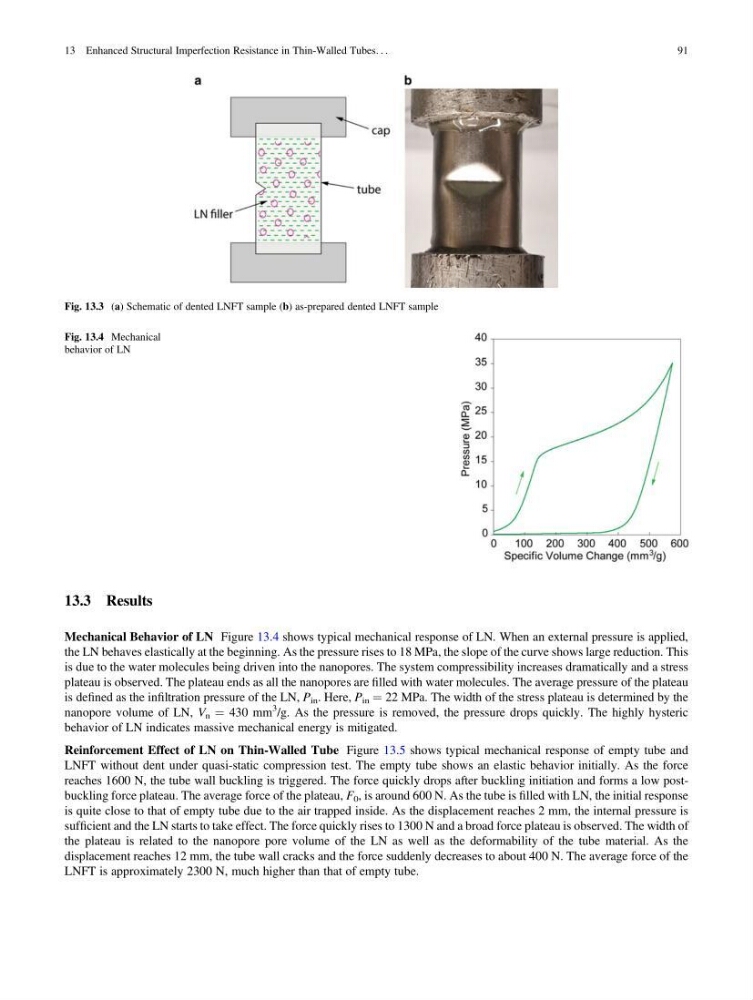
Mechanical Behavior of LN Figure 13.4 shows typical mechanical response of LN. When an external pressure is applied,
the LN behaves elastically at the beginning. As the pressure rises to 18 MPa, the slope of the curve shows large reduction. This
is due to the water molecules being driven into the nanopores. The system compressibility increases dramatically and a stress
plateau is observed. The plateau ends as all the nanopores are filled with water molecules. The average pressure of the plateau
is defined as the infiltration pressure of the LN, P in . Here, P in ¼ 22 MPa. The width of the stress plateau is determined by the
nanopore volume of LN, V n ¼ 430 mm
3 /g. As the pressure is removed, the pressure drops quickly. The highly hysteric
behavior of LN indicates massive mechanical energy is mitigated.
Reinforcement Effect of LN on Thin-Walled Tube Figure 13.5 shows typical mechanical response of empty tube and
LNFT without dent under quasi-static compression test. The empty tube shows an elastic behavior initially. As the force
reaches 1600 N, the tube wall buckling is triggered. The force quickly drops after buckling initiation and forms a low postbuckling force plateau. The average force of the plateau, F 0 , is around 600 N. As the tube is filled with LN, the initial response
is quite close to that of empty tube due to the air trapped inside. As the displacement reaches 2 mm, the internal pressure is
sufficient and the LN starts to take effect. The force quickly rises to 1300 N and a broad force plateau is observed. The width of
the plateau is related to the nanopore pore volume of the LN as well as the deformability of the tube material. As the
displacement reaches 12 mm, the tube wall cracks and the force suddenly decreases to about 400 N. The average force of the
LNFT is approximately 2300 N, much higher than that of empty tube.
Fig. 13.3 (a) Schematic of dented LNFT sample (b) as-prepared dented LNFT sample
Fig. 13.4 Mechanical
behavior of LN
13 Enhanced Structural Imperfection Resistance in Thin-Walled Tubes. . .
91
Mechanical Behavior of LN Figure 13.4 shows typical mechanical response of LN. When an external pressure is applied,
the LN behaves elastically at the beginning. As the pressure rises to 18 MPa, the slope of the curve shows large reduction. This
is due to the water molecules being driven into the nanopores. The system compressibility increases dramatically and a stress
plateau is observed. The plateau ends as all the nanopores are filled with water molecules. The average pressure of the plateau
is defined as the infiltration pressure of the LN, P in . Here, P in ¼ 22 MPa. The width of the stress plateau is determined by the
nanopore volume of LN, V n ¼ 430 mm
3 /g. As the pressure is removed, the pressure drops quickly. The highly hysteric
behavior of LN indicates massive mechanical energy is mitigated.
Reinforcement Effect of LN on Thin-Walled Tube Figure 13.5 shows typical mechanical response of empty tube and
LNFT without dent under quasi-static compression test. The empty tube shows an elastic behavior initially. As the force
reaches 1600 N, the tube wall buckling is triggered. The force quickly drops after buckling initiation and forms a low postbuckling force plateau. The average force of the plateau, F 0 , is around 600 N. As the tube is filled with LN, the initial response
is quite close to that of empty tube due to the air trapped inside. As the displacement reaches 2 mm, the internal pressure is
sufficient and the LN starts to take effect. The force quickly rises to 1300 N and a broad force plateau is observed. The width of
the plateau is related to the nanopore pore volume of the LN as well as the deformability of the tube material. As the
displacement reaches 12 mm, the tube wall cracks and the force suddenly decreases to about 400 N. The average force of the
LNFT is approximately 2300 N, much higher than that of empty tube.
Fig. 13.3 (a) Schematic of dented LNFT sample (b) as-prepared dented LNFT sample
Fig. 13.4 Mechanical
behavior of LN
13 Enhanced Structural Imperfection Resistance in Thin-Walled Tubes. . .
91