

of concrete were prepared. For each concrete mixture the slump was determined in order to study the workability of each
mixture. As recommended by IS standards a cubical mould of size 150 Â 150 Â 150 mm were used to cast concrete specimens
to test compressive strength. During casting to eliminate the voids proper vibration was carried out using vibrating machine.
Surface of concrete was finished level using a trowel and along with other specification was marked properly on it. Finished
specimens were left to harden and removed from molds approximately after 24 h of casting and then they were put in water
tank containing potable water and were left for curing. Total 48 specimens were casted, for each test 3 samples from each mix
were tested in every case and the average values were used for analysis.
12.3.4 Testing of Specimens
Workability is a measure of the ease with which fresh mix of concrete can be handled, placed and compacted. To the fresh
concrete, the slump cone test was carried out to measure the uniformity and consistency of fresh concrete and also slump gives
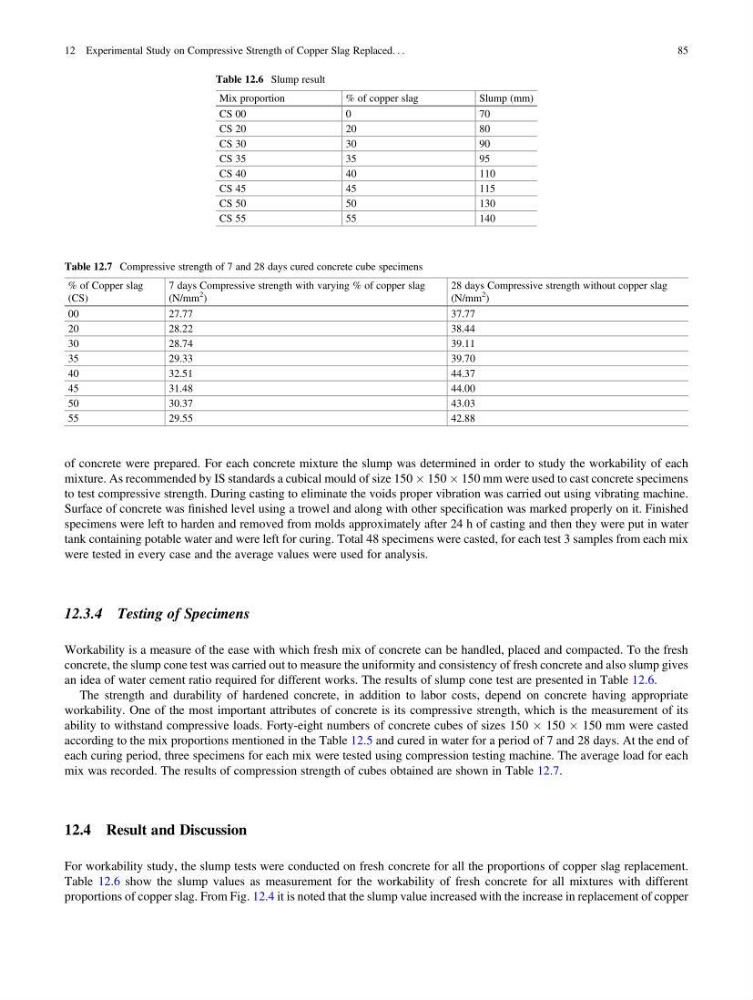
an idea of water cement ratio required for different works. The results of slump cone test are presented in Table 12.6.
The strength and durability of hardened concrete, in addition to labor costs, depend on concrete having appropriate
workability. One of the most important attributes of concrete is its compressive strength, which is the measurement of its
ability to withstand compressive loads. Forty-eight numbers of concrete cubes of sizes 150 Â 150 Â 150 mm were casted
according to the mix proportions mentioned in the Table 12.5 and cured in water for a period of 7 and 28 days. At the end of
each curing period, three specimens for each mix were tested using compression testing machine. The average load for each
mix was recorded. The results of compression strength of cubes obtained are shown in Table 12.7.
12.4 Result and Discussion
For workability study, the slump tests were conducted on fresh concrete for all the proportions of copper slag replacement.
Table 12.6 show the slump values as measurement for the workability of fresh concrete for all mixtures with different
proportions of copper slag. From Fig. 12.4 it is noted that the slump value increased with the increase in replacement of copper
Table 12.6 Slump result
Mix proportion
% of copper slag
Slump (mm)
CS 00
0
70
CS 20
20
80
CS 30
30
90
CS 35
35
95
CS 40
40
110
CS 45
45
115
CS 50
50
130
CS 55
55
140
Table 12.7 Compressive strength of 7 and 28 days cured concrete cube specimens
% of Copper slag
(CS)
7 days Compressive strength with varying % of copper slag
(N/mm
2
)
28 days Compressive strength without copper slag
(N/mm
2
)
00
27.77
37.77
20
28.22
38.44
30
28.74
39.11
35
29.33
39.70
40
32.51
44.37
45
31.48
44.00
50
30.37
43.03
55
29.55
42.88
12 Experimental Study on Compressive Strength of Copper Slag Replaced. . .
85
mixture. As recommended by IS standards a cubical mould of size 150 Â 150 Â 150 mm were used to cast concrete specimens
to test compressive strength. During casting to eliminate the voids proper vibration was carried out using vibrating machine.
Surface of concrete was finished level using a trowel and along with other specification was marked properly on it. Finished
specimens were left to harden and removed from molds approximately after 24 h of casting and then they were put in water
tank containing potable water and were left for curing. Total 48 specimens were casted, for each test 3 samples from each mix
were tested in every case and the average values were used for analysis.
12.3.4 Testing of Specimens
Workability is a measure of the ease with which fresh mix of concrete can be handled, placed and compacted. To the fresh
concrete, the slump cone test was carried out to measure the uniformity and consistency of fresh concrete and also slump gives
an idea of water cement ratio required for different works. The results of slump cone test are presented in Table 12.6.
The strength and durability of hardened concrete, in addition to labor costs, depend on concrete having appropriate
workability. One of the most important attributes of concrete is its compressive strength, which is the measurement of its
ability to withstand compressive loads. Forty-eight numbers of concrete cubes of sizes 150 Â 150 Â 150 mm were casted
according to the mix proportions mentioned in the Table 12.5 and cured in water for a period of 7 and 28 days. At the end of
each curing period, three specimens for each mix were tested using compression testing machine. The average load for each
mix was recorded. The results of compression strength of cubes obtained are shown in Table 12.7.
12.4 Result and Discussion
For workability study, the slump tests were conducted on fresh concrete for all the proportions of copper slag replacement.
Table 12.6 show the slump values as measurement for the workability of fresh concrete for all mixtures with different
proportions of copper slag. From Fig. 12.4 it is noted that the slump value increased with the increase in replacement of copper
Table 12.6 Slump result
Mix proportion
% of copper slag
Slump (mm)
CS 00
0
70
CS 20
20
80
CS 30
30
90
CS 35
35
95
CS 40
40
110
CS 45
45
115
CS 50
50
130
CS 55
55
140
Table 12.7 Compressive strength of 7 and 28 days cured concrete cube specimens
% of Copper slag
(CS)
7 days Compressive strength with varying % of copper slag
(N/mm
2
)
28 days Compressive strength without copper slag
(N/mm
2
)
00
27.77
37.77
20
28.22
38.44
30
28.74
39.11
35
29.33
39.70
40
32.51
44.37
45
31.48
44.00
50
30.37
43.03
55
29.55
42.88
12 Experimental Study on Compressive Strength of Copper Slag Replaced. . .
85