

conditions). Due to considerable dispersion of the test results, four specimens were tested for each test group to obtain average
values.
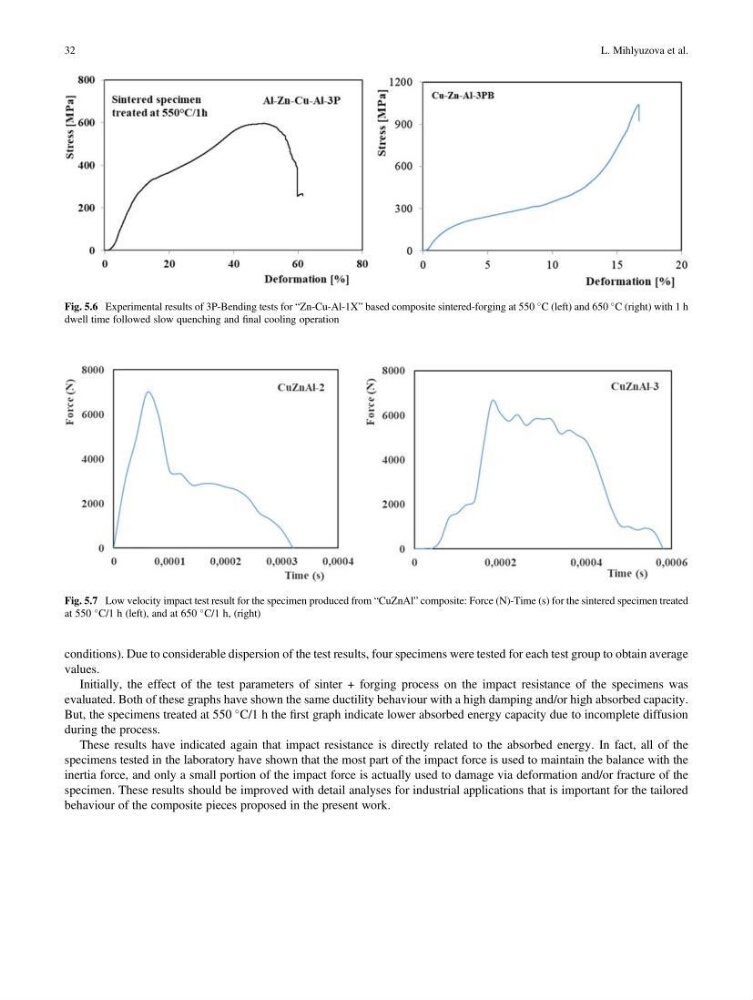
Initially, the effect of the test parameters of sinter + forging process on the impact resistance of the specimens was
evaluated. Both of these graphs have shown the same ductility behaviour with a high damping and/or high absorbed capacity.
But, the specimens treated at 550
C/1 h the first graph indicate lower absorbed energy capacity due to incomplete diffusion
during the process.
These results have indicated again that impact resistance is directly related to the absorbed energy. In fact, all of the
specimens tested in the laboratory have shown that the most part of the impact force is used to maintain the balance with the
inertia force, and only a small portion of the impact force is actually used to damage via deformation and/or fracture of the
specimen. These results should be improved with detail analyses for industrial applications that is important for the tailored
behaviour of the composite pieces proposed in the present work.
Fig. 5.6 Experimental results of 3P-Bending tests for “Zn-Cu-Al-1X” based composite sintered-forging at 550
C (left) and 650
C (right) with 1 h
dwell time followed slow quenching and final cooling operation
Fig. 5.7 Low velocity impact test result for the specimen produced from “CuZnAl” composite: Force (N)-Time (s) for the sintered specimen treated
at 550
C/1 h (left), and at 650
C/1 h, (right)
32
L. Mihlyuzova et al.
values.
Initially, the effect of the test parameters of sinter + forging process on the impact resistance of the specimens was
evaluated. Both of these graphs have shown the same ductility behaviour with a high damping and/or high absorbed capacity.
But, the specimens treated at 550
C/1 h the first graph indicate lower absorbed energy capacity due to incomplete diffusion
during the process.
These results have indicated again that impact resistance is directly related to the absorbed energy. In fact, all of the
specimens tested in the laboratory have shown that the most part of the impact force is used to maintain the balance with the
inertia force, and only a small portion of the impact force is actually used to damage via deformation and/or fracture of the
specimen. These results should be improved with detail analyses for industrial applications that is important for the tailored
behaviour of the composite pieces proposed in the present work.
Fig. 5.6 Experimental results of 3P-Bending tests for “Zn-Cu-Al-1X” based composite sintered-forging at 550
C (left) and 650
C (right) with 1 h
dwell time followed slow quenching and final cooling operation
Fig. 5.7 Low velocity impact test result for the specimen produced from “CuZnAl” composite: Force (N)-Time (s) for the sintered specimen treated
at 550
C/1 h (left), and at 650
C/1 h, (right)
32
L. Mihlyuzova et al.