

At the second stage of the microstructure analyses, certain amount of the specimens were also used for another type of
sintered-forging process carried out at the 550
C/1 h followed slow quenching and final cooling operation. As indicated at the
second section (experimental conditions) of the present paper, operational parameters such as sinter-forging temperature and
dwell time at that temperature influence of the ductility and transformation temperature.
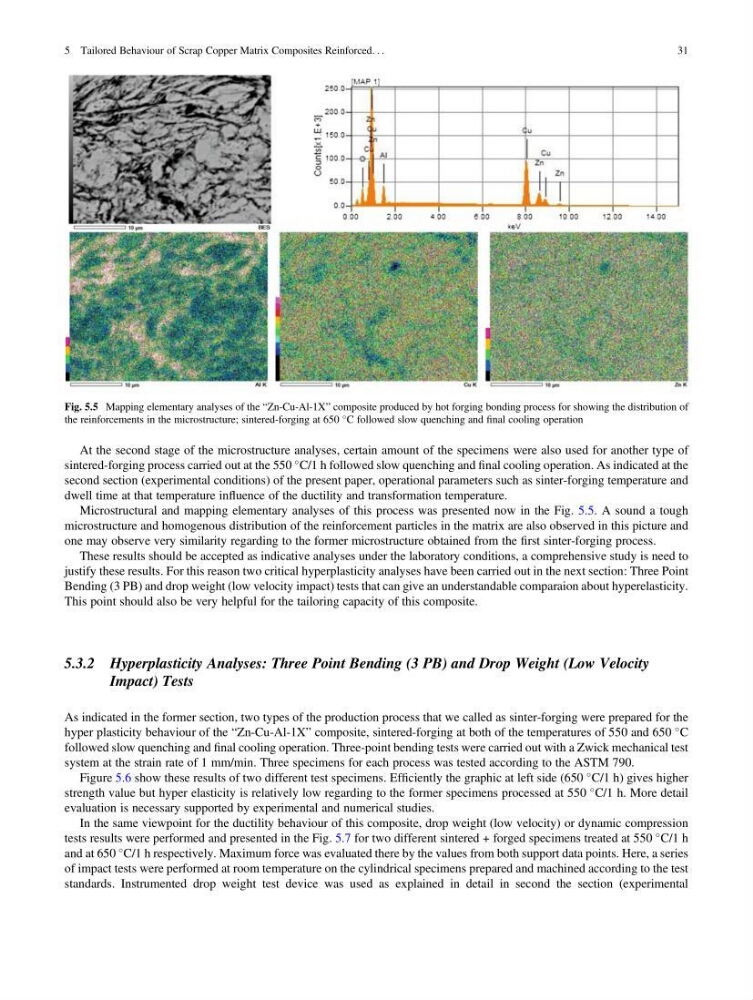
Microstructural and mapping elementary analyses of this process was presented now in the Fig. 5.5. A sound a tough
microstructure and homogenous distribution of the reinforcement particles in the matrix are also observed in this picture and
one may observe very similarity regarding to the former microstructure obtained from the first sinter-forging process.
These results should be accepted as indicative analyses under the laboratory conditions, a comprehensive study is need to
justify these results. For this reason two critical hyperplasticity analyses have been carried out in the next section: Three Point
Bending (3 PB) and drop weight (low velocity impact) tests that can give an understandable comparaion about hyperelasticity.
This point should also be very helpful for the tailoring capacity of this composite.
5.3.2 Hyperplasticity Analyses: Three Point Bending (3 PB) and Drop Weight (Low Velocity
Impact) Tests
As indicated in the former section, two types of the production process that we called as sinter-forging were prepared for the
hyper plasticity behaviour of the “Zn-Cu-Al-1X” composite, sintered-forging at both of the temperatures of 550 and 650
C
followed slow quenching and final cooling operation. Three-point bending tests were carried out with a Zwick mechanical test
system at the strain rate of 1 mm/min. Three specimens for each process was tested according to the ASTM 790.
Figure 5.6 show these results of two different test specimens. Efficiently the graphic at left side (650
C/1 h) gives higher
strength value but hyper elasticity is relatively low regarding to the former specimens processed at 550
C/1 h. More detail
evaluation is necessary supported by experimental and numerical studies.
In the same viewpoint for the ductility behaviour of this composite, drop weight (low velocity) or dynamic compression
tests results were performed and presented in the Fig. 5.7 for two different sintered + forged specimens treated at 550
C/1 h
and at 650
C/1 h respectively. Maximum force was evaluated there by the values from both support data points. Here, a series
of impact tests were performed at room temperature on the cylindrical specimens prepared and machined according to the test
standards. Instrumented drop weight test device was used as explained in detail in second the section (experimental
Fig. 5.5 Mapping elementary analyses of the “Zn-Cu-Al-1X” composite produced by hot forging bonding process for showing the distribution of
the reinforcements in the microstructure; sintered-forging at 650
C followed slow quenching and final cooling operation
5 Tailored Behaviour of Scrap Copper Matrix Composites Reinforced. . .
31
sintered-forging process carried out at the 550
C/1 h followed slow quenching and final cooling operation. As indicated at the
second section (experimental conditions) of the present paper, operational parameters such as sinter-forging temperature and
dwell time at that temperature influence of the ductility and transformation temperature.
Microstructural and mapping elementary analyses of this process was presented now in the Fig. 5.5. A sound a tough
microstructure and homogenous distribution of the reinforcement particles in the matrix are also observed in this picture and
one may observe very similarity regarding to the former microstructure obtained from the first sinter-forging process.
These results should be accepted as indicative analyses under the laboratory conditions, a comprehensive study is need to
justify these results. For this reason two critical hyperplasticity analyses have been carried out in the next section: Three Point
Bending (3 PB) and drop weight (low velocity impact) tests that can give an understandable comparaion about hyperelasticity.
This point should also be very helpful for the tailoring capacity of this composite.
5.3.2 Hyperplasticity Analyses: Three Point Bending (3 PB) and Drop Weight (Low Velocity
Impact) Tests
As indicated in the former section, two types of the production process that we called as sinter-forging were prepared for the
hyper plasticity behaviour of the “Zn-Cu-Al-1X” composite, sintered-forging at both of the temperatures of 550 and 650
C
followed slow quenching and final cooling operation. Three-point bending tests were carried out with a Zwick mechanical test
system at the strain rate of 1 mm/min. Three specimens for each process was tested according to the ASTM 790.
Figure 5.6 show these results of two different test specimens. Efficiently the graphic at left side (650
C/1 h) gives higher
strength value but hyper elasticity is relatively low regarding to the former specimens processed at 550
C/1 h. More detail
evaluation is necessary supported by experimental and numerical studies.
In the same viewpoint for the ductility behaviour of this composite, drop weight (low velocity) or dynamic compression
tests results were performed and presented in the Fig. 5.7 for two different sintered + forged specimens treated at 550
C/1 h
and at 650
C/1 h respectively. Maximum force was evaluated there by the values from both support data points. Here, a series
of impact tests were performed at room temperature on the cylindrical specimens prepared and machined according to the test
standards. Instrumented drop weight test device was used as explained in detail in second the section (experimental
Fig. 5.5 Mapping elementary analyses of the “Zn-Cu-Al-1X” composite produced by hot forging bonding process for showing the distribution of
the reinforcements in the microstructure; sintered-forging at 650
C followed slow quenching and final cooling operation
5 Tailored Behaviour of Scrap Copper Matrix Composites Reinforced. . .
31