

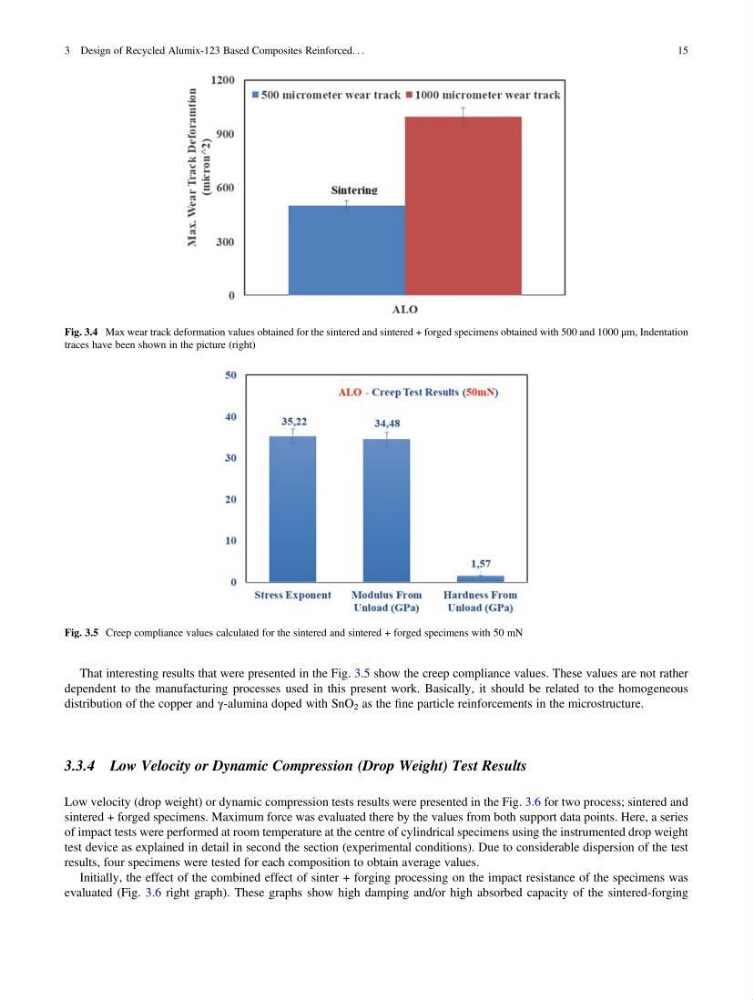
That interesting results that were presented in the Fig. 3.5 show the creep compliance values. These values are not rather
dependent to the manufacturing processes used in this present work. Basically, it should be related to the homogeneous
distribution of the copper and γ-alumina doped with SnO 2 as the fine particle reinforcements in the microstructure.
3.3.4 Low Velocity or Dynamic Compression (Drop Weight) Test Results
Low velocity (drop weight) or dynamic compression tests results were presented in the Fig. 3.6 for two process; sintered and
sintered + forged specimens. Maximum force was evaluated there by the values from both support data points. Here, a series
of impact tests were performed at room temperature at the centre of cylindrical specimens using the instrumented drop weight
test device as explained in detail in second the section (experimental conditions). Due to considerable dispersion of the test
results, four specimens were tested for each composition to obtain average values.
Initially, the effect of the combined effect of sinter + forging processing on the impact resistance of the specimens was
evaluated (Fig. 3.6 right graph). These graphs show high damping and/or high absorbed capacity of the sintered-forging
Fig. 3.4 Max wear track deformation values obtained for the sintered and sintered + forged specimens obtained with 500 and 1000 μm, Indentation
traces have been shown in the picture (right)
Fig. 3.5 Creep compliance values calculated for the sintered and sintered + forged specimens with 50 mN
3 Design of Recycled Alumix-123 Based Composites Reinforced. . .
15
dependent to the manufacturing processes used in this present work. Basically, it should be related to the homogeneous
distribution of the copper and γ-alumina doped with SnO 2 as the fine particle reinforcements in the microstructure.
3.3.4 Low Velocity or Dynamic Compression (Drop Weight) Test Results
Low velocity (drop weight) or dynamic compression tests results were presented in the Fig. 3.6 for two process; sintered and
sintered + forged specimens. Maximum force was evaluated there by the values from both support data points. Here, a series
of impact tests were performed at room temperature at the centre of cylindrical specimens using the instrumented drop weight
test device as explained in detail in second the section (experimental conditions). Due to considerable dispersion of the test
results, four specimens were tested for each composition to obtain average values.
Initially, the effect of the combined effect of sinter + forging processing on the impact resistance of the specimens was
evaluated (Fig. 3.6 right graph). These graphs show high damping and/or high absorbed capacity of the sintered-forging
Fig. 3.4 Max wear track deformation values obtained for the sintered and sintered + forged specimens obtained with 500 and 1000 μm, Indentation
traces have been shown in the picture (right)
Fig. 3.5 Creep compliance values calculated for the sintered and sintered + forged specimens with 50 mN
3 Design of Recycled Alumix-123 Based Composites Reinforced. . .
15