

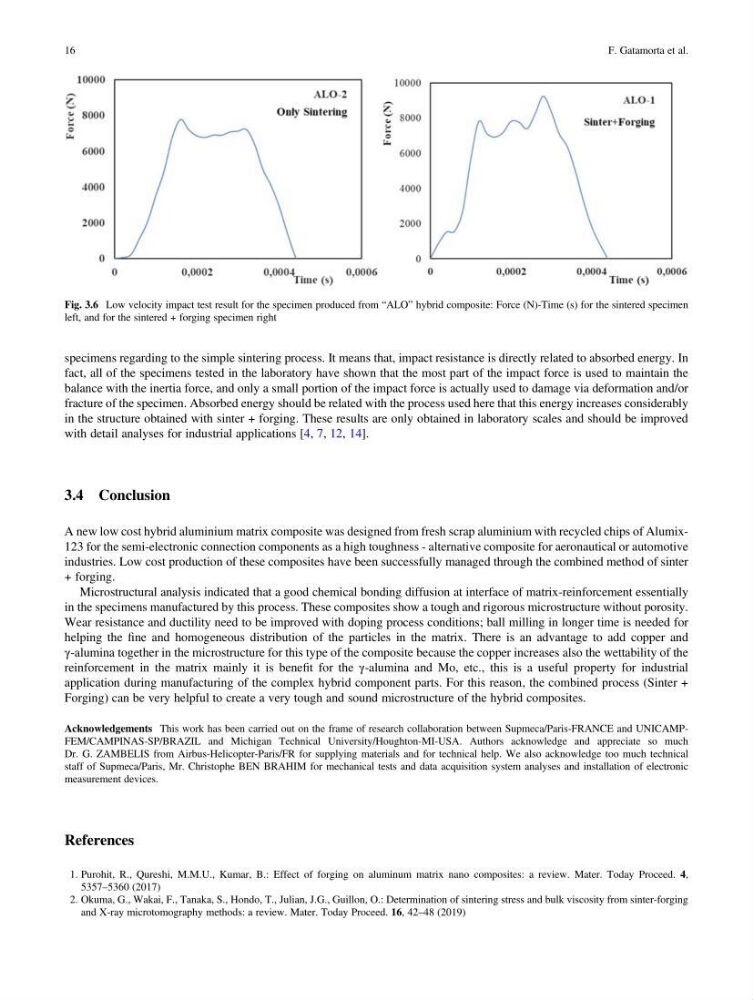
specimens regarding to the simple sintering process. It means that, impact resistance is directly related to absorbed energy. In
fact, all of the specimens tested in the laboratory have shown that the most part of the impact force is used to maintain the
balance with the inertia force, and only a small portion of the impact force is actually used to damage via deformation and/or
fracture of the specimen. Absorbed energy should be related with the process used here that this energy increases considerably
in the structure obtained with sinter + forging. These results are only obtained in laboratory scales and should be improved
with detail analyses for industrial applications [4, 7, 12, 14].
3.4 Conclusion
A new low cost hybrid aluminium matrix composite was designed from fresh scrap aluminium with recycled chips of Alumix123 for the semi-electronic connection components as a high toughness - alternative composite for aeronautical or automotive
industries. Low cost production of these composites have been successfully managed through the combined method of sinter
+ forging.
Microstructural analysis indicated that a good chemical bonding diffusion at interface of matrix-reinforcement essentially
in the specimens manufactured by this process. These composites show a tough and rigorous microstructure without porosity.
Wear resistance and ductility need to be improved with doping process conditions; ball milling in longer time is needed for
helping the fine and homogeneous distribution of the particles in the matrix. There is an advantage to add copper and
γ-alumina together in the microstructure for this type of the composite because the copper increases also the wettability of the
reinforcement in the matrix mainly it is benefit for the γ-alumina and Mo, etc., this is a useful property for industrial
application during manufacturing of the complex hybrid component parts. For this reason, the combined process (Sinter +
Forging) can be very helpful to create a very tough and sound microstructure of the hybrid composites.
Acknowledgements This work has been carried out on the frame of research collaboration between Supmeca/Paris-FRANCE and UNICAMPFEM/CAMPINAS-SP/BRAZIL and Michigan Technical University/Houghton-MI-USA. Authors acknowledge and appreciate so much
Dr. G. ZAMBELIS from Airbus-Helicopter-Paris/FR for supplying materials and for technical help. We also acknowledge too much technical
staff of Supmeca/Paris, Mr. Christophe BEN BRAHIM for mechanical tests and data acquisition system analyses and installation of electronic
measurement devices.
References
1. Purohit, R., Qureshi, M.M.U., Kumar, B.: Effect of forging on aluminum matrix nano composites: a review. Mater. Today Proceed. 4,
5357–5360 (2017)
2. Okuma, G., Wakai, F., Tanaka, S., Hondo, T., Julian, J.G., Guillon, O.: Determination of sintering stress and bulk viscosity from sinter-forging
and X-ray microtomography methods: a review. Mater. Today Proceed. 16, 42–48 (2019)
Fig. 3.6 Low velocity impact test result for the specimen produced from “ALO” hybrid composite: Force (N)-Time (s) for the sintered specimen
left, and for the sintered + forging specimen right
16
F. Gatamorta et al.
fact, all of the specimens tested in the laboratory have shown that the most part of the impact force is used to maintain the
balance with the inertia force, and only a small portion of the impact force is actually used to damage via deformation and/or
fracture of the specimen. Absorbed energy should be related with the process used here that this energy increases considerably
in the structure obtained with sinter + forging. These results are only obtained in laboratory scales and should be improved
with detail analyses for industrial applications [4, 7, 12, 14].
3.4 Conclusion
A new low cost hybrid aluminium matrix composite was designed from fresh scrap aluminium with recycled chips of Alumix123 for the semi-electronic connection components as a high toughness - alternative composite for aeronautical or automotive
industries. Low cost production of these composites have been successfully managed through the combined method of sinter
+ forging.
Microstructural analysis indicated that a good chemical bonding diffusion at interface of matrix-reinforcement essentially
in the specimens manufactured by this process. These composites show a tough and rigorous microstructure without porosity.
Wear resistance and ductility need to be improved with doping process conditions; ball milling in longer time is needed for
helping the fine and homogeneous distribution of the particles in the matrix. There is an advantage to add copper and
γ-alumina together in the microstructure for this type of the composite because the copper increases also the wettability of the
reinforcement in the matrix mainly it is benefit for the γ-alumina and Mo, etc., this is a useful property for industrial
application during manufacturing of the complex hybrid component parts. For this reason, the combined process (Sinter +
Forging) can be very helpful to create a very tough and sound microstructure of the hybrid composites.
Acknowledgements This work has been carried out on the frame of research collaboration between Supmeca/Paris-FRANCE and UNICAMPFEM/CAMPINAS-SP/BRAZIL and Michigan Technical University/Houghton-MI-USA. Authors acknowledge and appreciate so much
Dr. G. ZAMBELIS from Airbus-Helicopter-Paris/FR for supplying materials and for technical help. We also acknowledge too much technical
staff of Supmeca/Paris, Mr. Christophe BEN BRAHIM for mechanical tests and data acquisition system analyses and installation of electronic
measurement devices.
References
1. Purohit, R., Qureshi, M.M.U., Kumar, B.: Effect of forging on aluminum matrix nano composites: a review. Mater. Today Proceed. 4,
5357–5360 (2017)
2. Okuma, G., Wakai, F., Tanaka, S., Hondo, T., Julian, J.G., Guillon, O.: Determination of sintering stress and bulk viscosity from sinter-forging
and X-ray microtomography methods: a review. Mater. Today Proceed. 16, 42–48 (2019)
Fig. 3.6 Low velocity impact test result for the specimen produced from “ALO” hybrid composite: Force (N)-Time (s) for the sintered specimen
left, and for the sintered + forging specimen right
16
F. Gatamorta et al.