

The determination of the thermal parameters of the alloy, are made from the energy flow curve by temperature, finding
curves of its first and second order derivatives. The values found for Tsolidus temperature ¼ 555
C and Tliquidus ¼ 655
C
and are consistent when compared with the theoretical reference values present in the Metals Handbook [10]. Having a
temperature range of 100 K, that is, less than the 130 K recommended by LIU et al. [5].
From empirical tests, liquid fractions between 75% to 85% of the thixotropic paste result in better conditions for the
thixoinfiltration process, due to the lower necessary infiltration forces, therefore the temperature range of 644 to 646
C was
selected as working temperature for presenting from 75.382% to 85.425% of liquid fraction under these conditions.
The micro ceramic balloons used come from the by-product of coal combustion from thermoelectric plants, known as Fly
Ash. As they have a density between 0.6 and 0.8 g/cm
3 , they are ideal to be applied in the production of syntactic metallic
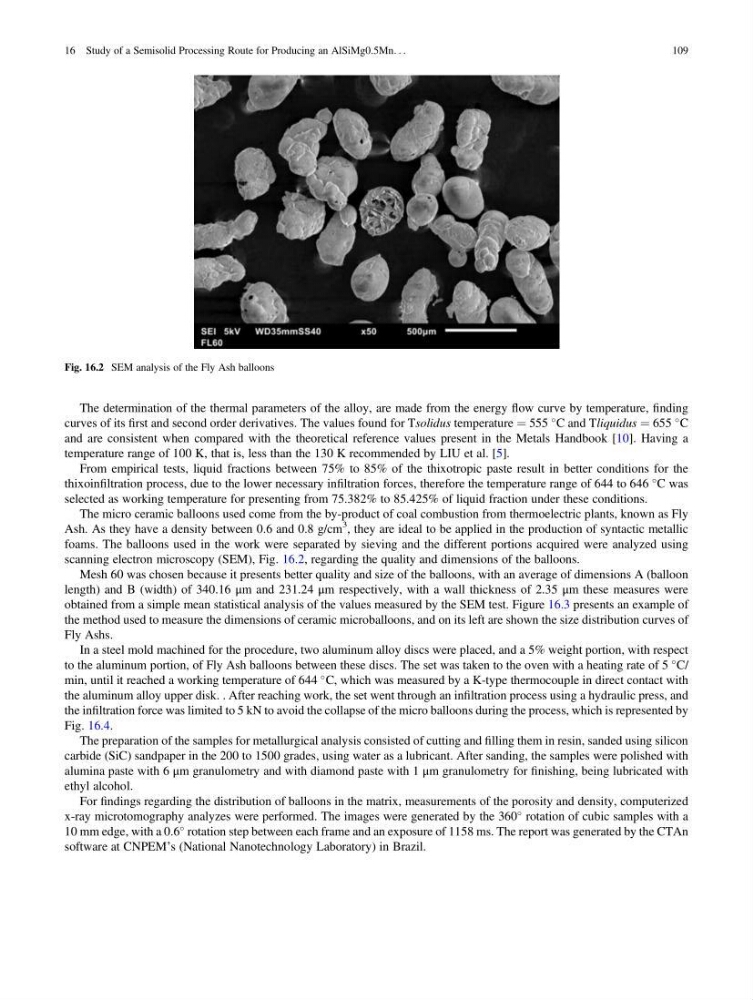
foams. The balloons used in the work were separated by sieving and the different portions acquired were analyzed using
scanning electron microscopy (SEM), Fig. 16.2, regarding the quality and dimensions of the balloons.
Mesh 60 was chosen because it presents better quality and size of the balloons, with an average of dimensions A (balloon
length) and B (width) of 340.16 μm and 231.24 μm respectively, with a wall thickness of 2.35 μm these measures were
obtained from a simple mean statistical analysis of the values measured by the SEM test. Figure 16.3 presents an example of
the method used to measure the dimensions of ceramic microballoons, and on its left are shown the size distribution curves of
Fly Ashs.
In a steel mold machined for the procedure, two aluminum alloy discs were placed, and a 5% weight portion, with respect
to the aluminum portion, of Fly Ash balloons between these discs. The set was taken to the oven with a heating rate of 5
C/
min, until it reached a working temperature of 644
C, which was measured by a K-type thermocouple in direct contact with
the aluminum alloy upper disk. . After reaching work, the set went through an infiltration process using a hydraulic press, and
the infiltration force was limited to 5 kN to avoid the collapse of the micro balloons during the process, which is represented by
Fig. 16.4.
The preparation of the samples for metallurgical analysis consisted of cutting and filling them in resin, sanded using silicon
carbide (SiC) sandpaper in the 200 to 1500 grades, using water as a lubricant. After sanding, the samples were polished with
alumina paste with 6 μm granulometry and with diamond paste with 1 μm granulometry for finishing, being lubricated with
ethyl alcohol.
For findings regarding the distribution of balloons in the matrix, measurements of the porosity and density, computerized
x-ray microtomography analyzes were performed. The images were generated by the 360
rotation of cubic samples with a
10 mm edge, with a 0.6
rotation step between each frame and an exposure of 1158 ms. The report was generated by the CTAn
software at CNPEM’s (National Nanotechnology Laboratory) in Brazil.
Fig. 16.2 SEM analysis of the Fly Ash balloons
16 Study of a Semisolid Processing Route for Producing an AlSiMg0.5Mn. . .
109
curves of its first and second order derivatives. The values found for Tsolidus temperature ¼ 555
C and Tliquidus ¼ 655
C
and are consistent when compared with the theoretical reference values present in the Metals Handbook [10]. Having a
temperature range of 100 K, that is, less than the 130 K recommended by LIU et al. [5].
From empirical tests, liquid fractions between 75% to 85% of the thixotropic paste result in better conditions for the
thixoinfiltration process, due to the lower necessary infiltration forces, therefore the temperature range of 644 to 646
C was
selected as working temperature for presenting from 75.382% to 85.425% of liquid fraction under these conditions.
The micro ceramic balloons used come from the by-product of coal combustion from thermoelectric plants, known as Fly
Ash. As they have a density between 0.6 and 0.8 g/cm
3 , they are ideal to be applied in the production of syntactic metallic
foams. The balloons used in the work were separated by sieving and the different portions acquired were analyzed using
scanning electron microscopy (SEM), Fig. 16.2, regarding the quality and dimensions of the balloons.
Mesh 60 was chosen because it presents better quality and size of the balloons, with an average of dimensions A (balloon
length) and B (width) of 340.16 μm and 231.24 μm respectively, with a wall thickness of 2.35 μm these measures were
obtained from a simple mean statistical analysis of the values measured by the SEM test. Figure 16.3 presents an example of
the method used to measure the dimensions of ceramic microballoons, and on its left are shown the size distribution curves of
Fly Ashs.
In a steel mold machined for the procedure, two aluminum alloy discs were placed, and a 5% weight portion, with respect
to the aluminum portion, of Fly Ash balloons between these discs. The set was taken to the oven with a heating rate of 5
C/
min, until it reached a working temperature of 644
C, which was measured by a K-type thermocouple in direct contact with
the aluminum alloy upper disk. . After reaching work, the set went through an infiltration process using a hydraulic press, and
the infiltration force was limited to 5 kN to avoid the collapse of the micro balloons during the process, which is represented by
Fig. 16.4.
The preparation of the samples for metallurgical analysis consisted of cutting and filling them in resin, sanded using silicon
carbide (SiC) sandpaper in the 200 to 1500 grades, using water as a lubricant. After sanding, the samples were polished with
alumina paste with 6 μm granulometry and with diamond paste with 1 μm granulometry for finishing, being lubricated with
ethyl alcohol.
For findings regarding the distribution of balloons in the matrix, measurements of the porosity and density, computerized
x-ray microtomography analyzes were performed. The images were generated by the 360
rotation of cubic samples with a
10 mm edge, with a 0.6
rotation step between each frame and an exposure of 1158 ms. The report was generated by the CTAn
software at CNPEM’s (National Nanotechnology Laboratory) in Brazil.
Fig. 16.2 SEM analysis of the Fly Ash balloons
16 Study of a Semisolid Processing Route for Producing an AlSiMg0.5Mn. . .
109