

Processing in the semi-solid state can be performed by cooling the liquid metal to the semi-solid state in the operation
called re-melting [6], or by heating the solid metal to the semi-solid condition in the operation called thixoforming [7], if the
liquid fraction is below 50% or thixoinfiltration, in the case of liquid fractions above 50% [8].
The thixoforming process results in specific advantages in product quality such as low porosity due to trapping gases, lower
shrinkage and better mechanical properties, in addition to improvements related to mold life compared to conventional casting
processes due to lower metal temperature [9].
Some commonly used criteria for ability for semi-solid materials are [5]:
• Highest knee of the fraction versus temperature curve should occur between 30 and 50% of liquid fraction.
• The sensitivity of the liquid fraction in the 0.4 liquid fraction must be less than 3% of the fraction variation by K.
• Solidification interval, that is, the temperature interval between liquidus and solidus temperature should not be too large
(less than 130 K).
16.2 Materials and Methods
The material used in the metallic matrix was the aluminum alloy AlSiMg0.5Mn, which has silicon in its composition as the
main alloying element. The main factors that led to his choice were the wide commercial use, excellent resistance to corrosion
in the marine atmosphere, and potential thixoability. The values used as a reference for the characteristics and properties of the
alloy come from the Metals Handbook [10]. The material used had its chemical composition determined (Table 16.1) by the
atomic spectrometry equipment (EEA).
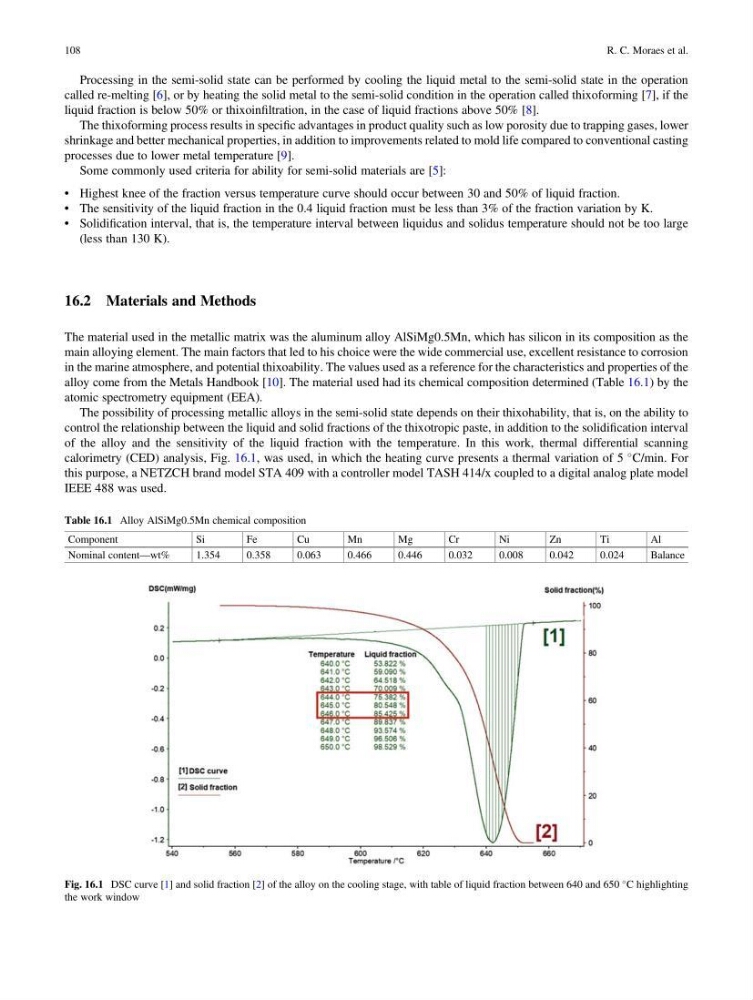
The possibility of processing metallic alloys in the semi-solid state depends on their thixohability, that is, on the ability to
control the relationship between the liquid and solid fractions of the thixotropic paste, in addition to the solidification interval
of the alloy and the sensitivity of the liquid fraction with the temperature. In this work, thermal differential scanning
calorimetry (CED) analysis, Fig. 16.1, was used, in which the heating curve presents a thermal variation of 5
C/min. For
this purpose, a NETZCH brand model STA 409 with a controller model TASH 414/x coupled to a digital analog plate model
IEEE 488 was used.
Table 16.1 Alloy AlSiMg0.5Mn chemical composition
Component
Si
Fe
Cu
Mn
Mg
Cr
Ni
Zn
Ti
Al
Nominal content—wt%
1.354
0.358
0.063
0.466
0.446
0.032
0.008
0.042
0.024
Balance
Fig. 16.1 DSC curve [1] and solid fraction [2] of the alloy on the cooling stage, with table of liquid fraction between 640 and 650
C highlighting
the work window
108
R. C. Moraes et al.
called re-melting [6], or by heating the solid metal to the semi-solid condition in the operation called thixoforming [7], if the
liquid fraction is below 50% or thixoinfiltration, in the case of liquid fractions above 50% [8].
The thixoforming process results in specific advantages in product quality such as low porosity due to trapping gases, lower
shrinkage and better mechanical properties, in addition to improvements related to mold life compared to conventional casting
processes due to lower metal temperature [9].
Some commonly used criteria for ability for semi-solid materials are [5]:
• Highest knee of the fraction versus temperature curve should occur between 30 and 50% of liquid fraction.
• The sensitivity of the liquid fraction in the 0.4 liquid fraction must be less than 3% of the fraction variation by K.
• Solidification interval, that is, the temperature interval between liquidus and solidus temperature should not be too large
(less than 130 K).
16.2 Materials and Methods
The material used in the metallic matrix was the aluminum alloy AlSiMg0.5Mn, which has silicon in its composition as the
main alloying element. The main factors that led to his choice were the wide commercial use, excellent resistance to corrosion
in the marine atmosphere, and potential thixoability. The values used as a reference for the characteristics and properties of the
alloy come from the Metals Handbook [10]. The material used had its chemical composition determined (Table 16.1) by the
atomic spectrometry equipment (EEA).
The possibility of processing metallic alloys in the semi-solid state depends on their thixohability, that is, on the ability to
control the relationship between the liquid and solid fractions of the thixotropic paste, in addition to the solidification interval
of the alloy and the sensitivity of the liquid fraction with the temperature. In this work, thermal differential scanning
calorimetry (CED) analysis, Fig. 16.1, was used, in which the heating curve presents a thermal variation of 5
C/min. For
this purpose, a NETZCH brand model STA 409 with a controller model TASH 414/x coupled to a digital analog plate model
IEEE 488 was used.
Table 16.1 Alloy AlSiMg0.5Mn chemical composition
Component
Si
Fe
Cu
Mn
Mg
Cr
Ni
Zn
Ti
Al
Nominal content—wt%
1.354
0.358
0.063
0.466
0.446
0.032
0.008
0.042
0.024
Balance
Fig. 16.1 DSC curve [1] and solid fraction [2] of the alloy on the cooling stage, with table of liquid fraction between 640 and 650
C highlighting
the work window
108
R. C. Moraes et al.