

50
2 Dynamic Compressive Mechanical Properties of UHPCC
σ = f e (ε) + E 1
t
0
˙
ε exp
−
t − τ
θ 1
dτ + E 2
t
0
˙
ε exp
−
t − τ
θ 2
dτ
(2.9)
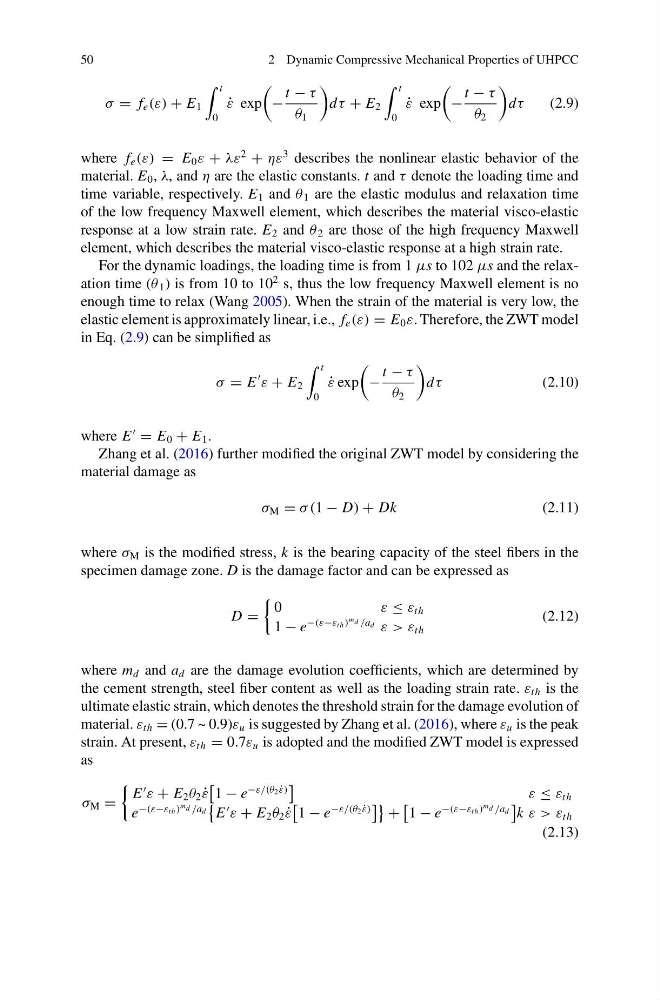
where f e (ε) = E 0 ε + λε
2
+ ηε
3 describes the nonlinear elastic behavior of the
material. E 0 , λ, and η are the elastic constants. t and τ denote the loading time and
time variable, respectively. E 1 and θ 1 are the elastic modulus and relaxation time
of the low frequency Maxwell element, which describes the material visco-elastic
response at a low strain rate. E 2 and θ 2 are those of the high frequency Maxwell
element, which describes the material visco-elastic response at a high strain rate.
For the dynamic loadings, the loading time is from 1 μs to 102 μs and the relaxation time (θ 1 ) is from 10 to 10
2 s, thus the low frequency Maxwell element is no
enough time to relax (Wang 2005). When the strain of the material is very low, the
elastic element is approximately linear, i.e., f e (ε) = E 0 ε. Therefore, the ZWT model
in Eq. (2.9) can be simplified as
σ = E
ε + E 2
t
0
˙
ε exp
−
t − τ
θ 2
dτ
(2.10)
where E
= E 0 + E 1 .
Zhang et al. (2016) further modified the original ZWT model by considering the
material damage as
σ M = σ (1 − D) + Dk
(2.11)
where σ M is the modified stress, k is the bearing capacity of the steel fibers in the
specimen damage zone. D is the damage factor and can be expressed as
D =
0
ε ≤ ε th
1 − e
−(ε−ε th )
m d /a d ε > ε th
(2.12)
where m d and a d are the damage evolution coefficients, which are determined by
the cement strength, steel fiber content as well as the loading strain rate. ε th is the
ultimate elastic strain, which denotes the threshold strain for the damage evolution of
material. ε th = (0.7 ~ 0.9)ε u is suggested by Zhang et al. (2016), where ε u is the peak
strain. At present, ε th = 0.7ε u is adopted and the modified ZWT model is expressed
as
σ M =
E
ε + E 2 θ 2 ˙
ε
1 − e
−ε/(θ 2 ˙
ε)
ε ≤ ε th
e
−(ε−ε th )
m d /a d
E
ε + E 2 θ 2 ˙
ε
1 − e
−ε/(θ 2 ˙
ε)
+
1 − e
−(ε−ε th )
m d /a d
k ε > ε th
(2.13)
2 Dynamic Compressive Mechanical Properties of UHPCC
σ = f e (ε) + E 1
t
0
˙
ε exp
−
t − τ
θ 1
dτ + E 2
t
0
˙
ε exp
−
t − τ
θ 2
dτ
(2.9)
where f e (ε) = E 0 ε + λε
2
+ ηε
3 describes the nonlinear elastic behavior of the
material. E 0 , λ, and η are the elastic constants. t and τ denote the loading time and
time variable, respectively. E 1 and θ 1 are the elastic modulus and relaxation time
of the low frequency Maxwell element, which describes the material visco-elastic
response at a low strain rate. E 2 and θ 2 are those of the high frequency Maxwell
element, which describes the material visco-elastic response at a high strain rate.
For the dynamic loadings, the loading time is from 1 μs to 102 μs and the relaxation time (θ 1 ) is from 10 to 10
2 s, thus the low frequency Maxwell element is no
enough time to relax (Wang 2005). When the strain of the material is very low, the
elastic element is approximately linear, i.e., f e (ε) = E 0 ε. Therefore, the ZWT model
in Eq. (2.9) can be simplified as
σ = E
ε + E 2
t
0
˙
ε exp
−
t − τ
θ 2
dτ
(2.10)
where E
= E 0 + E 1 .
Zhang et al. (2016) further modified the original ZWT model by considering the
material damage as
σ M = σ (1 − D) + Dk
(2.11)
where σ M is the modified stress, k is the bearing capacity of the steel fibers in the
specimen damage zone. D is the damage factor and can be expressed as
D =
0
ε ≤ ε th
1 − e
−(ε−ε th )
m d /a d ε > ε th
(2.12)
where m d and a d are the damage evolution coefficients, which are determined by
the cement strength, steel fiber content as well as the loading strain rate. ε th is the
ultimate elastic strain, which denotes the threshold strain for the damage evolution of
material. ε th = (0.7 ~ 0.9)ε u is suggested by Zhang et al. (2016), where ε u is the peak
strain. At present, ε th = 0.7ε u is adopted and the modified ZWT model is expressed
as
σ M =
E
ε + E 2 θ 2 ˙
ε
1 − e
−ε/(θ 2 ˙
ε)
ε ≤ ε th
e
−(ε−ε th )
m d /a d
E
ε + E 2 θ 2 ˙
ε
1 − e
−ε/(θ 2 ˙
ε)
+
1 − e
−(ε−ε th )
m d /a d
k ε > ε th
(2.13)